
For effective call center hiring, W-2 placement through a staffing partner is recommended for long-term, quality-focused needs, typically filling roles within 30 to 90 days at a cost of 15 to 25% of the first-year salary. For urgent or short-term requirements, gig platforms or full-service BPOs may be more suitable, with faster fill times and lower control over agent selection. It's crucial to match the staffing model to your specific needs, negotiate clear contract terms, and implement a structured onboarding plan to ensure agents reach productivity quickly.
In this article
For most employers building a stable in-house customer support team, W-2 placement through a staffing partner is the best starting point for call center hiring. It gives you the most control over quality and training without the long ramp of building a recruiting function from scratch.
- Timeline: W-2 placement typically fills roles in 30 to 90 days, depending on role complexity and location.
- Cost: Direct-hire placement fees commonly run 15 to 25% of first-year salary.
- Control: You manage the agent directly, which matters if quality and brand voice are non-negotiable.
If your need is short-term, seasonal, or urgent, gig/elastic platforms or a full-service BPO may fit better. Careerscape works across all three models, matched to what your hiring goal actually requires.
Key Takeaways
Matching the staffing model to your timeline, volume, and control needs, then negotiating bill-rate transparency up front, determines whether call center hiring succeeds or drags on for months.
| Point | Details |
|---|---|
| Match model to timeline | Gig platforms fill in 7 to 21 days, W-2 placement in 30 to 90 days, BPO in 30 to 60 days. |
| Get bill-rate transparency | Always request a pay-rate versus bill-rate breakdown before signing any staffing contract. |
| Plan a 30-day ramp | Provision CRM and knowledge base access on day zero to cut time to full productivity. |
| Consider hybrids past 100 agents | Combine core W-2 staff with gig overflow or BPO tier-1 support for surge capacity. |
| Work with a specialized partner | Careerscape offers contract staffing, salary benchmarking, and ATS integration built for call center hiring. |
Which Call Center Staffing Model Fits Your Hiring Goal?
Every call center hiring decision comes down to three engagement models, and each one shifts who owns the agent relationship and who absorbs the operational risk.
W-2 placement means a staffing agency recruits and screens candidates, then places them as your direct employee or as a contractor you manage day-to-day. You own training, scheduling, and performance management. Gig or elastic workforce platforms connect you with independent agents who work on-demand, often through a technology layer that handles scheduling and payment, but you have less say in who shows up on a given shift. Full-service BPO hands over the entire operation, agents, supervisors, infrastructure, and quality monitoring, to an outsourcer that runs the program under an SLA.
| Model | Time to fill | Cost structure | Control level | Best for |
|---|---|---|---|---|
| W-2 placement | 30 to 90 days | Placement fee (15 to 25% of salary) or hourly markup | High | Long-term, brand-sensitive support teams |
| Gig/elastic | 7 to 21 days | Per-hour or per-call rate | Low to moderate | Seasonal spikes, after-hours coverage |
| Full-service BPO | 30 to 60 days | Per-agent or per-minute billing | Low | High-volume, standardized workflows |
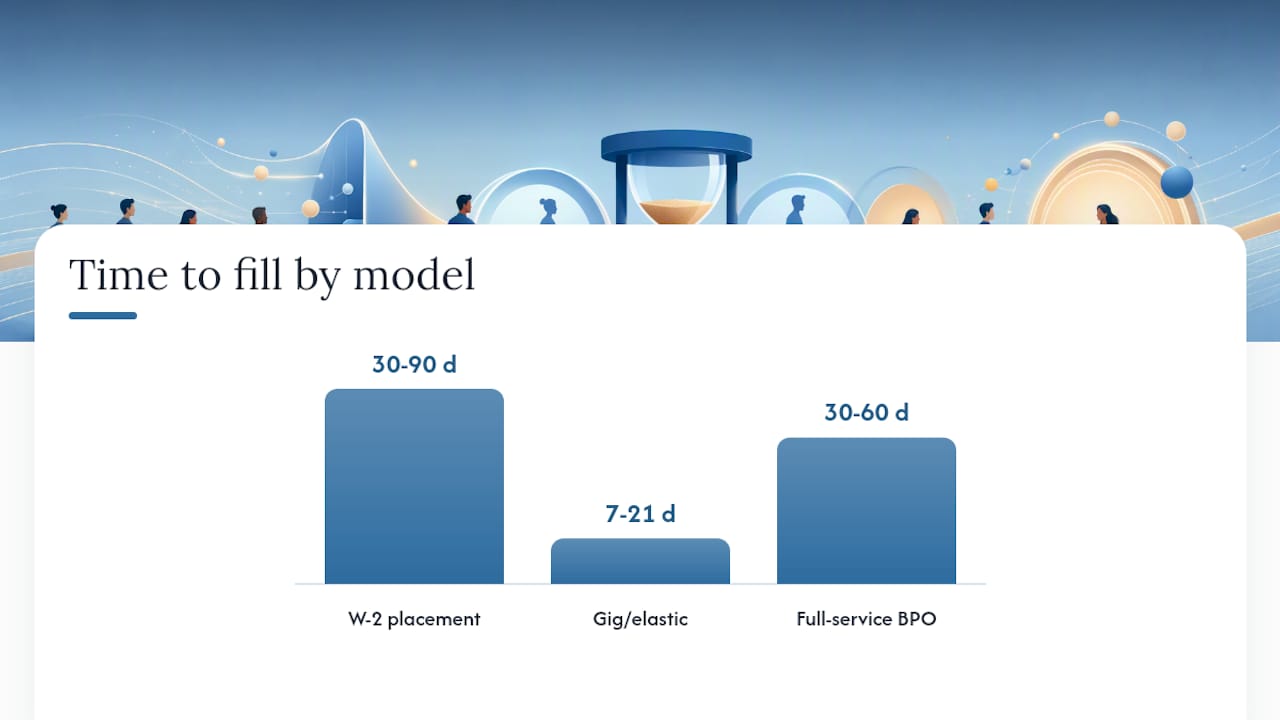
These time-to-fill ranges shift with role complexity, bilingual requirements, and how tight your local labor market is. Training complexity also scales inversely with control: W-2 hires need the most upfront investment but retain institutional knowledge longer, while gig agents ramp fast but churn faster.
Pro Tip: Always ask any agency or platform for a clear bill-rate versus pay-rate breakdown before signing. That single number tells you exactly what markup you’re paying for recruiting, compliance, and management overhead.
How Do You Choose the Right Model for Your Situation?
Picking a model isn’t a gut call. It’s a four-step filter that turns your operational constraints into a decision.
- Define the objective in hard numbers. How many agents, by what date, covering what hours, handling what level of call complexity? “We need help” isn’t a hiring plan. “We need 12 agents trained on tier-2 billing disputes within six weeks” is.
- Match your timeline and volume to model speed. If you need bodies in two weeks, W-2 placement’s 30 to 90 day window won’t work, gig platforms or an agency with a pre-vetted applicant bench will move faster.
- Score technical complexity. Simple order-taking or FAQ handling tolerates gig or BPO staffing well. Technical troubleshooting, regulated industries, or anything requiring deep product knowledge usually needs W-2 hires you can invest in long-term.
- Confirm contract flexibility before committing. Ask about temp-to-perm conversion terms, SLA guarantees, and volume discounts. A model that fits your timeline but locks you into a rigid 12-month contract can cost you more than it saves.
Two quick scenarios show how this plays out. A company needing 40 agents in 60 days for a new product launch usually lands on W-2 placement through an agency running continuous recruiting, since that timeline sits comfortably inside typical fill windows. A retailer needing 24/7 after-hours coverage for eight weeks around a holiday peak is a better match for gig/elastic staffing, where speed and short-term flexibility outweigh the loss of direct control.
Pro Tip: Negotiate volume discounts and temp-to-perm buyout pricing before you sign, not after. Agencies rarely offer these terms unprompted, but most will discuss them if you ask.
What Should You Expect on Timelines, Costs, and Contract Terms?
Time-to-fill benchmarks vary meaningfully by model and by how demanding the role is. Gig/elastic platforms can deploy agents in 7 to 21 days, W-2 placement typically runs 30 to 90 days, and full-service BPO ramp-up commonly falls in the 30 to 60 day range depending on how much infrastructure needs to be built. Bilingual requirements, niche technical knowledge, and tight local labor markets all push these ranges longer.
Cost structures differ just as much as timelines. Direct-hire placements commonly carry a fee of 15 to 25% of first-year salary, while temporary staffing markups typically run 25 to 75% on top of the worker’s hourly rate. BPO and gig platforms bill per agent, per minute, or per call, which shifts risk toward the vendor but often costs more per interaction at low volume.
Benchmark to know: Temporary staffing markups of 25 to 75% on hourly rate are standard in the industry, so a quote well outside that band deserves a direct question about what’s included.
Before signing anything, insist on:
- A clear bill-rate versus pay-rate disclosure, not a blended number.
- Replacement guarantees for direct hire, commonly a 60 to 90 day window.
- Temp-to-perm conversion pricing spelled out in writing, not left to “we’ll figure it out later.”
- SLA terms covering fill rate, quality thresholds, and termination notice.
- Data and PII handling terms, especially if agents touch customer payment or health information.
Pro Tip: Get the replacement guarantee window in writing before the offer stage. A verbal promise of “we’ll replace a bad hire” means nothing in a dispute.
How Do You Get New Agents Up to Speed Fast?
A fast fill doesn’t help if new agents take three months to hit target productivity. A structured 30-day ramp plan closes that gap.
- Day 0: Intake and system access, CRM login, ATS handoff notes, knowledge base credentials.
- Days 1 to 7: Scripted shadowing on live calls with a trained agent.
- Weeks 2 to 4: Monitored independent call handling with daily supervisor check-ins.
- Day 30: Formal QA review against target metrics before full autonomy.
Provisioning CRM and knowledge base access on day zero, not day five, is the single biggest lever for cutting ramp time. Pairing that with AI-assisted tools for tier-1 deflection lets new agents lean on guided responses while they build confidence on harder calls.
Track these KPIs weekly during ramp:
- Average handle time (AHT) against a trained-agent baseline
- First-call resolution on topics covered in training
- QA score from call monitoring
- Schedule adherence
For temporary or gig agents specifically, daily QA sampling and supervisor queue overlap matter more, since turnover risk is higher and there’s less time to catch bad habits before they become permanent.
When Does Combining Staffing Models Make Sense?
Most organizations running fewer than 100 agents can stick with a single model. Past that scale, hybrids become common because no single approach covers every scenario efficiently.
- Core W-2 plus gig overflow: A stable in-house team handles baseline volume, gig agents absorb seasonal spikes.
- W-2 for technical tiers, BPO for tier-1: Complex troubleshooting stays in-house, high-volume routine calls go to an outsourcer.
- Nearshore named agents plus onshore experts: Nearshore vendors can staff dedicated agents in as little as 7 days at lower all-in hourly rates, while onshore specialists handle escalations.
Watch for signals that it’s time to shift: unplanned attrition spikes, a seasonal peak that’s lasted longer than expected, or a sudden 24/7 coverage requirement your current model can’t absorb.
Pro Tip: Hybrid setups need clear ownership of quality standards across models, otherwise gig or BPO agents drift from your brand voice within weeks.
What Do Staffing Partners Learn from Running These Programs?
The lesson that comes up again and again: lock in hours, coverage windows, and SLA terms before you sign, not after the first bad week. Employers who skip this step end up renegotiating mid-contract from a weaker position.
Careerscape’s salary benchmarking data consistently shows employers underestimate what competitive pay looks like for technical support roles, which drags out fill times more than any staffing model choice does. Clients who lead with transparent pay ranges fill roles faster and see fewer early departures.

How Careerscape Supports Call Center Hiring
Careerscape works across contract staffing, project-based teams, and temp-to-perm placement, backed by ATS integration that speeds candidate handoff and salary benchmarking that keeps offers competitive from day one. That combination matters because the biggest hidden cost in call center hiring isn’t the placement fee, it’s the weeks lost to underpriced offers and mismatched skill sets.
Clients working with Careerscape on customer support programs typically see faster speed-to-fill because the recruiting pipeline stays warm between engagements rather than starting cold every time a request comes in. If you’re weighing W-2 placement against a BPO or gig platform for an upcoming hiring push, Careerscape can help you build the right mix. Reach out through Careerscape’s talent request form with your target headcount, timeline, and coverage hours ready, and you’ll get a model recommendation back within days.
FAQ
What is the fastest way to fill call center roles?
Gig or elastic staffing platforms typically deploy agents in 7 to 21 days, making them the fastest option when you need coverage quickly.
How much does call center staffing typically cost?
Direct-hire placement fees commonly run 15 to 25% of first-year salary, while temporary staffing markups typically run 25 to 75% on the hourly rate.
What’s the difference between bill rate and pay rate?
Pay rate is what the agent earns; bill rate is what you pay the agency, with the difference covering recruiting, compliance, and management overhead. Always ask for both numbers separately.
When should I use a hybrid staffing model?
Hybrids make sense once your team exceeds roughly 100 agents or when unplanned attrition, sustained seasonal peaks, or new 24/7 coverage needs outpace a single model’s flexibility.
Can Careerscape help with both direct hire and temporary call center staffing?
Yes. Careerscape offers contract staffing, temp-to-perm placement, and salary benchmarking to match your hiring timeline and budget.
Recommended
- Call Center Agent Salary 2026 — Customer Support & Contact Center Pay
- 9 Proven Ways to Attract Top Talent in 2026