
A General Counsel serves as the chief in-house lawyer, focusing on managing legal risk while enabling business objectives, and typically reports directly to the CEO or Board. A well-defined job description should include core responsibilities, separate essential qualifications from preferences, set clear KPIs, and tailor expectations based on the company's stage. Compensation should be benchmarked against real data, with a recommended average salary of approximately $132,593, adjusted according to market specifics.
In this article
A General Counsel is the company’s chief in-house lawyer and the CEO’s closest strategic legal partner. The role’s top priorities are managing legal risk, overseeing corporate governance and compliance, directing litigation and outside counsel spend, and clearing the path for commercial goals rather than just flagging obstacles to them. The Association of Corporate Counsel calls this the “counsellor-in-chief” model, and it typically reports directly to the CEO or Board. Careerscape recruits for these roles across industries and sees firsthand how much a well-scoped job description shapes who applies.
Key Takeaways
A hire-ready general counsel job description pairs a clear responsibilities checklist with realistic bar admission, experience, and compensation expectations tailored to company stage.
| Point | Details |
|---|---|
| Define the mission first | State the GC’s core purpose, managing risk while enabling business goals, before listing duties. |
| Separate must-haves from nice-to-haves | Require bar admission and leadership experience; treat sector specialization as preferred, not mandatory. |
| Set KPIs early | Use contract turnaround time, litigation spend variance, and in-house versus outside counsel ratio as measurable objectives. |
| Tailor by stage | A startup GC job description should emphasize hands-on work; an enterprise version should emphasize strategic management. |
| Benchmark pay against real data | Use Indeed’s aggregated average of roughly $132,593 as a reference point, then adjust with a source like Careerscape’s salary guide for your specific market. |
General Counsel Job Description: Core Responsibilities and Day-to-Day Duties
A strong general counsel job description reads like a portfolio, not a task list. The GC typically owns nine overlapping areas, and success in each looks different depending on company size.
- Corporate governance and board counsel — Success looks like clean board minutes, timely disclosures, and a governance calendar so nothing slips through.
- Commercial contracts — Measured by contract turnaround time and a template library that lets sales close deals without weekly legal fire drills.
- Litigation oversight — Tracked through litigation spend variance and a defensible strategy for when to fight versus settle.
- Regulatory and compliance — A living compliance program with documented training, not a binder nobody opens.
- IP, data, and privacy — Registered trademarks, clean data-processing agreements, and a breach response plan that’s been tested, not just written.
- Employment and labor — Policies that hold up in an audit and an HR partnership that catches problems before they become lawsuits.
- M&A support — Due diligence turned around fast enough to keep deal timelines intact.
- Policy and legislative tracking — Early warning on regulatory shifts that affect the business model.
- Outside counsel and vendor management — A panel of firms matched to matter type, with legal spend that trends down as in-house capability grows.
Pro Tip: In a small legal team, the GC should stay hands-on with contracts and litigation because there’s no one else to delegate to. In a team of ten or more, the GC’s real job shifts to managing outside counsel relationships and building the legal operations layer, rather than drafting NDAs.
What Skills and Experience Should You Require?
Every general counsel job description should separate hard requirements from preferences, because conflating the two shrinks your candidate pool for no good reason.
The non-negotiables: JD and active state bar admission, several years of relevant in-house or transactional/litigation experience, and demonstrated leadership managing attorneys or legal operations staff. Beyond that, commercial judgment matters more than pure legal technique. The ACC’s research on the modern GC makes the point directly: today’s GC is expected to balance legal risk against business objectives, not simply catalog the risks and walk away. That means negotiation skill, cross-functional partnership, and the ability to explain a legal position to a nonlawyer CFO in two sentences.
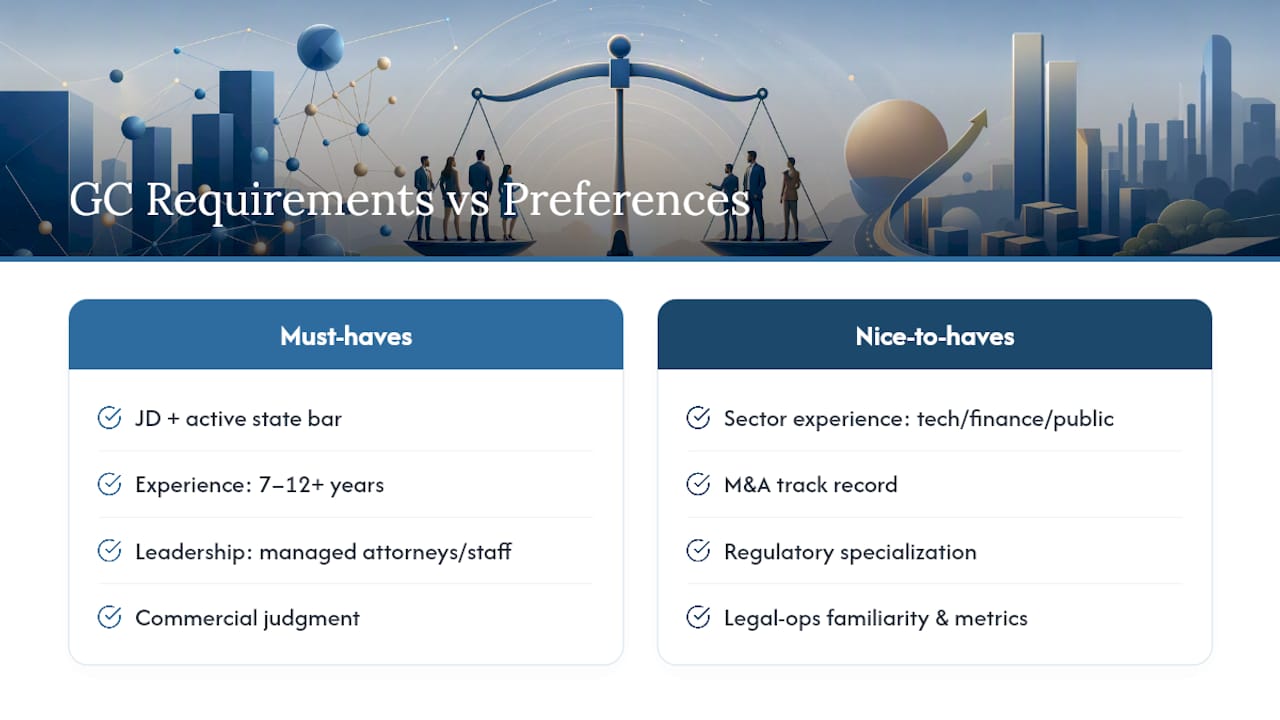
Nice-to-haves worth naming explicitly: sector experience in tech, financial services, or public sector; a track record on M&A transactions; a regulatory specialization relevant to your industry; and familiarity with legal operations tools and metrics.
A quick calibration on experience: early-stage companies often hire GCs with 7 to 10 years of experience who can still be hands-on, while mature or public companies tend to look for 12-plus years and prior leadership of a multi-attorney team. Use your title to signal level, senior counsel, general counsel, or chief legal officer, so candidates self-select correctly before they apply.
Who Does a General Counsel Report To?
Reporting lines matter because they determine how much authority the GC actually has. In most organizations, the GC reports directly to the CEO and sits on the executive team, with regular check-ins to the Board or its audit and governance committees. Public-sector versions of the role, like the DCAS General Counsel post in New York City, show the range: that posting describes a GC leading close to 60 attorneys, auditors, and support staff across procurement, real estate, compliance, and litigation.
Team scope varies widely. A startup GC might have zero direct reports and lean on outside counsel; an enterprise GC might manage a legal operations manager, several practice-area leads, and a panel of law firms.
Useful KPIs to build into the objectives section:
- Contract turnaround time from request to signature
- Litigation spend as a percentage of revenue, tracked year over year
- Compliance program maturity against a documented framework
- Percentage of legal matters handled in-house versus sent to outside counsel
Copy-Paste General Counsel Job Description Template
Use this as a starting draft, not a final posting. Trim or expand each section to match your company’s actual scope.
Job Title: General Counsel
Role Summary: [Company] is seeking a General Counsel to serve as chief legal officer and strategic advisor to the CEO and executive team. This role owns corporate governance, commercial contracting, litigation strategy, and regulatory compliance while partnering with business leaders to enable growth.
Key Responsibilities:
- Advise the CEO, Board, and executive team on legal risk and corporate governance
- Draft, review, and negotiate commercial contracts and vendor agreements
- Manage litigation strategy and outside counsel relationships
- Oversee regulatory compliance, employment law matters, and IP protection
- Support M&A due diligence and integration
- Build and manage legal operations processes and, where applicable, a legal team
Qualifications (required):
- JD from an accredited law school and active bar admission in [state]
- [X] years of relevant legal experience, including in-house or transactional practice
- Demonstrated leadership managing attorneys or legal staff
Qualifications (preferred):
- Experience in [industry] with relevant regulatory knowledge
- M&A transaction experience
- Legal operations or contract management system familiarity
Reports To: Chief Executive Officer
Location / Remote Policy: [Specify on-site, hybrid, or remote eligibility]
Equal Opportunity Statement:
Keep the posting to one page. State bar admission and work authorization requirements explicitly. Both the ACC’s sample GC job description and ACC jobline templates are useful cross-references if you want to see how other companies phrase equivalent sections.
Tailoring the Description by Stage, Industry, and Size
A template only works once you adjust it to who’s actually reading it. Startups need a GC job description that reads “builder,” not “administrator.” Emphasize hands-on contract drafting, willingness to be the only lawyer in the building, and comfort with ambiguity.
Enterprise and public companies should flip that emphasis toward strategic management: overseeing a legal team, setting policy, and managing outside counsel budgets rather than drafting every agreement personally. Enterprise postings, like Moody’s Analytics’ general counsel role, highlight commercial contracting for software and data licensing plus cross-functional leadership across legal, compliance, and product.
- Tech companies: emphasize data privacy, SaaS licensing, and IP strategy.
- Financial services: emphasize regulatory examination experience and consumer protection law.
- Public sector or nonprofit: emphasize procurement law, public records requests, and interagency coordination.
- Regulated industries generally: name the specific regulatory bodies the GC will interact with.
Compensation Expectations and What Drives Pay
Indeed’s aggregated hiring data reports an average General Counsel salary; though this figure blends companies of varying size and complexity, it should be treated as a general reference rather than a specific target. A GC at a 20-person startup and a GC running a 60-person legal department, like the scope described in the DCAS posting, are not competing for the same compensation band.
Factors that move pay meaningfully:
- Company revenue and growth stage
- Size of the legal team being managed
- Regulatory or global complexity (multi-jurisdiction operations raise the bar)
- Equity versus cash mix, especially at pre-IPO companies
- Urgency of the hire, a vacant GC seat during litigation or a deal commands a premium
Before finalizing a range, check Careerscape’s corporate counsel salary guide or request a market benchmark from a recruiter who’s placed similar roles recently.
Common Challenges and Pitfalls Facing General Counsels
The biggest failure mode isn’t legal skill, it’s scope creep without authority. Many GCs get pulled into HR disputes, real estate negotiations, and vendor contracts far outside their original mandate, without a corresponding increase in headcount or budget. That’s how a “strategic” role quietly turns into a bottleneck.

A second common pitfall: GCs who default to “no” instead of “here’s how.” The ACC’s framing of the counsellor-in-chief model exists precisely because business leaders lose patience with lawyers who identify risk without offering a path forward. A GC who can’t translate legal exposure into a business tradeoff will get worked around, not consulted.
Outside counsel spend is another recurring headache. Without a clear framework for what stays in-house versus what goes to a law firm, legal budgets balloon quietly until finance notices at year-end. The strongest GCs build a documented matter-routing policy early, before spend becomes a crisis conversation.
Board relationships carry their own risk. A GC who only shows up when something’s wrong trains the Board to see legal as a fire department instead of a strategic function. Regular, proactive reporting, even when there’s nothing urgent, builds the credibility that makes the harder conversations easier later.
Finally, compliance programs decay if nobody owns their maintenance. A policy written once and never revisited stops matching how the business actually operates within a year or two.
Career Growth Paths for General Counsel Professionals
The GC seat isn’t usually a terminal role anymore. A growing number of General Counsels move laterally into Chief Legal Officer titles once their scope expands to include enterprise risk, ESG, or government affairs, functions that go beyond traditional legal work but build naturally on a GC’s stakeholder trust.
Others move upward into board seats, particularly at companies where governance expertise is scarce. Some transition into Chief Compliance Officer or Chief Risk Officer roles at larger organizations, using the regulatory fluency built as GC. A smaller but notable path leads to the C-suite generally: several sitting CEOs started as General Counsel, largely because the role forces fluency in every part of the business.
For professionals still building toward the seat, the clearest accelerants are: leading a major litigation or M&A matter to a successful close, building a compliance program from scratch, or managing a legal team through a company’s growth stage transition (startup to Series C, or private to public). Bar association leadership roles and ACC committee involvement also build the external network that surfaces GC openings before they’re publicly posted.
Professional development budgets for sitting GCs should include continuing legal education, ACC membership, and executive coaching focused on board communication, since the technical legal skills that got someone into the seat aren’t always the skills that keep them credible in it.
What We Look for When Screening General Counsel Candidates
The resumes that stand out aren’t the ones with the most impressive firm names. They’re the ones where a candidate can explain a specific tradeoff they made between legal risk and a business deadline, in plain language, without hedging.
Red flags show up fast on a first call: candidates who can’t name a stakeholder relationship that was actually difficult, or who describe every past decision as purely “legally correct” with no mention of the commercial context.
Three quick filters we use: Can they explain a legal decision’s business impact in under a minute? Did they manage people, not just matters? Do they ask about company strategy before asking about scope?
How Careerscape Helps You Hire a General Counsel
Finding a GC who fits your stage, industry, and budget takes more than a job board post. Careerscape’s corporate counsel recruiting team specializes in in-house legal searches, from first hands-on GC hires at growing companies to senior legal leadership at established firms, and screens for exactly the commercial judgment and stakeholder skills outlined above. If your legal function needs a gap covered while you run a permanent search, Careerscape’s contract staffing solutions can place interim legal leadership without pausing the business. Ready to see qualified candidates instead of guessing at a job posting? Request candidates through Careerscape and get a market benchmark for your specific hire.
FAQ
Is General Counsel a High-Level Position?
Yes. The GC typically ranks among the top legal and executive roles in an organization, often reporting directly to the CEO and sitting on the executive team.
What’s the Difference Between a General Counsel and a Lawyer?
A lawyer provides legal services generally, while a General Counsel is a specific in-house leadership role that combines legal expertise with executive-level business strategy and team management.
Do You Need to Be a Lawyer to Become a General Counsel?
Yes, a General Counsel job description almost always requires a JD and active state bar admission, since the role carries direct legal accountability for the organization.
What Determines the Highest General Counsel Salaries?
Company size, revenue, regulatory complexity, and geography drive the widest pay differences; large public companies and highly regulated industries tend to pay well above the aggregated average of roughly $132,593 that Indeed reports across all company sizes.
Recommended
- Legal Operations Manager Recruiters — Legal Tech & Process | Careerscape
- Hire Compliance Officers | BSA/AML, SOX & Regulatory | Careerscape