
Mis-hires are expensive. Research consistently shows replacing a bad hire can cost anywhere from 50% to 200% of that person’s annual salary, accounting for lost productivity, recruiting fees, and onboarding time. Yet most companies still rely on gut instinct, loosely defined criteria, and inconsistent interview formats that open the door to bias and missed talent. The result is longer time-to-fill, weaker team performance, and diversity goals that stall at the résumé stage. This guide walks you through a structured, evidence-based screening process designed to surface the best candidates, reduce unconscious bias, and build teams that actually deliver.
Table of Contents
- Clarifying screening goals and prerequisites
- Implementing objective and fair screening methods
- Structured interviews: Standardizing the next stage
- Spotting red flags and edge cases in modern screening
- Tracking metrics and continuous improvement
- What most guides miss about candidate screening
- Need help building a better screening process?
- Frequently asked questions
Key Takeaways
| Point | Details |
|---|---|
| Early alignment matters | Get the hiring team on the same page before screening to avoid bias and groupthink. |
| Blind screening boosts diversity | Removing identifying info can increase underrepresented hires and reduce bias in your pipeline. |
| Structure your interviews | Use standardized questions and scorecards to ensure fair, reliable candidate comparisons. |
| Track and adapt with metrics | Monitor funnel data to spot gaps and continuously refine your process for better results. |
Clarifying Screening Goals and Prerequisites
A fair and effective screening process does not start with reviewing résumés. It starts well before the first application lands in your inbox. Hiring teams that skip the preparation stage often end up evaluating candidates against different mental criteria, which introduces inconsistency and bias from the very beginning.
The most important early action is criteria alignment. Every member of the hiring team, including the recruiter, the hiring manager, and any panel participants, should agree on the must-have qualifications, the nice-to-have skills, and the specific competencies tied to job performance. Involve hiring managers early in that alignment conversation, then have each team member complete independent evaluations before any group discussion takes place. This simple step significantly reduces groupthink, where louder voices shape everyone else’s assessments.
Here is a checklist of what you need in place before screening begins:
- A finalized job description with clear, role-specific competencies
- A written scoring rubric with defined rating scales for each criterion
- A structured interview question bank tied to those competencies
- Agreement on knockout criteria (automatic disqualifiers vs. negotiable gaps)
- A designated decision-making process for tie-breaking or borderline candidates
- Compliance documentation ensuring screening criteria meet equal employment opportunity standards
| Prerequisite | Why it matters | Who owns it |
|---|---|---|
| Criteria alignment meeting | Prevents inconsistent evaluation | Hiring manager + recruiter |
| Scoring rubric | Removes subjectivity from ratings | HR lead |
| Knockout criteria list | Speeds up top-of-funnel screening | Recruiter |
| Legal compliance review | Reduces risk of discriminatory screening | HR/legal |
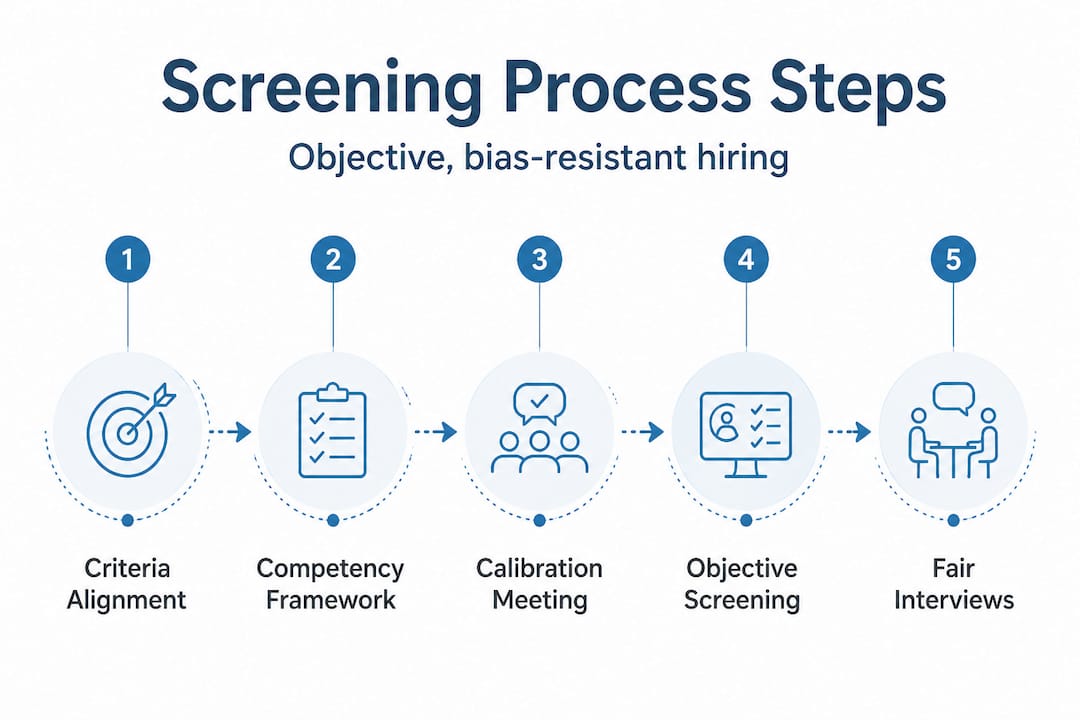
Teams hiring for industry-specific roles should also build role-specific competency frameworks that go beyond generic job descriptions. Generic criteria lead to generic hires.
Pro Tip: Run a 30-minute pre-screening calibration meeting where each team member independently lists their top five must-have criteria. Compare the lists before building the rubric. Gaps in that meeting reveal potential bias sources early, before they affect real candidates.
Implementing Objective and Fair Screening Methods
With your goals set, you can now ensure every candidate is evaluated on equal footing. This is the stage where most traditional processes break down, because informal résumé reviews carry enormous potential for unconscious bias. Name-based bias, school prestige bias, and employment gap bias are well-documented problems that reduce diversity and lower the overall quality of your candidate pool.
Blind resume screening is one of the most effective tools available. This means removing names, photos, graduation years, and school names from résumés before review. The data is compelling: blind screening increases minority candidate interview rates by 24%, lifts underrepresented group hiring by up to 45%, and reduces gender bias by 28%. Those are not marginal gains. They represent a measurable shift in who gets a fair shot.
Here is how to implement a fair, skills-based screening process step by step:
- Strip identifying information from résumés before distributing them to reviewers. Many applicant tracking systems (ATS) have a built-in anonymization feature.
- Build a skills-based rubric with weighted scores for each must-have competency. For example, a software engineering role might weight problem-solving at 35%, technical proficiency at 40%, and communication at 25%.
- Score independently before comparing. Each reviewer completes their rubric without seeing others’ ratings.
- Set a minimum threshold score for advancing to the phone screen stage, so advancement is tied to data, not impressions.
- Audit your results after the first batch. If a particular demographic group is consistently screened out at this stage, examine which criteria are responsible and whether they are truly predictive of job success.
- Document everything. A record of scoring decisions protects your organization and creates a feedback loop for future improvements.
| Method | Bias reduced | Implementation complexity | Impact on diversity |
|---|---|---|---|
| Blind résumé review | Name, gender, school | Low to medium | High |
| Skills-based rubric | Credential and prestige bias | Medium | Medium to high |
| ATS keyword filtering | Varied (can introduce bias) | Low | Mixed |
| Structured scoring sheets | Interviewer subjectivity | Medium | High |
You can also review the full hiring process overview to understand how each screening stage connects to the broader talent pipeline.
Pro Tip: Pair blind screening with a skills-based assessment in the first round. A short, role-relevant task (a data analysis exercise, a writing sample, or a coding challenge tied to job specialization) eliminates credential bias at scale and surfaces strong candidates who might not have prestigious school names on their résumés.
Structured Interviews: Standardizing the Next Stage
After winnowing your applicant pool, structured interviews ensure that deeper assessments are fair and consistent. Unstructured interviews, the kind where conversation flows naturally and questions vary by interviewer, are widely used but poorly predictive of actual job performance. They favor candidates who are skilled at casual conversation over those who are skilled at the job.

Structured interviews solve this with a standardized format. As Google’s research on structured interviewing explains, using predetermined job-relevant questions, standardized scoring rubrics, and proper interviewer training minimizes bias and significantly improves predictive validity. In other words, structured interviews are better at predicting who will succeed in the role.
Here is a step-by-step approach to building a structured interview process:
- Develop a question bank with 8 to 12 behavioral and situational questions tied directly to your competency framework. Behavioral questions (“Tell me about a time you…”) draw on past performance. Situational questions (“What would you do if…”) test judgment.
- Assign each question a weight corresponding to its competency category. Higher-stakes competencies get higher weight.
- Create a numeric scoring guide with anchored descriptors. For example, a score of 1 means the response lacked a clear example; a 5 means the candidate demonstrated measurable impact with a specific, relevant story.
- Train interviewers before the process begins. Reviewers should practice using the rubric on sample responses and calibrate their scoring expectations.
- Conduct interviews in the same format for every candidate for the same role. The same questions, same order, same time allocation.
- Collect scores independently before any debrief discussion.
“Structured interviewing significantly reduces the impact of demographic characteristics on hiring decisions while improving the ability to predict job performance outcomes.” — A Guide to Structured Interviewing
Teams filling executive-level screening roles should add a case presentation component to the structured interview. This tests strategic thinking and communication in a format that closely mirrors real job demands.
Pro Tip: Record the scoring sheet completion time for each interviewer. Reviewers who complete rubrics very quickly may not be engaging deeply with the rating criteria. A quick coaching conversation often realigns expectations and improves inter-rater reliability.
Spotting Red Flags and Edge Cases in Modern Screening
Beyond structured interviews, adapting your approach is key as candidate tactics and technologies evolve. Modern screening now involves challenges that did not exist five years ago, and hiring managers who ignore them risk making decisions based on inaccurate information.
AI-assisted candidate responses are increasingly common in both written application materials and asynchronous video interviews. Research on AI-era screening highlights several signals to watch for, including unnatural pauses while a candidate appears to read off-screen text, language that feels formulaic or generic, and responses that cover all the right keywords but lack specific personal examples or concrete details.
Here are the key red flags to monitor across your screening process:
- Inconsistent communication quality: A polished cover letter paired with vague, halting phone screen responses may indicate AI-assisted writing.
- Off-camera eye movement in video screens: Candidates who consistently look away from the camera during answers may be reading from a secondary screen.
- Overly perfect responses: Real candidates have imperfect moments, hesitations, and genuine thinking pauses. Suspiciously smooth, jargon-complete answers warrant a follow-up probe.
- Response delays in asynchronous video: Extended thinking time before answering in an async format, especially combined with scripted-sounding delivery, is worth flagging.
- Declined async video invitations: Asynchronous video interviews deter over 50% of applicants, and the dropout rate is disproportionately higher among women. Be cautious about over-relying on this format if diversity is a priority.
- Poor follow-through on logistics: Missed deadlines for skills assessments or last-minute reschedules are behavioral signals worth tracking.
Teams evaluating tech candidates should be especially alert to AI-generated code submissions. Requiring candidates to explain their reasoning live during a technical review is one of the most reliable ways to validate authenticity.
Tracking Metrics and Continuous Improvement
After implementing your updated process, continuous tracking ensures improvement and helps you reach your hiring goals. You cannot improve what you do not measure, and that principle applies directly to screening. Most teams measure time-to-fill and cost-per-hire at the macro level, but the more valuable data lives inside the funnel.
Diversity funnel metrics show you where underrepresented candidates are dropping out of your process. Track the demographic breakdown (where legally permissible) at each stage:
- Total applicants by demographic group
- Phone screen advancement rate by group
- Structured interview invitation rate by group
- Offer rate by group
- Acceptance rate by group
If the numbers narrow sharply at a specific stage, that is where bias or structural barriers are at play. Blind hiring data confirms that skills-focused screening effectively counters credential bias, but warns that blind methods alone are not sufficient. They must be paired with behavioral assessments that evaluate culture contribution and interpersonal competencies to predict long-term retention.
| Metric | What it reveals | Review frequency |
|---|---|---|
| Stage-by-stage diversity ratio | Where drop-off occurs by group | Monthly |
| Interviewer scoring variance | Inter-rater reliability gaps | Per hiring cycle |
| Offer-to-acceptance rate | Candidate experience quality | Quarterly |
| 90-day retention by source | Screening quality vs. channel | Quarterly |
| Time-to-fill by role type | Process efficiency | Monthly |
Use these metrics to run monthly retrospectives with your hiring team. Ask one focused question each month: “Where did we lose strong candidates, and why?” Review teams working on specialty hiring should also track skills assessment pass rates over time to ensure rubrics remain calibrated to real job performance benchmarks.
The goal is a living process. Screening methods that work well for one role type or one quarter may need recalibration as your talent market and organizational needs shift.
What Most Guides Miss About Candidate Screening
Most screening guides focus on what to add: more structure, more tools, more rubrics. The harder conversation is about what to pull back on. Over-automation and over-standardization are real risks that high-performing hiring teams navigate carefully.
Here is the honest picture: rubrics and scoring systems are only as good as the criteria behind them. If your competency framework was built around the profile of your current team, you are likely filtering for sameness, not excellence. That is a trap that even well-intentioned teams fall into regularly.
The teams at Careerscape have seen this play out across dozens of client engagements. A technology company invested heavily in a skills-based screening platform, built beautiful rubrics, and ran beautifully structured interviews. Their diversity numbers did not improve because the underlying competency model was built by a homogenous leadership team that unknowingly modeled it after themselves. The process was fair in execution but biased in design.
The real sweet spot in candidate screening is a hybrid approach: use technology and structure to remove as much human subjectivity as possible in the early stages, then use trained human judgment at the later stages where context, nuance, and culture contribution actually matter. Neither algorithms alone nor gut instinct alone produces the best results.
The most overlooked metric in screening is post-hire performance at 6 and 12 months. That data, tracked consistently and tied back to screening stage decisions, is what tells you whether your rubrics are actually predicting success. Without it, you are optimizing a process without knowing if it is working.
Need Help Building a Better Screening Process?
If you are ready to move beyond theory and apply a structured, bias-resistant screening process, Careerscape offers the expertise and tools to make that practical. Whether you need support across industry recruiting solutions like healthcare, technology, or engineering, or require flexible coverage through contract staffing, the Careerscape team can design a screening approach tailored to your role type, team size, and diversity goals. We understand that every hiring challenge is different, which is why we work alongside your team rather than handing you a generic template. Take the next step and request talent to start a conversation about what a stronger screening process looks like for your organization.
Frequently Asked Questions
What Is Blind Resume Screening and Why Does It Matter?
Blind screening removes identifying details such as name, gender, or school to reduce unconscious bias, and research shows it increases minority interview rates by 24% and underrepresented group hiring by up to 45%.
How Can I Avoid Groupthink When Screening Candidates?
Encourage each hiring team member to complete independent evaluations and submit individual scores before any group debrief or discussion begins, which keeps early assessments uninfluenced by dominant voices.
What Are the Signs of AI-Assisted Candidate Responses?
Common indicators include off-camera eye movement during video interviews, unusually smooth and jargon-complete answers lacking personal detail, and delayed responses in async formats that suggest the candidate is reading from a secondary source.
Why Are Structured Interviews Better than Casual Interviews?
Structured interviews use predetermined questions and standardized scoring rubrics, which minimize interviewer bias and improve the accuracy of predicting how a candidate will actually perform in the role.
Recommended
- Employer Portal | Careerscape
- Careerscape | National Staffing & Recruiting Agency
- Employer Brand Strategy & Audit | Careerscape