
Sector-specialist recruiting focuses on filling complex roles within specific industries, providing greater expertise and reducing the risk of mis-hires compared to generalist recruiters. This model is particularly valuable for technical, regulated, or rapidly evolving positions, where hiring mistakes can be costly. Collaborating effectively with sector-specialist recruiters involves aligning early, setting clear criteria, and maintaining open communication to optimize hiring outcomes.
In this article
Many companies assume that any experienced recruiter can fill any open role. That assumption costs them time, money, and talent. The reality is that recruiting for a senior cybersecurity engineer, a healthcare compliance officer, or a derivatives trader requires a fundamentally different skill set than recruiting for a general office manager. Sector-specialist recruiting exists precisely to bridge that gap. This guide explains what sector-specialist recruiting actually is, where it delivers the most value, how it compares to other models, and how HR professionals can get the most out of a specialist partnership.
Key Takeaways
| Point | Details |
|---|---|
| Sector-specialist definition | Sector-specialist recruiters use industry expertise to fill complex, nuanced roles more effectively than generalists. |
| Best-fit roles | Specialists are most valuable for technical, regulated, or fast-changing positions where hiring mistakes are expensive. |
| Model comparison | Hybrids and ex-industry specialists often outperform traditional recruiters in challenging, evolving markets. |
| Partnership tips | Best results come when HR and sector-specialists align early, set clear criteria, and foster open communication. |
| Risk reduction | Sector-specialist recruiting helps companies avoid costly mis-hires by leveraging deep market insight and networks. |
What Is Sector-Specialist Recruiting?
At its core, sector-specialist recruiting means working with recruiters who focus exclusively, or very heavily, on a specific industry or discipline. Instead of casting a wide net across every sector, these recruiters build deep knowledge, networks, and candidate pipelines within a defined domain. Think of it this way: a generalist recruiter knows a little about many industries, while a sector-specialist knows a great deal about one.
The contrast becomes clearest when you look at what each type of recruiter does during a typical search. A generalist will post to job boards, screen resumes for matching keywords, and conduct introductory interviews. A sector-specialist will tap a cultivated network of passive candidates, evaluate technical credentials in context, and assess cultural fit based on firsthand knowledge of how that industry actually operates.
Examples of sectors where specialist knowledge is not just helpful but essential include:
- Information technology and cybersecurity, where credential stacks, tooling, and threat landscapes shift rapidly
- Financial services, where regulatory frameworks like SEC, FINRA, or Basel III shape candidate requirements
- Healthcare and life sciences, where clinical experience, licensing, and compliance requirements are non-negotiable
- Engineering and manufacturing, where project-specific certifications and technical depth determine real capability
- Legal and compliance, where nuanced knowledge of practice area or regulatory specialty separates a good hire from a costly mismatch
The core activities of sector-specialist recruiters go well beyond keyword matching. They attend industry conferences, maintain relationships with passive candidates over months or years, understand the career paths typical within their sector, and can interpret a resume the way a hiring manager would. They know which companies are known for developing talent and which are known for burning through it. That context shapes every shortlist they produce.
“Generalist recruiters are more likely to miss critical nuances in complex, technical roles, which raises mis-hire risk significantly compared to sector-specialist approaches.”
The two biggest differentiators are network depth and industry context. A specialist recruiter in industry-specialized recruiting has spent years cultivating relationships with professionals who rarely post their resumes publicly. They also understand the language of the role, whether that’s discussing FPGA design with an embedded systems engineer or understanding the regulatory capital implications of a Basel IV change with a risk manager. That fluency accelerates trust with candidates and sharpens the quality of every conversation.
When you work with sector specialist staffing, you are not just getting a recruiter. You are getting a talent advisor who speaks your industry’s language.
Where Sector-Specialist Recruiting Adds Value
Now that we’ve defined sector-specialist recruiting, let’s explore when and why it makes a real difference for your hiring outcomes.
The clearest cases are roles that are difficult to source through conventional channels. Consider a DevSecOps engineer with experience in FedRAMP-compliant cloud environments, or a medical device regulatory affairs specialist familiar with the FDA’s 510(k) pathway. These are not roles where a generalist can quickly build a credible shortlist. The candidate pool is small, the credentials are highly specific, and most qualified individuals are already employed and not actively searching.
Here are the situations where role-specific recruiting consistently delivers a measurable advantage:
- Hard-to-source technical roles where the talent pool is narrow and passive candidates dominate the market
- Roles with regulatory or compliance requirements that demand verifiable credentials and sector-specific knowledge
- Leadership positions within specialist functions, such as a Chief Risk Officer or VP of Clinical Operations, where cultural fit inside the industry is just as important as functional competence
- Rapid organizational scaling in a specific sector, such as a fintech company doubling its engineering headcount within six months
- Backfilling a senior or revenue-critical role quickly, where a mis-hire would be both costly and visible
- Emerging or fast-evolving fields where the skills required did not exist two years ago, such as AI governance or quantum computing applications
The benefits of sector-specialist recruiting extend directly to core hiring metrics. Time-to-fill drops because the recruiter already knows where qualified candidates are and has existing relationships with them. Cost-per-hire improves because fewer interview rounds are wasted on unqualified applicants. Retention rates tend to be higher because the specialist has already filtered for genuine role fit, not just resume proximity.

Sector-specialists are most effective in fast-changing sectors or when the position demands deep industry expertise that a generalist simply has not accumulated.
Industry shifts also play a role. When a sector moves fast, whether through regulatory change, new technology adoption, or market disruption, a generalist recruiter is perpetually behind. They are learning what the job requires at the same time they are trying to fill it. A specialist recruiter is already current.
Pro Tip: If your internal team is struggling to build a shortlist after four weeks, or if fewer than 20% of submitted candidates are making it past the first interview, that is a strong signal to bring in a sector-specialist. The problem is rarely the job itself. It is the mismatch between the search strategy and the complexity of the role.
Comparing Sector-Specialists, Generalists, and Hybrids
But sector-specialists aren’t the only model. How do they compare to generalists and hybrids, and how should you decide which approach fits your organization’s needs?
The choice between recruiting models is not a value judgment. Each model has legitimate strengths, and the right fit depends on your hiring volume, role complexity, and talent market conditions.
| Recruiting model | Best for | Key strengths | Key limitations |
|---|---|---|---|
| Generalist | High-volume, broad-function, or entry-level hiring | Wide reach, flexible, cost-efficient at scale | Misses technical nuance, higher mis-hire risk for complex roles |
| Sector-specialist | Niche, technical, senior, or compliance-driven roles | Deep networks, faster time-to-fill, better role fit | Narrower scope, possible hands-off restrictions |
| Hybrid / practitioner-led | Fast-evolving sectors, cross-functional senior roles | Industry experience plus recruiting methodology | Harder to find, potentially higher cost |
The generalist model works well for roles that are relatively straightforward to define and where the candidate pool is large. Administrative support, general sales, or entry-level customer success positions are examples where a generalist approach is efficient and cost-effective. The risk profile is lower because the roles themselves are easier to assess.
Sector-specialists carry a structural advantage in complex searches, but they are not without limitations. One of the most significant is the hands-off agreement, which is a contractual restriction that prevents a recruiter from placing candidates at competitor firms within their network. This can narrow the active candidate pool in tightly networked industries. However, that same tight network is precisely what makes the specialist valuable, so the trade-off is typically worth it for senior or specialized searches.
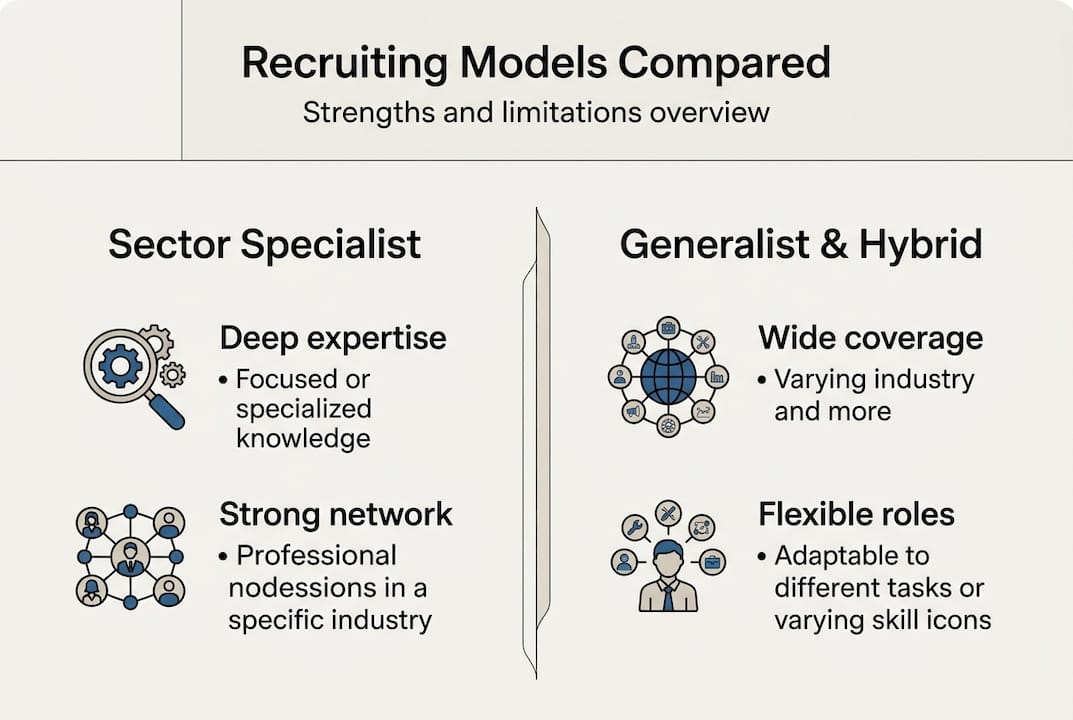
Practitioner-led or hybrid models with ex-industry experience are particularly strong in fast-changing sectors where the recruiter’s own career background gives them genuine credibility with both clients and candidates.
A useful framework for choosing your model: if the role could be filled by someone transitioning from a different industry with minimal ramp-up, a generalist will likely perform well. If the role requires demonstrated sector-specific credentials, current market knowledge, or relationships with a small, specialized talent pool, the sector-specialist is the right call. For organizations scaling a specific practice area quickly, a hybrid model may offer the best balance of depth and flexibility.
The statistic that matters most here is retention. Research consistently shows that hires made through specialist recruiters demonstrate stronger long-term retention than those placed through generalist channels, particularly in technical or regulated industries. When you factor in replacement costs, which can reach 50 to 200 percent of annual salary for a senior role, the cost-per-hire advantage of a generalist quickly evaporates if the hire does not stick.
For organizations that want professional recruiting services that match model to need, clarity on role complexity and sector dynamics is the starting point for every decision.
How to Collaborate Effectively with a Sector-Specialist Recruiter
If you choose the sector-specialist route, how can you make the most of the partnership and ensure the investment delivers measurable results?
The quality of any recruiter relationship is directly proportional to the quality of the information you give them. This is where many hiring managers inadvertently undermine their own search. They share a job description written six months ago, provide minimal feedback on submissions, and assume the recruiter will figure out the rest. A sector-specialist can work around some of that friction, but they cannot fully compensate for a client who treats them like a transactional vendor.
Here is how the most effective collaborations are structured:
| Responsibility | Hiring manager | Sector-specialist recruiter |
|---|---|---|
| Intake and briefing | Share full context: culture, team dynamics, must-haves vs. nice-to-haves | Ask probing questions to uncover unstated requirements |
| Candidate feedback | Provide specific, structured feedback within 48 hours | Use feedback to recalibrate search criteria |
| Market intelligence | Share internal salary data and competitive positioning | Provide real-time salary benchmarks and candidate availability data |
| Interview process | Commit to clear timelines and decision criteria | Prepare candidates, manage expectations, reduce dropout |
| Offer stage | Move quickly and stay within market range | Manage counter-offer risk and closing conversations |
The most common collaboration pitfall is under-informing the recruiter at the brief stage. If you do not share the real reasons your last candidate did not work out, or if you do not mention that the role has shifted since the job description was written, your specialist is working from an incomplete map. That costs everyone time.
Effective collaboration tips include:
- Schedule a live intake call rather than sending a job description by email. The conversation surfaces context that no written brief captures
- Share your structured interview scorecard upfront so the recruiter understands how candidates will be evaluated
- Flag changes in priority or timeline immediately. A recruiter working on a four-week search needs to know by week two if the requirements have changed
- Give candidate feedback that is specific and behavioral, not just “not a fit.” Tell the recruiter exactly what was missing and why
- Treat the recruiter’s market feedback as intelligence, not pushback. If they tell you the compensation range is below market, that is data worth acting on
Practitioner-led recruiting partnerships are most effective when the client treats the recruiter as an extension of their talent team, rather than an outside vendor on a transaction.
Organizations that are ready to formalize this kind of working model can explore recruitment process outsourcing as a way to embed specialist recruiting capability more deeply into their hiring workflow. For longer-term talent strategy alignment, building workforce partnerships with sector-focused firms creates a proactive pipeline rather than a reactive search.
Our Perspective: Where Most Companies Get Specialist Recruiting Wrong
Here is the insight most guides skip entirely. Companies invest in sector-specialist recruiters and then unintentionally degrade the relationship until it performs like a generalist one.
The pattern is predictable. A hiring manager brings in a specialist, then over-manages the process, restricts the recruiter’s access to decision-makers, delays feedback by a week or more, and withholds context about internal shifts or budget changes. The recruiter, working blind, starts submitting safe candidates instead of truly differentiated ones. The hiring manager concludes the specialist was not worth the fee.
The uncomfortable truth is that the specialist’s value is conditional. It depends on the client creating the conditions for real partnership. That means sharing information generously, responding quickly, and trusting the recruiter’s market judgment even when it challenges internal assumptions.
The best way to test for genuine specialized staffing expertise before committing? Ask the recruiter to describe the current talent market for your specific role. Not in general terms. Ask about compensation benchmarks, typical notice periods, the two or three firms most likely to have the profile you need, and the biggest objections active candidates have to making a move right now. A true specialist answers those questions without hesitation. A generalist pivots to the process.
Treating sector-specialists as partners rather than vendors is not a philosophical preference. It is the single biggest variable in whether the engagement delivers.
Connect with Proven Sector-Specialist Recruiters
Careerscape is built on the belief that hiring should be fast, honest, and backed by people who actually understand your industry. Our team brings sector-specific depth to every search, from technical and engineering disciplines to finance, healthcare, and beyond. If your current recruiting approach is producing long time-to-fill numbers, high mis-hire rates, or shortlists that consistently miss the mark, the issue is likely the approach, not the talent market.
Explore our industry-specialized recruiting services to see how we match recruiting expertise to sector complexity. Ready to go deeper? See our specialties to find the right fit for your next critical search. The right recruiter makes every other part of the hiring process faster and cleaner.
Frequently Asked Questions
How Is Sector-Specialist Recruiting Different from Generalist Recruiting?
Sector-specialist recruiting applies in-depth industry knowledge and cultivated candidate networks to deliver stronger hiring outcomes for complex or technical roles. Generalists carry higher mis-hire risk in specialized searches because they often miss critical role nuances.
When Should Companies Prioritize Sector-Specialist Recruiters?
Prioritize sector-specialists for hard-to-fill roles, positions with technical or regulatory requirements, or when the talent market in your sector is moving faster than a generalist can track. Sector-specialists are optimal when deep expertise and current market intelligence are non-negotiable.
Can Sector-Specialist Recruiters Adapt to Shifting Company Requirements?
Practitioner-led or hybrid specialist recruiters adapt well to evolving needs, though hands-off agreements may limit the candidate pool in tightly networked industries. Early and ongoing communication about priority changes minimizes that risk.
What Risks Do Companies Face with Generalist Recruiters?
For specialized or senior roles, generalist recruiters are more likely to submit candidates who look right on paper but lack the nuanced fit that reduces mis-hire risk and improves long-term retention.
Recommended
- Industry-Specialized Recruiting | Careerscape
- Careerscape | National Staffing & Recruiting Agency
- Industry-Specialized Staffing & Recruitment | Careerscape
- Cybersecurity & SOC Analyst Staffing — SIEM, IR & Threat Hunting | Careerscape