
Staffing is a strategic process that goes beyond simple recruiting, involving workforce planning, role identification, sourcing, candidate selection, onboarding, and retention management. Companies incur significant costs and time in hiring, averaging $4,700 and 42 days per position, making a structured approach essential for efficiency and quality. Adopting the right staffing models—such as permanent, temporary, and contract—and focusing on agility and outcome-based strategies can help organizations meet evolving challenges like skills shortages and compliance risks while enhancing overall hiring effectiveness.
In this article
Filling a single position costs companies an average of $4,700 and 42 days. That is not a small investment, and it does not happen by accident. Yet many hiring managers still treat staffing as a simple task rather than the structured, strategic process it actually is. This guide breaks down what staffing really means, how the process works step by step, which models fit which situations, and what challenges you can expect along the way. Whether you are scaling quickly, filling a niche role, or managing seasonal demand, understanding staffing as a system gives you a measurable advantage.
Key Takeaways
| Point | Details |
|---|---|
| Staffing is strategic | It involves much more than just recruiting and is critical to organizational growth. |
| Choose the right model | Matching staffing model to business needs enhances flexibility and efficiency. |
| Challenges are evolving | Modern staffing faces issues like skills shortages, compliance risks, and slow cycles but new solutions exist. |
| Agility drives results | Adopting outcome-based and agile staffing approaches is essential for success in 2026. |
Defining Staffing: What It Really Means
Staffing is one of those terms that gets used loosely. People sometimes use it interchangeably with recruiting or hiring, but those words do not capture the full picture. According to the Gartner HR Glossary, staffing is the process of identifying roles, sourcing talent, and hiring employees to meet organizational goals. That definition matters because it frames staffing as a deliberate, goal-oriented system rather than a reaction to an open seat.
At its core, staffing is about matching organizational needs with the right talent at the right time. That means before a single job posting goes live, decisions about headcount, role scope, required skills, and team structure should already be in motion. Staffing is also continuous. It does not stop when someone accepts an offer. As your business changes, so do your staffing requirements.
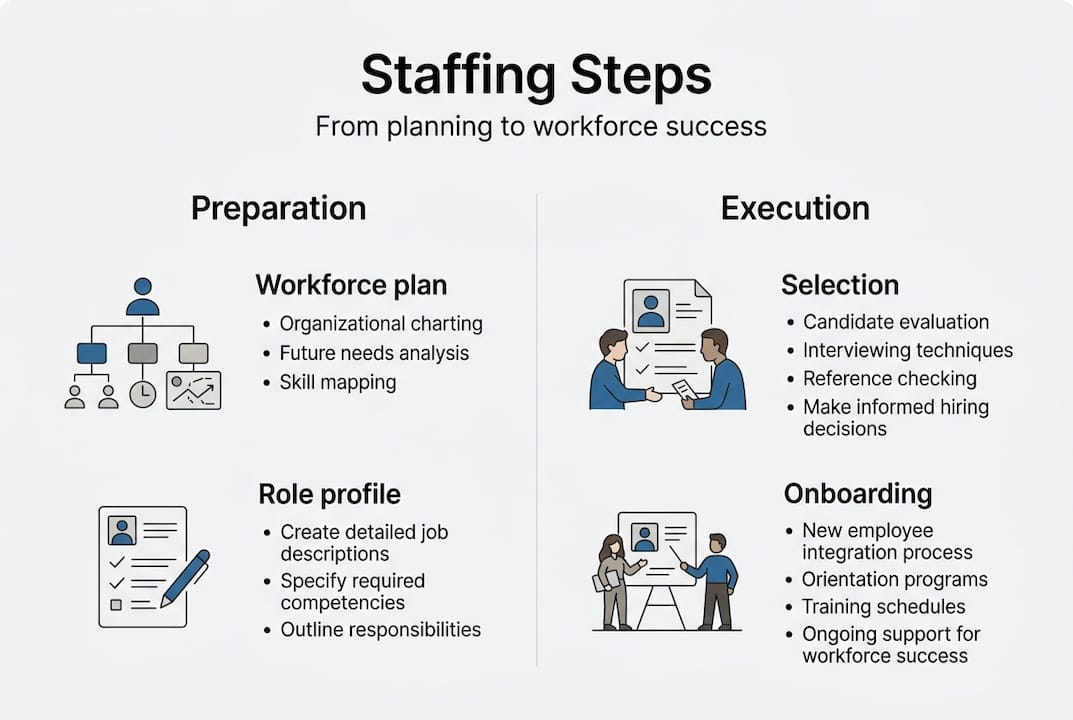
Here is what a complete staffing function typically includes:
- Workforce planning: Analyzing current and future talent needs based on business goals
- Role identification: Defining the specific skills, responsibilities, and outcomes tied to each position
- Sourcing: Building and activating pipelines through job boards, referrals, agencies, and passive outreach
- Candidate selection: Screening, interviewing, and evaluating candidates against defined criteria
- Onboarding: Transitioning new hires into the role effectively to reduce time-to-productivity
- Retention management: Monitoring performance, engagement, and satisfaction to keep good people longer
The reason organizations struggle with staffing is often not a lack of effort. It is a lack of structure. When each step is treated as a separate task rather than part of a connected system, the process breaks down. Roles take longer to fill, quality of hire drops, and cost-per-hire climbs. Treating staffing as a whole system is what separates efficient hiring teams from reactive ones.
It is also worth noting that staffing adapts. A startup in rapid growth mode has different staffing needs than an enterprise managing succession planning. The core steps remain consistent, but the pace, priorities, and models shift depending on organizational context. That adaptability is a feature, not a complexity to fear.

The Staffing Process: Steps and Best Practices
Knowing what staffing means is one thing. Executing it well is another. The core staffing process includes manpower planning, recruitment, training, and retention as interconnected stages. Here is how that plays out in practice:
- Workforce planning: Assess current gaps and forecast future needs based on business objectives. This is where headcount decisions get made with data, not guesswork.
- Recruitment: Activate sourcing channels, write clear job descriptions, and build a pipeline of qualified candidates. Volume matters less than fit.
- Selection: Use structured interviews and scorecards to evaluate candidates consistently. Consistency reduces bias and improves quality-of-hire.
- Onboarding: Set up new hires for success from day one. Poor onboarding is one of the fastest routes to early attrition.
- Retention: Track engagement, compensation alignment, and performance regularly. Retention starts at hire, not when someone is already considering leaving.
Workforce planning and structured hiring are recognized as the most impactful methodologies for improving outcomes across the entire process. When you invest in planning upfront, every downstream stage gets easier.
Here is a quick benchmark comparison to help calibrate your own process:
| Metric | Industry average | High-performing organizations |
|---|---|---|
| Time-to-hire | 42 days | 20 to 25 days |
| Cost-per-hire | $4,700 | $2,500 to $3,500 |
| Retention rate (90-day) | 69% | 85% or higher |
| Quality-of-hire score | Moderate | High, tracked quarterly |
If your numbers fall below these benchmarks, the problem usually lives in one or two stages of the process. Targeting the right fix is more effective than overhauling everything at once.
Pro Tip: Shift from volume-focused recruiting to outcome-based hiring. Define what success looks like in the role at 30, 60, and 90 days, then screen candidates against those outcomes rather than credentials alone. This approach consistently improves quality-of-hire scores. Organizations working with workforce advisory partners often see faster time-to-fill and better long-term retention. Pairing structured process with industry-specialized recruiting adds another layer of precision.
Types of Staffing Models: Permanent, Temporary, Contract, and More
Not every role needs the same solution. Choosing the right staffing model is one of the most practical decisions you can make as a hiring manager. The main types of staffing include permanent, temporary, contract, temp-to-hire, and recruitment process outsourcing (RPO).
Here is a side-by-side comparison:
| Model | Best for | Speed | Cost commitment |
|---|---|---|---|
| Permanent | Core, strategic roles | Slower | High |
| Temporary | Seasonal or short-term needs | Fast | Low |
| Contract | Project-based or specialized work | Moderate | Medium |
| Temp-to-hire | Trial before committing | Moderate | Low to medium |
| RPO | High-volume or full-cycle outsourcing | Scalable | Variable |
Each model has a clear use case. The mistake most organizations make is defaulting to permanent hiring when the role does not actually require it. That inflates cost-per-hire and increases long-term overhead unnecessarily.
Here are common scenarios where a specific model fits best:
- Permanent staffing: Leadership roles, specialized technical positions, and functions tied directly to long-term business strategy
- Temporary staffing: Covering leave, managing seasonal demand, or testing capacity during growth phases. Temporary staffing options are particularly useful when speed and flexibility matter most.
- Contract staffing: Bringing in expertise for a defined scope of work without a long-term commitment. Contract staffing solutions work well for IT projects, compliance audits, or product launches.
- Project-based staffing: Assembling a team around a specific deliverable with a clear start and end date. Explore project-based staffing when you need focused execution without permanent overhead.
- Specialized staffing: Roles requiring niche certifications, clearances, or domain expertise benefit from specialized staffing partners who already have access to those pools.
Pro Tip: Consider hybrid staffing models that combine permanent core teams with flexible contract or temporary resources. This approach gives you workforce agility without sacrificing organizational stability. Companies that build this kind of flexibility into their staffing strategy are better positioned to respond to demand shifts without the disruption of constant full-cycle hiring.
Staffing Challenges and Innovative Solutions
Even well-structured staffing programs hit friction. The most common pain points are not always the most obvious ones. Top staffing challenges include skills shortages, high turnover, seasonal demand swings, compliance risks, and increasingly, the complexity of managing distributed or remote teams.
“The average time-to-hire sits at 42 days. Organizations that use staffing agencies as a bridge often reduce this significantly, with many reporting placements in days rather than weeks.”
Here is how these challenges break down and what you can do about each one:
- Skills shortages: Talent pools for specialized roles are shrinking. The solution is building proactive pipelines rather than waiting for vacancies. Firms like technology and IT recruiters maintain active networks for hard-to-fill roles year-round.
- High turnover: Often tied to poor onboarding, misaligned expectations, or compensation gaps. Track your 90-day retention rate and tie it back to your sourcing and selection process.
- Long time-to-hire: A 42-day average is costly. Reducing decision bottlenecks, pre-qualifying candidates, and using structured scorecards consistently cuts days off the cycle.
- Compliance risks: Misclassification of workers, local labor regulations, and evolving remote work laws create legal exposure. Working with regional experts, including an Austin staffing agency for Texas-based operations, reduces that risk.
- Seasonal demand: Plan your temporary and contract staffing needs at least one quarter ahead. Reactive seasonal hiring almost always costs more and produces lower-quality placements.
AI integration and agile staffing are the two most significant innovations reshaping how employers address these challenges in 2026. AI tools now handle resume screening, interview scheduling, and initial candidate ranking at a fraction of the time cost. Agile staffing models allow organizations to adjust team size and composition based on project phases rather than annual headcount reviews.
Why Staffing Success Depends on Agility and Outcome Thinking
Here is a perspective that gets overlooked in most hiring conversations: rigidly following a process does not guarantee a good hire. It guarantees a completed process. Those are not the same thing.
The organizations that consistently outperform on quality-of-hire and retention are not the ones with the most elaborate hiring workflows. They are the ones that stay adaptive. They define what a successful placement looks like before the search starts, then build every evaluation step around that outcome. They also recognize when a staffing model is not working and change it, rather than defaulting to what is familiar.
Contract staffing expertise is a good example. Many employers use contract hiring reactively, as a last resort. High-performing teams use it strategically to test fit, accelerate project delivery, and build talent relationships before making permanent offers.
Agility in staffing means being willing to reconfigure your approach based on real data. Track your metrics. Identify where the process breaks. Then fix that stage, not the whole system.
Connect with Proven Staffing Solutions
Careerscape is a staffing and recruiting firm built on the idea that hiring should be fast, honest, and backed by people who understand your industry. Whether your immediate need involves contract staffing solutions for a technical project, project-based teams for a defined initiative, or temporary staffing services to manage demand peaks, Careerscape has the networks and industry knowledge to move quickly. We work across sectors, source from pre-qualified candidate pools, and focus on placements that last. If your current staffing process is not producing the results you need, we are ready to help you build one that does.
Frequently Asked Questions
How Does Staffing Differ from Recruitment?
Staffing is a broader process that includes planning, recruitment, selection, onboarding, training, and retention, while recruitment focuses narrowly on sourcing and interviewing candidates. Staffing is the full system; recruitment is one stage within it.
What Staffing Model Is Best for Seasonal Hiring?
Temporary and contract models are the most effective for seasonal demand because they offer speed and flexibility without long-term cost commitment. Temporary and contract models let you scale the workforce up or down in response to short-term needs without the overhead of permanent hires.
What Are the Biggest Staffing Challenges in 2026?
The top challenges are skills shortages, high turnover, and a 42-day average time-to-hire, along with compliance complexity and the logistics of managing remote or hybrid teams effectively.
Is AI Making Staffing More Efficient for Employers?
Yes. AI tools are streamlining resume screening, candidate ranking, and scheduling, reducing administrative load significantly. However, regulatory and compliance considerations around AI use in hiring must be carefully managed to avoid legal exposure.
Recommended
- Project-Based Staffing & Teams | Careerscape
- Shift-Based Staffing Solutions | Careerscape
- Contract Staffing Solutions | Careerscape
- Complete Guide to the Role of Branding in Recruitment
- What is a video interview? A practical guide for hiring