
Nearly 85% of jobs are filled through networking, yet many hiring managers still rely on job boards, resulting in lost time and potential candidates. Referrals not only lead to higher quality hires, but they also enhance retention rates and reduce hiring costs. To improve recruitment outcomes, organizations should diversify their networks, actively engage with talent communities, and blend various sourcing channels, ensuring that relationships are nurtured even when there are no immediate hiring needs.
In this article
Nearly 85% of jobs are filled through networking, yet most hiring managers still anchor their strategy to job boards and applicant tracking systems. That gap between belief and reality costs organizations time, money, and great candidates. The assumption that postings drive placements is one of the most persistent misconceptions in talent acquisition. This guide cuts through the noise, using data and practical frameworks to show how professional networks consistently outperform traditional channels. Whether you are refining an existing referral program or building a talent pipeline from scratch, what follows gives you the evidence and the tools to recruit smarter.
Key Takeaways
| Point | Details |
|---|---|
| Networks drive most hires | Over 80% of jobs are filled through networking, not public postings. |
| Referrals outperform job boards | Referral hires are more likely to be successful, stay longer, and cost less. |
| Diversifying networks avoids bias | Broaden your reach to improve diversity and minimize common recruiting pitfalls. |
| Sustained relationships pay off | Consistent engagement with talent communities yields better long-term results. |
Why Networks Matter in Recruitment
The numbers are hard to ignore. 85% of jobs are filled through networking, which means job boards and career sites only account for a fraction of successful placements. For hiring managers, this single data point reframes the entire sourcing strategy conversation. If your team is spending the majority of its budget on posting and waiting, you are competing for a small slice of the market.
Referrals make the gap even clearer. Employee referrals represent 40% of hires despite making up just 7% of total applicants. That is an extraordinary conversion rate, one no job board can match. When someone inside your organization vouches for a candidate, trust is already established. The screening process is shorter, the cultural alignment is stronger, and the time-to-fill drops significantly.
Then there is the hidden job market to consider. Research suggests up to 80% of open roles are never publicly posted. Companies fill them quietly through internal mobility, recruiter outreach, or warm introductions. If your networking in recruitment strategy is passive, you are not just missing candidates. You are missing entire categories of opportunity.
“The best candidates are not always looking. They are found through relationships built long before a vacancy opens.”
Building your sourcing strategy around networks delivers measurable advantages:
- Higher-quality hires: Referred candidates arrive with context and endorsement, reducing risk.
- Faster time-to-fill: Warm introductions shorten the pipeline from sourcing to offer.
- Better culture fit: Employees refer people whose work styles they know firsthand.
- Lower cost-per-hire: Network-sourced candidates require fewer paid sourcing resources.
- Access to passive talent: Strong networks surface candidates who are not actively applying.
For technology sector recruiting and other specialized fields, where qualified talent is scarce and competition is fierce, these advantages compound quickly. Building network-driven sourcing into your talent acquisition model is not a nice-to-have. It is a competitive necessity.
Types of Networks Leveraged in Effective Recruitment
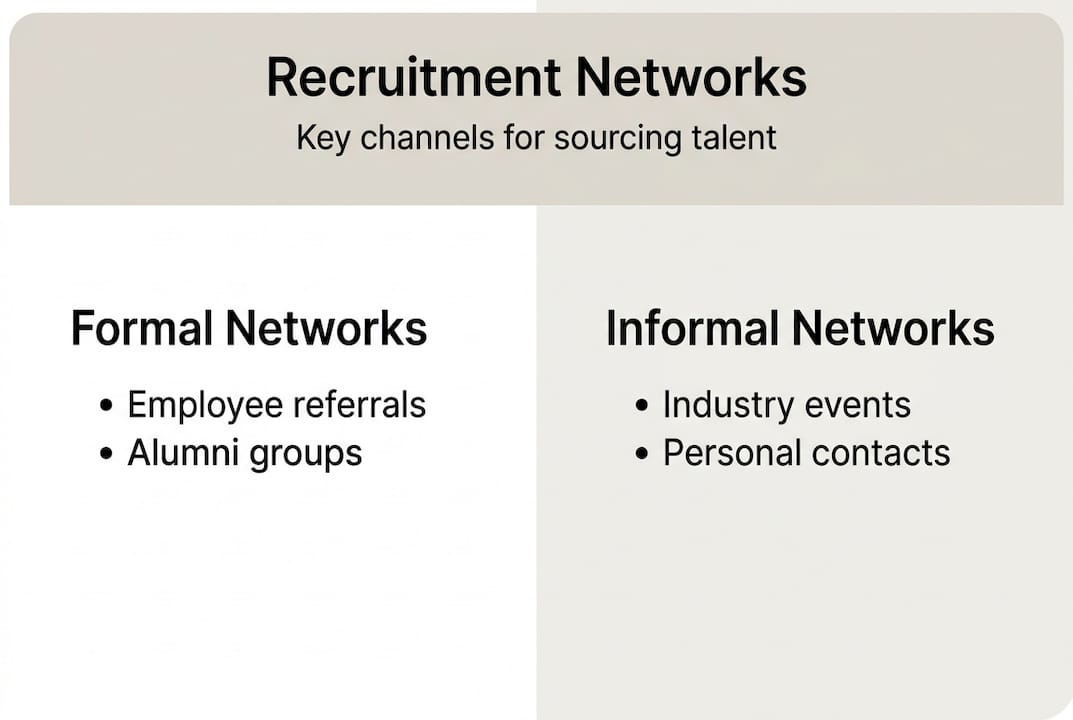
Not all networks are created equal. Effective talent sourcing draws on a range of channels, each with distinct strengths and limitations. Understanding which channel fits which hiring need is what separates reactive recruiting from a proactive talent pipeline strategy.
| Network channel | Strengths | Limitations |
|---|---|---|
| Employee referrals | High conversion, fast trust-building | Risk of homogeneity if not managed |
| LinkedIn and platforms | Broad reach, searchable filters | High noise-to-signal ratio |
| Events and conferences | Real-time relationship building | Costly and time-intensive |
| Alumni networks | Pre-existing trust and shared values | Limited to specific institutions |
| Talent communities | Long-term pipeline building | Requires consistent engagement |
For most organizations, no single channel is sufficient. The goal is a blended approach. Here is how to activate each one:
- Employee referrals: Launch or refresh referral program insights with clear incentive structures and transparent criteria.
- LinkedIn and platforms: Train recruiters to use Boolean search, InMail sequences, and content engagement to identify passive candidates.
- Events and conferences: Assign team members to industry events with specific outreach targets and follow-up protocols.
- Alumni networks: Partner with university career offices and leverage alumni groups for specialized roles.
- Talent communities: Build and nurture talent communities by sharing useful content, updating members on company news, and inviting engagement.
Pro Tip: Blending formal programs like structured referral incentives with informal relationship-building at events maximizes both the volume and quality of your network pipeline. Managers who rely on only one channel leave significant talent on the table.
The key is consistency. Networks deteriorate when contact becomes transactional. Candidates and connections need to feel valued before a job opens, not just when you need to fill a seat.
Key Advantages of Network-Driven Recruitment
The case for network-based hiring is not just anecdotal. The data on retention, performance, and cost consistently favors referrals and network-sourced candidates over those from traditional channels.
Referral hires show 25% higher retention and stay 45% longer than employees sourced through job boards. For roles with high onboarding costs, that retention edge translates directly into budget savings. Replacing an employee typically costs between 50% and 200% of their annual salary, so reducing turnover through smarter sourcing is one of the highest-leverage moves a hiring manager can make.
“Referral hires have 25% higher retention rates and stay an average of 45% longer than non-referral hires.”
Performance data is equally compelling. Referrals are 10 times more likely to be hired and outperform non-referrals by 20% to 33% on key performance metrics. Part of this comes from the pre-screening effect. Referring employees have already done informal vetting. They know the role, the culture, and the expectations.

| Metric | Referral hires | Non-referral hires |
|---|---|---|
| Retention rate | 25% higher | Baseline |
| Average tenure | 45% longer | Baseline |
| Performance rating | 20 to 33% above average | Baseline |
| Hiring likelihood | 10x more likely | Baseline |
| Time-to-fill | Shorter | Longer |
The advantages extend beyond individual performance:
- Speed: Network-sourced candidates move through the pipeline faster.
- Retention: Longer tenure reduces replacement costs and knowledge loss.
- Performance: Higher output drives better team results.
- Cost-per-hire: Fewer paid sourcing channels means lower overall spend.
- Culture fit: Referred candidates align more naturally with team dynamics.
For roles requiring specialized judgment, like advisory board recruitment strategies or senior legal hires, the culture fit and trust advantages of network-based sourcing are especially valuable. These are not positions where a resume scan is enough.
Pitfalls, Biases, and How to Diversify Your Recruitment Networks
Network-based recruiting has real risks. The most significant is affinity bias. When employees refer people similar to themselves, and managers favor candidates from familiar circles, over-reliance can limit your talent pool. Organizations end up hiring for comfort rather than capability. Over time, this erodes diversity of thought, background, and skill.
SHRM research notes that networks must be balanced with skills-based hiring and proactive diverse outreach to remain effective. Networking alone, without structure, can reinforce existing demographic patterns rather than expand them.
The good news is that bias in network recruiting is manageable when you build the right guardrails:
- Set diversity KPIs for your referral program. Track the demographic makeup of referred candidates and set measurable targets for representation.
- Train employees on inclusive referral practices. Help your team recognize who they are not thinking of when they recommend candidates.
- Expand your network reach. Actively engage with professional associations, affinity groups, and cross-industry events to surface candidates outside your usual circles.
- Use structured interview scorecards. Standardized evaluation criteria reduce the influence of personal familiarity on hiring decisions.
- Audit sourcing data regularly. Review where your hires are coming from and identify channels that underperform on diversity metrics.
Pro Tip: Set a quarterly review of referral source data across demographic indicators. This turns a potential blind spot into a measurable process improvement.
Strategies like expanding referral networks across departments and industries help counter the natural pull toward familiar candidates. And building diverse sourcing strategies that include skills-based criteria alongside network connections gives your hiring process both the reach and rigor it needs.
Building and Sustaining a High-Impact Recruitment Network
Knowing the value of networks is one thing. Building one that consistently delivers is another. The managers who do this well start by mapping what they already have.
Begin with an audit of your current connections: employees, former colleagues, industry contacts, alumni, and vendor relationships. Identify gaps by role type, seniority, and sector. Then target influencers in those gaps, people who know many candidates even if they are not candidates themselves.
Sustained networking success comes from consistent relationship-building through events, LinkedIn, alumni engagement, and regular check-ins. The relationships that produce the best referrals are rarely transactional. They are built on mutual value over time.
Here is a practical framework for operationalizing your network strategy:
- Initiate: Reach out to new connections with a specific, relevant reason to connect. Generic messages get ignored.
- Maintain: Schedule quarterly check-ins with key contacts. Share useful content, celebrate their milestones, and stay visible.
- Incentivize: Reward referrals meaningfully. Financial bonuses help, but recognition and career visibility also drive participation.
- Measure: Track referral conversion rates, time-to-fill from network sources, and retention by sourcing channel. Review talent community best practices to benchmark your engagement metrics.
- Expand: Regularly identify new contacts to bring into your network, especially in underrepresented talent segments.
Pro Tip: Use a simple scheduling tool to automate reminder prompts for monthly or quarterly outreach to your top 20 connections. Consistency is what separates networks that produce results from those that go dormant.
Formal programs, such as structured alumni engagement and talent community newsletters, keep your pipeline warm between open roles. The goal is to be a resource for your network before you need to be a recruiter.
Our Take: Why Effective Recruiting Is Always Relationship-Driven
Technology has transformed every step of the hiring process. AI can screen resumes, schedule interviews, and predict candidate fit with reasonable accuracy. But here is what it cannot do: earn trust.
From our experience across multiple industries, the hires that last, perform, and elevate teams almost always trace back to a relationship. Not a keyword match. Not an algorithm score. A person who knew a person who believed in the candidate.
Most organizations underinvest in alumni networks and passive candidate relationships because the return is not immediately visible. That is exactly why it is a competitive advantage. The managers building those relationships now are filling roles six months from now with less effort and better outcomes than those still waiting on job board traffic.
AI and automation are powerful support tools, but they work best when layered onto a strong relational foundation. The data confirms it. The experience of every seasoned recruiter confirms it. Relationships are not a soft skill in hiring. They are the primary asset.
Let Careerscape Elevate Your Recruitment Network
The strategies in this guide only work when they are consistently applied, and that takes time most hiring managers do not have. Careerscape is a staffing and recruiting firm built on the belief that hiring should be fast, honest, and backed by people who understand your industry.
Our team works within established professional networks across industry-specialized recruiting to surface qualified candidates who are not visible on job boards. Whether you need contract staffing solutions for a short-term gap or project-based hiring for a critical initiative, Careerscape brings the network relationships and recruiting expertise to get it done. Connect with us today to put your network to work.
Frequently Asked Questions
What Makes Referrals More Effective than Job Boards?
Referrals lead to dramatically higher hire rates, stronger retention, and lower cost-per-hire compared to job board applicants. Referrals make up 40% of hires from just 7% of total applicants, a conversion rate no posting channel can match.
How Can Hiring Managers Avoid Bias When Networking?
By diversifying outreach, setting structured evaluation criteria, and tracking diversity KPIs, managers reduce the impact of affinity bias. Over-reliance on familiar networks is the primary driver of homogeneity in referral-based hiring.
What Practical Steps Grow a Recruitment Network?
Engage consistently with events, activate employee referral programs, reconnect with alumni groups, and maintain regular contact with key connections. Sustained check-ins and content sharing keep relationships warm and referral pipelines active between open roles.
Recommended
- Partnerships & Workforce Solutions | Careerscape
- Industry-Specialized Recruiting | Careerscape
- Network Engineer Staffing — Cisco, Juniper & Cloud Networking | Careerscape
- HR Recruiters by City — Local People Operations Staffing | Careerscape
- Hiring and retention are a must and need a more evidence-based approach – xpath.global
- Recruit & Select Training | Summit SCALE® Coaching