
The 70% figure comes from RippleMatch's spring 2023 survey of Gen Z students and new grads. Newer Deloitte and BLS data show a more mixed picture, and clear career steps matter more than speed alone.
- The 70% figure is real but dated: it comes from RippleMatch’s spring 2023 pulse survey of students and new grads, not from workers already in jobs.
- Expectations are cooling. In the same survey, the share expecting a promotion within one year fell from 75% in 2022 to 40% in 2023.
- Newer data shows a split: in Deloitte’s 2026 survey, 25% of Gen Z prefer rapid promotions, while 44% prefer steady progress and 21% would take lateral moves.
- Workers aged 20 to 24 have a median of 1.5 years with their current employer (BLS, January 2026), so the 18-month mark is often when early-career people leave if they see no path.
- Employers close the gap with written career levels, a 6-month check-in rhythm and growth steps between promotions; employees close it by asking how promotions work before they accept.
In this article
The claim that 70% of Gen Z expect a promotion within 18 months comes from a spring 2023 RippleMatch survey of more than 3,000 Gen Z students and new grads. Is it realistic? Sometimes. A first step up inside 18 months happens in fast-growing teams and roles with clear levels, but many employers move slower, so Gen Z promotion expectations often run ahead of what companies actually offer.
Where the 70% Gen Z promotion statistic comes from
The number traces back to RippleMatch, an early-career recruiting platform. In a July 2023 article on its Early Career Recruitment Index, RippleMatch reported that 70% of Gen Z respondents expected a promotion within 18 months on the job. The pulse survey ran in spring 2023 and covered more than 3,000 Gen Z students and new grads looking for internships and jobs.
Three details matter when you quote it:
- Who was asked. Students and recent graduates, most of whom had not started a full-time job yet. It measures hopes going in, not what happened.
- When. Spring 2023, during a hot hiring market. RippleMatch did not publish a margin of error or detailed sampling method.
- The trend inside it. Expectations were already falling. The share expecting a promotion within one year or less dropped from 75% in spring 2022 to 40% in spring 2023, and the share who did not expect one before the two-year mark rose from 11% to 30%.
So the fair reading is: most Gen Z job seekers in 2023 hoped for a step up within about a year and a half, and that hope was getting more modest, not more extreme.
What newer data says about Gen Z career expectations
The most recent large survey is Deloitte’s 2026 Gen Z and Millennial Survey, which polled 22,595 people (14,384 of them Gen Z) in 44 countries between November 24, 2025 and January 15, 2026. It paints a more mixed picture than “everyone wants to be promoted fast.”
| Preferred way to progress (Deloitte 2026) | Gen Z | Millennials |
|---|---|---|
| Steady, gradual progress | 44% | 45% |
| Fast progression with rapid promotions | 25% | 21% |
| Lateral moves to gain experience | 21% | 20% |
Deloitte also found that only 6% of Gen Zs and millennials say reaching a leadership position is their primary career goal, even though 76% of Gen Zs are interested in a senior role at some point. The barriers they named were stress and burnout (50% of Gen Zs), too much responsibility (50%) and work/life balance (41%).
Put together: a meaningful minority of Gen Z wants speed, but most want visible, regular progress and a role they can sustain. A title change is one way to show progress, not the only one.
Is a promotion within 18 months realistic?
It depends on the employer, the role and the person. There is no official U.S. statistic on average time to first promotion, so treat any single number with care.
One useful reference point is a StandOut CV analysis of LinkedIn job histories for 19,363 employees at 20 of the largest U.S. and UK companies. It found an average of 30.4 months between promotions, ranging from 10.4 months at Tesla to 98 months at Rio Tinto. That is a small, large-company sample built from self-reported profiles, so it shows the spread more than a national norm.
In practice, an 18-month promotion is more likely when:
- The company has defined levels (for example Analyst I, II, III or Associate to Senior Associate) with written criteria.
- The team is growing, so new senior seats open up.
- The role has measurable output: sales, recruiting, customer support, operations and many technical jobs.
- The employee has been fully productive for at least a couple of review cycles and is already doing some of the next level’s work.
It is less likely in flat organizations, slow-growth industries, and roles where the next step is a management job that only opens when someone leaves.
Why the 18-month mark matters for retention
The Bureau of Labor Statistics employee tenure data for January 2026 shows how short early-career stints already are. Workers aged 20 to 24 had been with their current employer a median of 1.5 years, and workers aged 25 to 34 a median of 3.0 years, compared with 4.1 years for all workers.
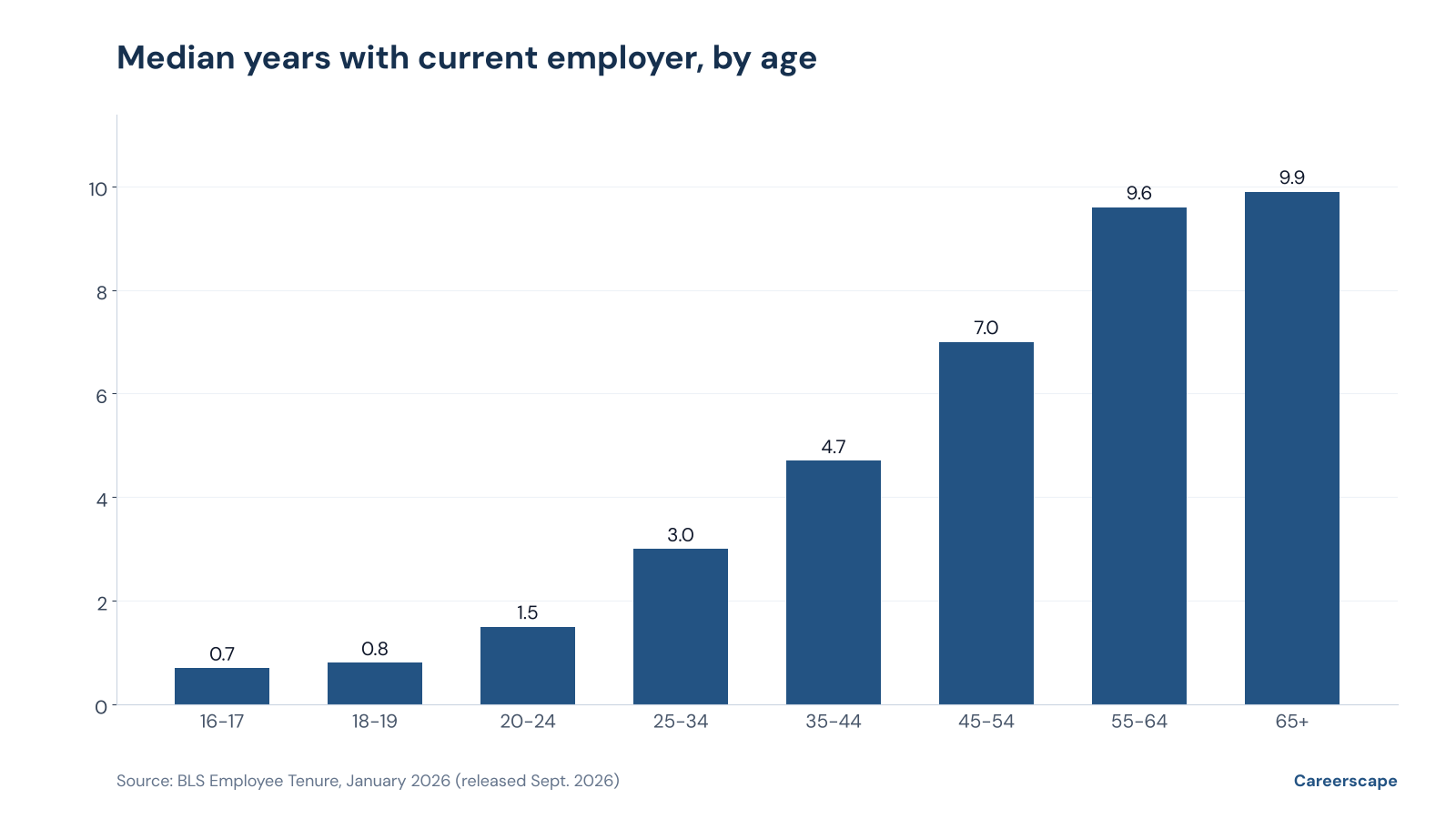
Tenure data does not say why people leave, but the timing lines up: half of employed 20-to-24-year-olds have been with their employer for 18 months or less, which is about when many expect a step forward. If you want to keep early-career hires, the first 12 to 18 months are where you win or lose them. See our guide on why talent retention matters for business performance for the cost side.
How employers can meet Gen Z promotion expectations
You don’t have to promote everyone in 18 months. You do have to make progress visible and predictable.
Publish a simple career ladder
For each early-career role, write down the next level, what someone must show to get there, and the typical range of time it takes. Share it in the interview and again at onboarding. An honest “usually 18 to 30 months” beats silence.
Set a check-in rhythm
Use a short career conversation every six months, separate from the annual review. A simple agenda works:
- What you have done well since we last talked, with specific examples.
- Where you are against the next level’s criteria (met, partly met, not yet).
- One or two skills or projects to focus on before the next check-in.
- What I, as your manager, will do to help (training, a stretch project, visibility with leadership).
Offer steps between promotions
Deloitte’s data shows many Gen Z workers value steady progress and lateral moves. Use them: sub-levels with a pay step, ownership of a project or client, a rotation into another team, mentoring a newer hire, or a certification paid by the company. Each one is a real, visible step.
Be clear about pay
Explain how raises work (merit cycle, promotion increases, market adjustments) and when they happen. In states with pay range disclosure rules, the ranges you post for the next level up are visible anyway; see pay transparency laws by state.
Hire for fit with your real timeline
If your company promotes slowly, say so and explain what people gain in the meantime. Candidates who accept with accurate expectations are more likely to stay than those who discover the timeline later.
How Gen Z employees can set realistic promotion goals
If you are early in your career, you can raise your odds without job-hopping every year.
- Ask before you accept. “What does the next level look like for this role, and how long do people usually take to get there?” “When was the last time someone on this team was promoted?”
- Get the criteria in writing. In your first month, ask your manager what “ready for promotion” means in concrete terms, then track your results against it. Our guide to starting a new job covers what to set up in the first 90 days.
- Show next-level work. Promotions usually follow evidence that you are already doing parts of the bigger job.
- Raise it at 12 months, not 18. A conversation at a year gives you and your manager time to agree on a plan. A script: “I’d like to be considered for [next title] within the next six months. Which gaps do you see, and what would you need to see from me?”
- Count more than titles. New skills, bigger scope and pay increases are progress too. If none of them are moving after a year or more of strong work, it is reasonable to look elsewhere.
If you do get an offer from another employer, our job offer negotiation scripts help you ask for the level and pay you have earned.
How Careerscape can help
Careerscape is a U.S. staffing and recruiting firm. Employers can use our direct hire recruiting to find early-career candidates whose expectations match the growth path you can offer, and job seekers can browse open jobs across many industries and U.S. metro markets.
Frequently asked questions
Do 70% of Gen Z really expect a promotion within 18 months?
In RippleMatch’s spring 2023 pulse survey of more than 3,000 Gen Z students and new grads, 70% said they expected a promotion within 18 months on the job. It reflects job seekers’ expectations at that time, not current employees or later years. The same survey showed expectations falling: fewer respondents expected a promotion within one year than in 2022.
How long does it usually take to get promoted?
There is no official U.S. average. One LinkedIn-based analysis of 20 large U.S. and UK companies found an average of 30.4 months between promotions, with wide variation by company. Many employers place a first promotion somewhere between about 18 months and three years, depending on levels, growth and performance.
What do Gen Z workers want from their careers?
Deloitte’s 2026 survey found that 44% of Gen Z prefer steady progress, 25% want rapid promotions and 21% would make lateral moves to gain experience. Only 6% of Gen Zs and millennials called leadership their primary goal, and 96% of Gen Zs said a sense of purpose at work matters to their job satisfaction and well-being.
Is it bad to ask for a promotion after one year?
No, as long as you frame it as a plan rather than a demand. Ask what the next level requires, where you stand against it, and what timeline is realistic. A one-year conversation gives your manager time to support your case at the next review cycle.
Why do Gen Z employees leave jobs so quickly?
Short tenure is common early in any career. BLS data for January 2026 shows a median of 1.5 years with the current employer for workers aged 20 to 24. The tenure data does not record reasons, but if growth expectations are part of the picture, a visible career path in the first year gives early-career hires a reason to stay.
- RippleMatch: How fast does Gen Z expect to be promoted? (July 2023)
- Deloitte: 2026 Gen Z and Millennial Survey press release (June 2026)
- Deloitte: 2026 Gen Z and Millennial Survey
- U.S. Bureau of Labor Statistics: Employee Tenure, Table 1 (January 2026 data)
- U.S. Bureau of Labor Statistics: Employee Tenure in 2026 (September 2026)
- StandOut CV: Time to promotion at the largest U.S. and UK companies (updated March 2025)