
Candidate experience refers to the overall perception a job seeker has of an employer throughout the hiring process, significantly influencing their decision to accept job offers and recommend the company. Key factors affecting candidate experience include communication quality, application complexity, interview transparency, and employer branding. Improving candidate experience can lead to higher retention rates, reduced hiring costs, and a stronger organizational reputation, making it essential for HR professionals to prioritize and measure this aspect of recruitment.
In this article
Candidate experience is the overall perception a job seeker forms of an employer based on every interaction during the hiring process, from the first job posting through onboarding. This perception shapes whether top candidates accept offers, recommend your company to peers, or walk away frustrated. 66% of candidates cite a positive hiring experience as a deciding factor in accepting a job offer, while 26% decline offers specifically because of poor communication or disorganized processes. For HR professionals and hiring managers, understanding what is candidate experience is not optional. It is the foundation of every successful recruiting strategy.
What Is Candidate Experience, and How Does It Differ from the Candidate Journey?
Candidate experience is the emotional and perceptual response a job seeker has to each touchpoint in your recruitment process. The candidate journey, by contrast, is the sequence of steps: job discovery, application, screening, interview, offer, and onboarding. The journey is the map. The experience is how the candidate feels while traveling it.
This distinction matters because you can have a well-structured candidate journey and still deliver a poor experience. A five-step interview process can feel respectful and transparent, or it can feel chaotic and disrespectful, depending on how your team communicates and behaves at each stage. Candidate experience applies to every applicant, including those rejected early or who withdraw. Every interaction leaves an impression that affects future applications and word-of-mouth recommendations.

The biggest misconception in recruiting is that candidate experience only concerns the people you hire. Rejected candidates talk. They post reviews on Glassdoor, warn colleagues, and remember how your company treated them when they were vulnerable. Treating every applicant as a brand ambassador is not idealism. It is risk management.
What Factors Most Influence Candidate Experience?
Several specific touchpoints consistently drive candidate satisfaction or dissatisfaction. Understanding these factors is the first step toward fixing them.
- Communication quality and speed: 61% of candidates report being ghosted after an interview, and 60% abandon applications mid-process due to complexity or silence. Delayed responses signal disrespect and disorganization.
- Application process length and complexity: Long, repetitive forms with no mobile optimization push qualified candidates to drop off before you ever see their resume. Every unnecessary field is a barrier.
- Interview process transparency: Candidates who do not know what to expect in an interview, how many rounds remain, or what criteria you are using will interpret that opacity as a red flag about your culture.
- Technology and candidate-facing tools: Applicant tracking systems like Workday, Greenhouse, and Lever shape the application experience directly. Clunky portals that require duplicate data entry frustrate candidates before they meet a single human.
- Employer brand and cultural representation: Job descriptions, career pages, and recruiter behavior all signal what it is like to work at your company. Misalignment between those signals and reality increases early turnover risk.
Pro Tip: Review your own application process as a candidate once per quarter. Time how long it takes, note every friction point, and fix the top three before the next hiring cycle.
How Is Candidate Experience Measured and Analyzed?
You cannot improve what you do not measure. The primary quantitative tool for measuring candidate experience is the Candidate Net Promoter Score, or cNPS. cNPS surveys candidates on their likelihood to recommend your hiring process to others, using the standard NPS scale of 0–10. Promoters score 9–10, passives score 7–8, and detractors score 0–6. Your cNPS equals the percentage of promoters minus the percentage of detractors.
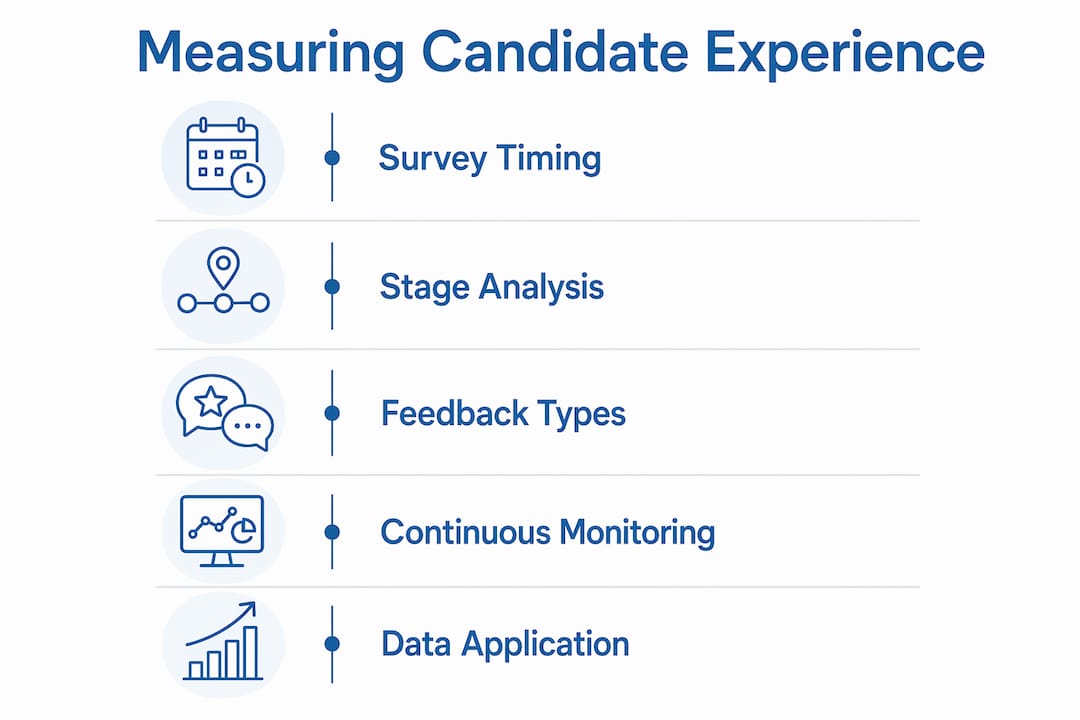
The real power of cNPS comes from applying it at each recruitment stage. Measuring cNPS by stage reveals exactly where the experience breaks down, whether that is at the application, the phone screen, or the final interview. A single overall score hides the problem. Stage-level scores locate it.
Pro Tip: Send cNPS surveys within 24 hours of each major stage, not just at the end of the process. Response rates drop sharply after 48 hours, and the feedback becomes less specific.
Beyond cNPS, several supporting metrics give HR professionals a fuller picture:
| Metric | What it measures | Why it matters |
|---|---|---|
| Application completion rate | Percentage of started applications finished | Reveals friction in your application form |
| Time-to-first-contact | Hours between application and first recruiter response | Signals responsiveness and candidate respect |
| Offer acceptance rate | Percentage of offers accepted | Reflects overall hiring process quality |
| Retention at 6 months | Percentage of new hires still employed | Connects candidate experience to onboarding alignment |
| Interview-to-offer ratio | Interviews conducted per offer extended | Indicates process efficiency and candidate fit |
Structured feedback surveys outperform anecdotal reports every time. A recruiter’s gut feeling about how an interview went is not a data point. A cNPS score tied to a specific stage is.
What Are the Best Practices to Improve Candidate Experience?
Improving candidate experience does not require a complete overhaul of your hiring process. It requires consistent execution of a small number of high-impact practices.
- Respond within 24 hours of every application. An automated acknowledgment is acceptable as a first step, but a personalized follow-up within one business day sets a professional tone. Silence after application submission is the single fastest way to lose a qualified candidate.
- Simplify your application form. Remove any field that does not directly inform a hiring decision. If you ask candidates to upload a resume and then manually re-enter the same information, you are creating unnecessary friction. Tools like SparkCV help candidates present their qualifications clearly, which also reduces the burden on your screening process.
- Set clear process expectations upfront. Tell candidates how many interview rounds to expect, who they will meet, and when they will hear back. Publish this in the job posting or confirm it in the first recruiter call.
- Train interviewers on structured interview scorecards. Unstructured interviews introduce bias and inconsistency. Structured scorecards keep assessments fair, defensible, and comparable across candidates.
- Close the loop with every candidate. Send rejection notices promptly and, where possible, include brief, specific feedback. Candidates who receive a respectful rejection are far more likely to reapply or recommend your company than those who are ghosted.
- Audit your job posting quality regularly. Vague or inflated job descriptions attract mismatched applicants and set false expectations that damage experience before the first interview.
“Transparency and speed are the two variables candidates weight most heavily when evaluating a hiring process. Get those right, and most other friction points become manageable.” — Qualtrics Candidate Experience Research
Monitoring candidate feedback continuously, rather than reviewing it annually, allows HR teams to catch process breakdowns before they become patterns. Build a monthly review of cNPS scores and application completion rates into your recruiting calendar.
What Is the Business Impact of Investing in Candidate Experience?
The financial and reputational stakes of candidate experience are concrete and measurable. Organizations with strong candidate experience and onboarding retain new hires at rates 82% higher than those with weaker processes. That difference in retention directly reduces cost-per-hire, time-to-fill, and the productivity loss that comes with early turnover.
Candidate resentment toward hiring processes reached a 13-year high in 2024. That peak signals a widening gap between what candidates expect and what most employers deliver. The companies that close that gap gain a measurable recruiting advantage.
The table below compares outcomes across different levels of candidate experience quality:
| Experience quality | Offer acceptance rate | Retention at 12 months | Employer brand impact |
|---|---|---|---|
| Strong | High (66%+ influenced by positive experience) | 82% higher than weak processes | Positive referrals, strong Glassdoor ratings |
| Average | Moderate | Baseline | Neutral word-of-mouth |
| Poor | Reduced (26% decline offers due to poor experience) | Below baseline, early turnover risk | Negative reviews, peer warnings, increased cost-per-hire |
Candidates use their recruitment experience as a proxy for company culture. A disorganized hiring process signals a disorganized workplace. That perception increases the risk of early turnover within the first 6–12 months, even among candidates who accept the offer. Negative candidate experience also carries cumulative long-term costs. Candidates warn peers, post reviews, and reduce the size of your future talent pipeline. The damage compounds over time in ways that standard recruiting metrics do not capture until the cost-per-hire rises sharply.
Investing in attracting top talent starts with delivering a process those candidates want to complete.
Key Takeaways
Strong candidate experience is the single most controllable factor in offer acceptance rates, new hire retention, and long-term employer brand health.
| Point | Details |
|---|---|
| Define experience vs. journey | The candidate journey maps steps; candidate experience measures how applicants feel at each one. |
| Measure by stage, not overall | Track cNPS at each recruitment stage to pinpoint exactly where satisfaction drops. |
| Communication is the top driver | Ghosting and slow responses are the leading causes of candidate drop-off and offer declines. |
| Retention is directly linked | Organizations with strong hiring experiences retain new hires at rates 82% higher than weak ones. |
| Every candidate is a brand ambassador | Rejected applicants influence future hiring costs and employer reputation through peer recommendations. |
What I Have Learned from Watching Companies Get This Wrong
Most HR teams treat candidate experience as a post-hire concern. They survey new employees about the hiring process during onboarding and call that measurement. By then, the candidates who had the worst experiences are already gone. They declined the offer, withdrew mid-process, or were screened out and never heard from again. Those voices are invisible in the data.
The companies I have seen improve their recruiting outcomes fastest share one habit: they track cNPS at every stage and review it monthly, not annually. When the phone screen score drops, they investigate that specific touchpoint. They do not wait for a pattern to emerge across a quarter of data. They treat a single bad week as a signal worth examining.
Technology helps, but it does not replace the human element. Automated scheduling tools, ATS platforms like Greenhouse, and AI-powered screening reduce friction. They do not create trust. Trust comes from a recruiter who follows up when they said they would, an interviewer who respects the candidate’s time, and a hiring manager who gives honest feedback after a rejection. Those behaviors are free. They are also the ones most consistently skipped when teams are under pressure to fill roles fast.
The organizations that treat every applicant, hired or not, as a future customer or referral source consistently outperform those that focus only on the candidates they extend offers to. That mindset shift is the actual competitive advantage.
— Bradford
How Careerscape Supports a Better Hiring Process
Careerscape, builds hiring processes around speed, honesty, and industry expertise. For HR professionals who need flexible options, contract staffing solutions give you access to qualified professionals without the delays that frustrate candidates and inflate time-to-fill. Careerscape’s recruiters specialize by industry, which means candidates interact with people who understand their field and can answer questions with authority. That specificity improves candidate perception at every touchpoint. If your team is ready to reduce friction and improve offer acceptance rates, Careerscape’s project-based staffing and direct hire services are built to support exactly that outcome.
FAQ
What Is the Candidate Experience Definition in HR?
Candidate experience is the overall perception a job seeker forms of an employer based on every interaction during the hiring process. It covers every touchpoint from job discovery through onboarding, including application, screening, interviews, and communication.
Why Is Candidate Experience Important for Hiring Managers?
Poor candidate experience directly reduces offer acceptance rates and increases early turnover. Research shows 26% of candidates decline offers due to poor communication, and organizations with strong hiring experiences retain new hires at rates 82% higher than those with weak processes.
What Is Cnps and How Does It Measure Candidate Experience?
Candidate Net Promoter Score (cNPS) surveys applicants on their likelihood to recommend your hiring process, using a 0–10 scale. Measuring cNPS at each recruitment stage identifies the specific touchpoints where candidate satisfaction breaks down.
What Affects Candidate Experience the Most?
Communication speed and quality are the top drivers. Ghosting after interviews and complex application forms are the leading causes of candidate drop-off and negative employer brand perception.
How Do You Improve Candidate Experience Quickly?
Respond to every application within 24 hours, simplify your application form, and set clear process expectations in the first recruiter contact. These three changes address the most common friction points without requiring a full process redesign.
Recommended
- What is recruiting? The employer’s guide to modern hiring
- 9 Proven Ways to Attract Top Talent in 2026
- How to Shortlist Applicants: A Hiring Manager’s Guide