
Replacing an employee costs 50–200% of their annual salary, and U.S. companies spent nearly $900 billion on voluntary turnover in 2023 alone, making retention a direct financial and strategic priority. The primary drivers of employee departures are cultural and developmental — 37% leave due to poor culture, not pay — and organizations that invest in recognition, visible career paths, and manager relationships see measurably higher retention rates. Evidence-backed strategies focus on reducing daily workflow friction, making internal mobility transparent, and conducting structured re-recruitment conversations at key tenure milestones rather than relying on compensation adjustments or perks.
In this article
Most leaders assume turnover is a compensation problem. Raise the salary, stop the bleeding. But why talent retention actually matters runs much deeper than the paycheck. The real drivers of employee loyalty are cultural, developmental, and relational, and most organizations are measuring the wrong things entirely. This article breaks down the true cost of losing people, the non-financial factors that keep top performers around, and the evidence-backed strategies HR professionals and business leaders can act on right now.
Key Takeaways
| Point | Details |
|---|---|
| Turnover costs are severe | Replacing a single employee costs between 50% and 200% of their annual salary. |
| Culture outweighs compensation | 37% of employees cite poor culture as why they left, not inadequate pay. |
| Recognition multiplies retention | Employees with frequent peer recognition are 5x more likely to stay beyond three years. |
| Measurement predicts outcomes | Tracking regretted attrition and internal mobility ratios reveals culture health before problems escalate. |
| Retention is a leadership metric | Organizations that treat retention as a business priority consistently outperform those that treat it as an HR task. |
Why Talent Retention Is a Financial and Strategic Imperative
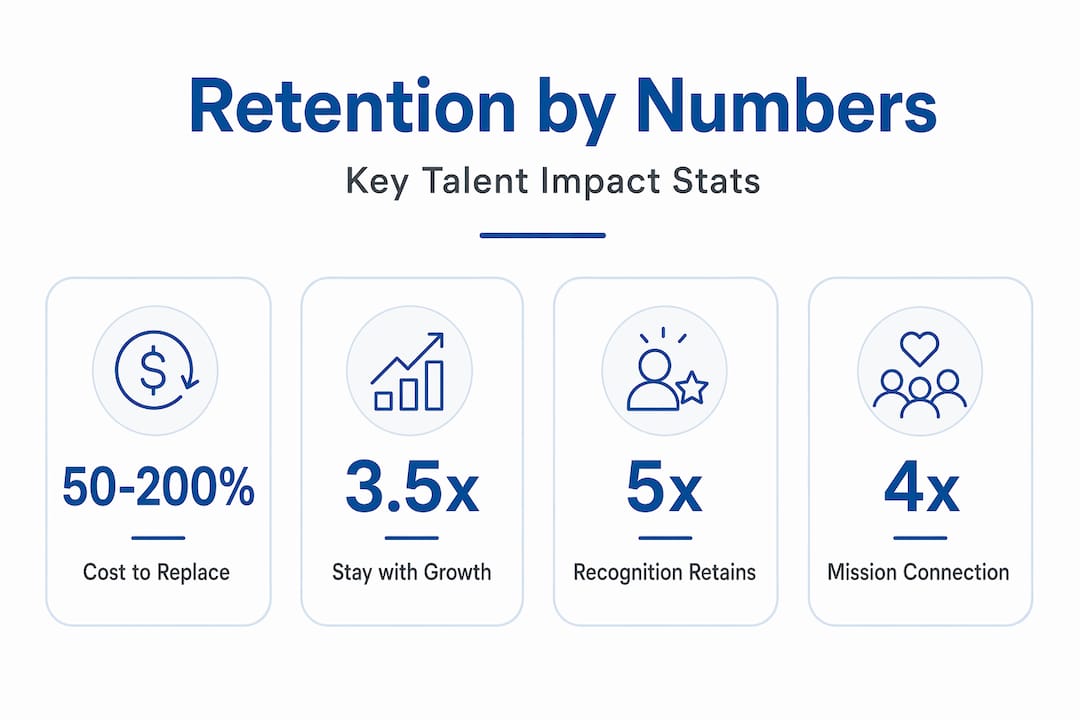
The numbers are difficult to ignore. Replacing an employee costs between 50% and 200% of their annual salary once you account for recruiting fees, onboarding, lost productivity, and the time it takes a new hire to reach full performance. Multiply that across a team of 50 with even moderate turnover, and the financial exposure becomes significant.
At the macro level, U.S. companies spent nearly $900 billion in 2023 replacing employees who voluntarily left. That figure represents more than payroll costs. It reflects lost institutional knowledge, stalled projects, and the compounding effect of institutional memory walking out the door.
Beyond the direct costs, consider what high retention actually enables:
- Faster project delivery because experienced teams require less ramp-up time
- Lower cost-per-hire as internal promotions replace external recruiting cycles
- Stronger client relationships built on continuity and trust
- Competitive advantage from accumulated skills and organizational know-how
The importance of talent retention is not just about saving money. High-retention organizations reinvest what they save on turnover back into development and recognition systems, creating a compounding advantage that low-retention competitors cannot replicate without first fixing the root problem.
Pro Tip: Calculate your organization’s actual annual turnover cost by multiplying your average salary by 100% (a conservative replacement multiplier), then by the number of employees who left in the past 12 months. The resulting number usually changes how leadership views retention budgets.
Non-Financial Drivers of Why Employees Stay or Leave
This is where most retention strategies fail. Leaders over-index on compensation benchmarking and under-invest in the factors that research consistently shows are more decisive. According to data on retention patterns, 37% of workers left their shortest-tenured job because of poor culture, not inadequate pay. Another 30% cited a lack of clear advancement opportunities as a primary factor.
Culture is not a ping pong table or a wellness stipend. It is the daily lived experience of whether an employee feels seen, respected, and included in decisions that affect them. An employee can be fairly compensated and still actively searching for a new role because their manager never acknowledges good work.
The Recognition Multiplier
The data on recognition is striking. Employees who feel their company invests in their skills are 3.5x more likely to stay beyond two years. Employees who receive frequent peer recognition are 5x more likely to stay beyond three years. These are not soft metrics. They represent a measurable, manageable lever that most organizations are not fully using.
Peer recognition programs cost a fraction of what one mid-level departure costs in recruiting fees alone. Yet many organizations still treat recognition as an annual performance review event rather than a continuous practice.
Growth Paths and Emotional Connectedness
The benefits of retaining employees extend beyond what they produce. Long-tenured employees carry institutional knowledge that cannot be documented in a handbook. They mentor newer colleagues, hold client relationships, and stabilize culture during leadership transitions.

Employees emotionally connected to the mission are up to 4x more likely to perform at higher levels. That emotional connection is built through visible career paths, meaningful work, manager relationships, and the sense that the organization is genuinely invested in their future.
Pro Tip: Run a simple quarterly pulse check asking employees three questions: Do you see a future here? Do you feel recognized? Do you have what you need to do great work? The responses will surface risks months before anyone submits a resignation letter.
Strategies for Improving Talent Retention
The best frameworks for how to improve talent retention focus less on adding perks and more on reducing friction and building genuine connection. Here are five evidence-backed approaches:
- Build a community-first retention model. The modern talent retention approach treats employees, alumni, and candidates as a connected community rather than separate audiences. Branded talent communities increase internal mobility rates and create visible growth pathways that reduce turnover risk. When employees see clear movement within the organization, the impulse to look externally weakens.
- Make internal mobility visible. One of the most common employee retention challenges is that open roles go unfilled internally not because the talent doesn’t exist, but because employees never hear about them. Posting roles internally first, with transparent criteria and timelines, signals that growth is a real option rather than a slogan.
- Conduct structured re-recruitment conversations. At 12 months, 24 months, and 36 months of tenure, managers should have a dedicated conversation about the employee’s career ambitions, satisfaction, and what would make them more committed. Most employees do not leave suddenly. They disengage gradually. These conversations catch that drift early.
- Reduce daily friction before adding new perks. Top retention failure often comes from disconnected tools and unclear workflows, not from an absence of free snacks. Audit what slows your team down every day. Fixing those friction points builds more trust and satisfaction than a new benefit that employees interact with quarterly.
- Redefine flexibility beyond remote work. Burnout is driven more by disconnected technology and unclear expectations than by long hours. True flexibility means redesigning meeting structures, clarifying outcome expectations, and giving employees control over how they achieve results rather than just where they work.
| Retention approach | What it addresses |
|---|---|
| Community-first model | Isolation, lack of belonging, weak internal networks |
| Visible internal mobility | Career stagnation, lack of growth perception |
| Re-recruitment conversations | Silent disengagement, unspoken career drift |
| Friction reduction | Daily frustration, tool disconnects, workflow inefficiency |
| Flexible outcome expectations | Burnout, micromanagement, unclear accountability |
For broader context on talent acquisition strategy and how it intersects with retention, understanding the full talent lifecycle helps HR leaders build cohesion between how they hire and how they keep people.
Measuring Retention as a Performance Indicator
You cannot improve what you do not measure. That principle applies to retention more than almost any other workforce metric. The problem is that most organizations track turnover as a lagging indicator, meaning they count who left after it already happened. Organizations that measure what drives retention, rather than just tracking departures, gain a strategic advantage to improve culture and performance before the damage occurs.
The metrics worth tracking fall into three categories:
- Regretted attrition rate: The percentage of departures you genuinely did not want to lose. This separates natural attrition from talent loss that reflects a problem.
- Internal mobility ratio: The share of open roles filled by existing employees. A low ratio signals that growth is not visible or accessible internally.
- Alumni rehire rate: Boomerang hires cost 30-40% less to source, ramp up 2x faster, and bring external perspective back into the organization. Tracking this rate shows how well you maintained relationships post-departure.
Traditional annual engagement surveys are not sufficient. They capture sentiment at one point in time, often months after disengagement has already begun. Continuous measurement methods that correlate engagement signals with retention outcomes give HR leaders early warning before a resignation is submitted.
Careerscape recommends treating retention rate as a leading indicator of culture health, reviewed at the leadership level quarterly alongside financial performance metrics. When retention drops, something in the organization’s culture or operations has shifted. The data exists to find it early.
My Perspective on Retention as a Leadership Priority
I’ve worked with enough organizations to say this plainly: the most persistent talent retention challenge is not a shortage of solutions. It is a shortage of ownership. When retention is treated as HR’s problem alone, it gets managed with surveys and exit interviews rather than with the daily decisions leaders make about how they recognize, develop, and communicate with their people.
What I’ve seen consistently is that the organizations with the strongest retention are not the ones with the best benefits packages. They are the ones where managers genuinely know their people’s career goals and create space for those conversations. The emotional connectedness piece is not a soft concept. It is measurable, predictable, and directly tied to performance outcomes.
The uncomfortable truth is that the biggest misconception in this space is that retention is a compensation equation. Leaders who chase that assumption spend enormous sums on counter-offers and salary adjustments while the actual reasons people leave stay unaddressed. I’ve found that employees who feel valued and included will stay through periods of slower pay growth that would otherwise prompt a search.
If I had one recommendation for HR professionals reading this: get retention onto the executive scorecard. Not as a footnote to the HR update, but as a strategic metric alongside revenue, margin, and customer satisfaction. That shift in visibility changes behavior across every layer of management.
— Chris
How Careerscape Supports Your Retention Strategy
Retention does not start on day 90 of employment. It starts with the quality of the hire. When job fit is strong and expectations are set honestly from the first conversation, employees are far more likely to stay, grow, and perform at the level you need. That is the philosophy behind how Careerscape approaches every placement.
Careerscape offers contract staffing solutions designed to reduce turnover risk by matching your organization with professionals who fit both the role and the culture. For organizations managing workforce fluctuations, project-based staffing gives you access to qualified professionals without the long-term attrition risk of a poor permanent fit. The team at Careerscape also offers workforce advisory support to help leaders build the systems and employer brand needed to retain talent for the long term. If you are ready to improve your talent pipeline and employee fit simultaneously, explore staffing best practices that align recruitment with your retention goals.
FAQ
What Is Talent Retention and Why Does It Matter?
Talent retention refers to an organization’s ability to keep its employees engaged and employed over time. It matters because replacing a single employee costs between 50% and 200% of their annual salary, and high-retention organizations consistently outperform peers financially.
Why Do Employees Leave Despite Competitive Pay?
Pay is rarely the sole or even primary reason employees leave. 37% of workers cite poor culture and 30% cite lack of career growth as key departure factors, both of which outrank compensation in many surveys.
What Metrics Should HR Track to Monitor Retention?
The three most informative retention metrics are regretted attrition rate, internal mobility ratio, and alumni rehire rate. These metrics reveal culture health and career development effectiveness, not just raw headcount loss.
How Does Recognition Affect Employee Retention Rates?
Employees who receive frequent peer recognition are 5x more likely to stay beyond three years, making recognition one of the highest-return retention investments an organization can make.
What Is the Fastest Way to Reduce Turnover Risk?
Start by auditing daily workflow friction and ensuring employees have clear internal mobility paths. Organizations that reduce disconnected tools and clarify outcome expectations see faster retention improvements than those adding benefits without addressing root causes.
Recommended
- What is the talent market? A guide for smarter hiring
- Staffing best practices to boost recruitment and culture
- Why Companies Are Building Employee Connect Sites