
Professional networking outperforms cold job board applications because most positions are filled through personal connections before they're ever publicly posted, making a polished LinkedIn profile, clear elevator pitch, and targeted outreach essential preparation. Informational interviews and strategic use of "moderately weak ties" — former classmates, past colleagues, and alumni connections — are the highest-leverage tactics, as these contacts open doors to new social circles and opportunities that close friends cannot. Job seekers should allocate roughly 60% of their search time to networking and direct outreach, using job boards only as a secondary channel to avoid applicant tracking system filters and application burnout.
In this article
Professional networking for job seekers is the practice of building purposeful relationships with industry contacts to access job opportunities, referrals, and career insights that job boards alone cannot provide. Studies consistently show that the majority of positions are filled through personal connections rather than cold applications. If you know how to network for jobs effectively, you gain access to what recruiters call the “hidden job market,” the pool of roles filled before they are ever posted publicly. Tools like LinkedIn, alumni networks, informational interviews, and targeted email outreach are the primary channels that make this possible.
What Are the Best Tools and Preparations for Job Networking?
Preparation separates job seekers who get responses from those who get ignored. Before you reach out to a single contact, three things need to be in place: a polished LinkedIn profile, a clear personal introduction, and a defined job target.
Your LinkedIn profile is your professional handshake. Every section should reflect concrete achievements, not just job titles. Instead of “managed a team,” write “led a five-person team that reduced client onboarding time by 30%.” A professional LinkedIn photo also matters more than most candidates realize. Profiles with professional headshots receive significantly more connection requests and profile views than those without.

Your personal introduction, sometimes called an elevator pitch, should answer three questions in under 60 seconds: who you are, what you do or want to do, and what kind of role you are targeting. Vagueness kills networking conversations. “I’m looking for something in marketing” tells a contact nothing useful. “I’m a recent communications graduate targeting content strategy roles at mid-size B2B tech companies” gives them something to work with.
Here is a quick overview of the core tools available to you:
| Tool | Best use case | Cost |
|---|---|---|
| Profile visibility, connection outreach, alumni search | Free / Premium | |
| University alumni networks | Warm introductions within your school’s community | Free |
| Career services offices | Employer connections, resume review, mock interviews | Free |
| Email outreach | Direct contact with professionals outside your network | Free |
| Informational interviews | Learning conversations that open doors to referrals | Free |
Pro Tip: Before attending any job networking event or sending any outreach message, update your LinkedIn profile completely. Contacts will search for you immediately after meeting you, and an incomplete profile signals low effort.
How Do You Conduct Informational Interviews to Expand Your Network?
An informational interview is a 20 to 30 minute learning conversation, not a job interview. That distinction is critical. You are asking someone for their time and knowledge, not for a job. Framing it this way reduces perceived risk for the contact and dramatically increases the chance they say yes.
Here is a step-by-step process that works:
-
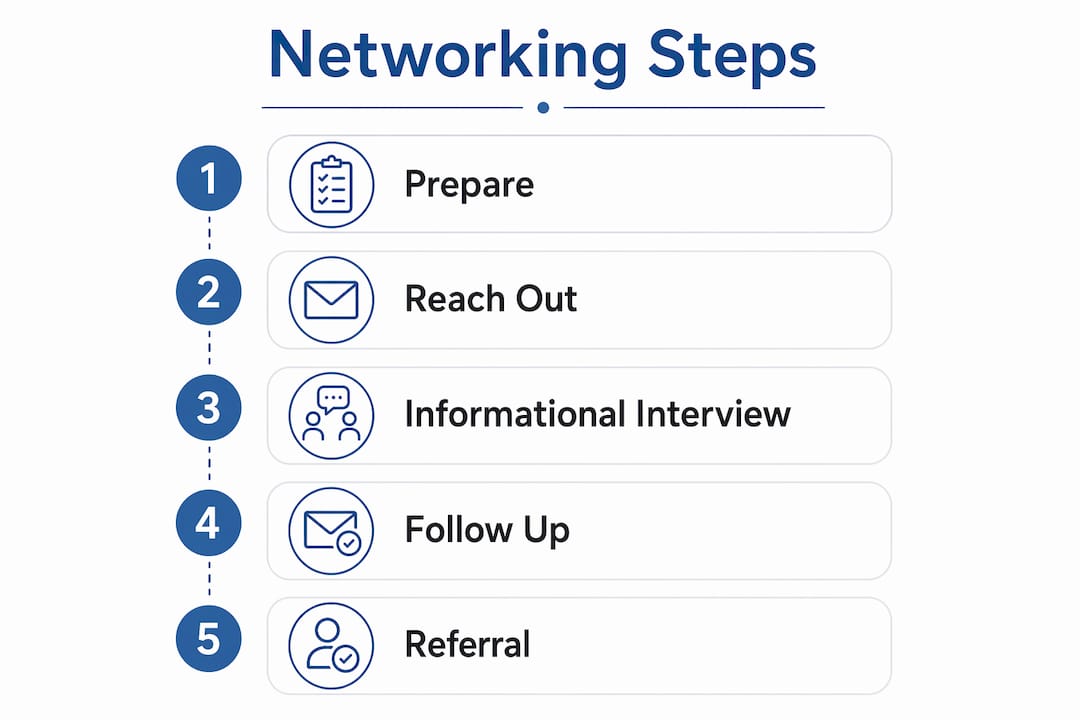
Write a concise outreach message. Introduce yourself in one sentence, explain how you found them, state your specific interest in their work or company, and request a 20 to 30 minute conversation. Keep the entire message under 150 words.
-
Offer specific scheduling options. Offering specific days and times greatly increases positive responses because it removes the scheduling burden from the contact. Include your preferred format, whether that is a phone call, Zoom meeting, or coffee in person.
-
Prepare five to seven focused questions. Ask about their career path, what a typical week looks like, what skills they see as most valued in your target role, and what they wish they had known earlier. Avoid asking them to review your resume during the meeting. That is a separate request.
-
Respect the agreed time. If you scheduled 25 minutes, end at 25 minutes unless they invite you to continue. Professionals remember who respects their time and who does not.
-
Send a thank-you note within 24 hours. A brief, specific email referencing something they said shows you were genuinely listening. Follow it with a LinkedIn connection request that includes a short personalized note.
-
Ask for one next connection. This is the step most job seekers skip. Ending each conversation with a request for one specific next contact compounds your network faster than attending a dozen job networking events. Ask: “Is there one other person you think I should speak with given what I’ve shared about my goals?”
Pro Tip: Treat every informational interview as a research session. Take notes during the call and review them afterward. The specific language professionals use to describe their roles and challenges is exactly the vocabulary you should use in your resume and cover letters.
What Strategies Maximize Referrals and Weak Ties in Job Networking?
The most counterintuitive finding in networking research is that your closest contacts are often the least useful for finding new jobs. A LinkedIn study of 20 million users found that moderately weak ties, defined as connections sharing roughly 10 mutual friends, nearly doubled job change likelihood compared to very weak ties with only one mutual friend. Your close friends already know the same people and opportunities you do. Moderately weak ties connect you to entirely new social circles.
This does not mean you should ignore strong ties. It means you need to actively build and maintain connections with people you know somewhat but not deeply. Former classmates, past colleagues from internships, professors, and contacts from professional associations all fall into this category.
Here is how to put this into practice:
- Reconnect with dormant contacts. Reach out to someone you have not spoken with in one to two years. Reference something specific, a project you worked on together, a class you shared, or a conversation you remember. This reactivation is low-effort and high-return.
- Use alumni networks strategically. Most universities give graduates access to alumni directories. A shared alma mater is a warm introduction by default. Contacts are far more likely to respond when you open with your shared connection to the school.
- Ask for introductions, not just advice. Effective referral requests explain who you are in relation to the contact, specify what you are after, include a credibility point, and end with a specific next step. “Could you introduce me to [Name] at [Company]? I’d love to ask them about their experience in supply chain analytics” is far more effective than “Do you know anyone I should talk to?”
The table below shows how tie strength affects networking outcomes:
| Tie type | Mutual connections | Job mobility impact | Best use |
|---|---|---|---|
| Strong ties | Many (close friends, family) | Low for new leads | Emotional support, references |
| Moderately weak ties | ~10 mutual friends | Highest job change rate | New opportunities, introductions |
| Very weak ties | 1 mutual friend | Low | Broad awareness only |
Balancing your time between nurturing existing relationships and building new moderately weak ties is the core discipline of effective networking strategies for career advancement.
How Should You Balance Networking with Job Board Applications?
Job boards are not the enemy. They are a starting point, not a strategy. Early-career job seekers should spend approximately 60% of their job search time on networking and direct outreach, with the remaining 40% on targeted applications. That ratio prevents the burnout that comes from mass applying to hundreds of roles with no human follow-up.
The most common mistake recent graduates make is treating job boards as their primary channel. They apply to 50 roles in a week, hear nothing back, and conclude the market is impossible. The real problem is that applicant tracking systems filter out a large percentage of cold applications before a human ever sees them. Networking bypasses those filters entirely.
Here is how to structure a productive weekly job search:
- Monday and Tuesday: Identify five to ten target companies. Search LinkedIn for employees in roles adjacent to what you want. Send two to three outreach messages per day.
- Wednesday: Conduct any scheduled informational interviews. Send thank-you notes from previous conversations.
- Thursday: Apply to three to five roles that genuinely match your skills. Tailor each resume to the specific job posting. Do not use a generic resume.
- Friday: Follow up with any contacts at companies where you have submitted applications. A brief message saying you applied and would love to connect takes two minutes and significantly increases your visibility.
Pro Tip: Use job postings as research tools even when you do not apply. The language in a job description tells you exactly what skills and experiences a company values. Use that language in your LinkedIn profile and outreach messages.
Referred candidates have significantly higher hiring rates than cold applicants, which is the clearest argument for prioritizing networking over volume applications. Quality and connection beat quantity every time.
Key Takeaways
Effective job networking combines informational interviews, moderately weak ties, and a 60/40 time split between outreach and applications to maximize hiring outcomes.
| Point | Details |
|---|---|
| Prepare before outreaching | Complete your LinkedIn profile and define a specific job target before contacting anyone. |
| Use informational interviews | Frame requests as 20 to 30 minute learning conversations to increase positive responses. |
| Prioritize moderately weak ties | Connections with roughly 10 mutual friends produce the highest job change rates. |
| End every conversation with a referral ask | Requesting one next contact compounds your network faster than attending multiple events. |
| Balance networking with applications | Spend 60% of job search time on networking and 40% on targeted, tailored applications. |
What I’ve Learned After Years of Watching Job Seekers Network
Most job seekers treat networking as a transaction. They reach out when they need something, ask vague questions, and disappear after the conversation ends. That approach produces mediocre results, and it is completely avoidable.
What I have seen work, consistently, is treating every networking conversation as a genuine learning opportunity. When you approach a contact with real curiosity about their work and career path, the conversation becomes natural. You stop sounding desperate and start sounding like a professional worth knowing. That shift in framing changes everything.
The other thing I cannot stress enough is follow-up. Most job seekers send one message and give up if they do not hear back within three days. Busy professionals miss emails. A polite second message sent one week later, referencing your original note, recovers a significant portion of non-responses. Persistence, done respectfully, is not annoying. It is professional.
The hidden job market is real. A large share of roles are filled through referrals and internal recommendations before they are ever posted. Networking is not a supplement to your job search. It is the core of it. If you want to find your next job faster, build the relationships before you need them.
— Chris
How Careerscape Can Accelerate Your Job Search
Networking opens doors, but sometimes you need a recruiter who already has the keys. Careerscape, connects qualified professionals with companies actively hiring across specialized industries. Whether you are looking for a contract staffing role to build experience quickly or a direct hire position that matches your long-term goals, Careerscape works with employers who are ready to move fast. The firm’s industry-specific approach means your profile reaches hiring managers who understand your background, not just your job title. Explore Careerscape’s talent community to get on the radar of employers before a role is ever posted publicly.
FAQ
What Does “Networking for Jobs” Actually Mean?
Networking for jobs is the practice of building professional relationships to access job opportunities, referrals, and career insights beyond what job boards offer. It includes informational interviews, alumni outreach, LinkedIn connections, and referral requests.
How Do I Start Networking if I Have No Professional Contacts?
Start with your university’s alumni network, former professors, classmates, and anyone you have worked with in internships or part-time roles. A shared school or workplace is a warm introduction by default, and most professionals are willing to speak with someone early in their career.
How Long Should an Informational Interview Be?
An informational interview should be 20 to 30 minutes. Keeping it short and focused respects the contact’s time and increases the likelihood they will agree to meet in the first place.
Are Weak Ties Really More Useful than Close Friends for Job Searching?
Research from a LinkedIn study of 20 million users confirms that moderately weak ties produce the highest job change rates. Close contacts share the same information and opportunities you already have access to, while moderately weak ties open new networks.
How Much Time Should I Spend Networking Versus Applying Online?
Career development experts recommend spending about 60% of job search time on networking and direct outreach, with 40% on targeted applications. This balance prevents burnout and significantly improves your odds of getting a referral.
Recommended
- Job Hunting Strategies 2026: Win the Hidden Market
- Job Posting Optimization: A 2026 Recruiter’s Guide
- The Financial Reality of Job Seekers in 2026 | Careerscape