
Contract employment offers professionals greater schedule flexibility, project variety, and hourly pay rates up to 40% higher than comparable permanent roles, though contractors must self-fund benefits and account for self-employment taxes when evaluating true compensation. Worker classification is a critical legal consideration, as the distinction between contractor and employee affects tax obligations and access to labor protections. Beyond immediate income, contract roles accelerate career growth by exposing professionals to multiple industries and clients, with contract-to-hire conversions offering a low-risk path to permanent employment.
Contract employment is defined as a fixed-term or project-based work arrangement where a professional provides services to a client without becoming a permanent employee. Professionals who choose contract jobs gain control over their schedules, their project selection, and often their earning potential. According to Indeed, flexibility attracts caregivers, multiple job holders, and professionals who need adaptable hours. That flexibility is not a minor perk. It reshapes how work fits into your life. If you are weighing your options, understanding why choose contract jobs is the clearest starting point for making a well-informed career decision.
Why Choose Contract Jobs over Permanent Roles?
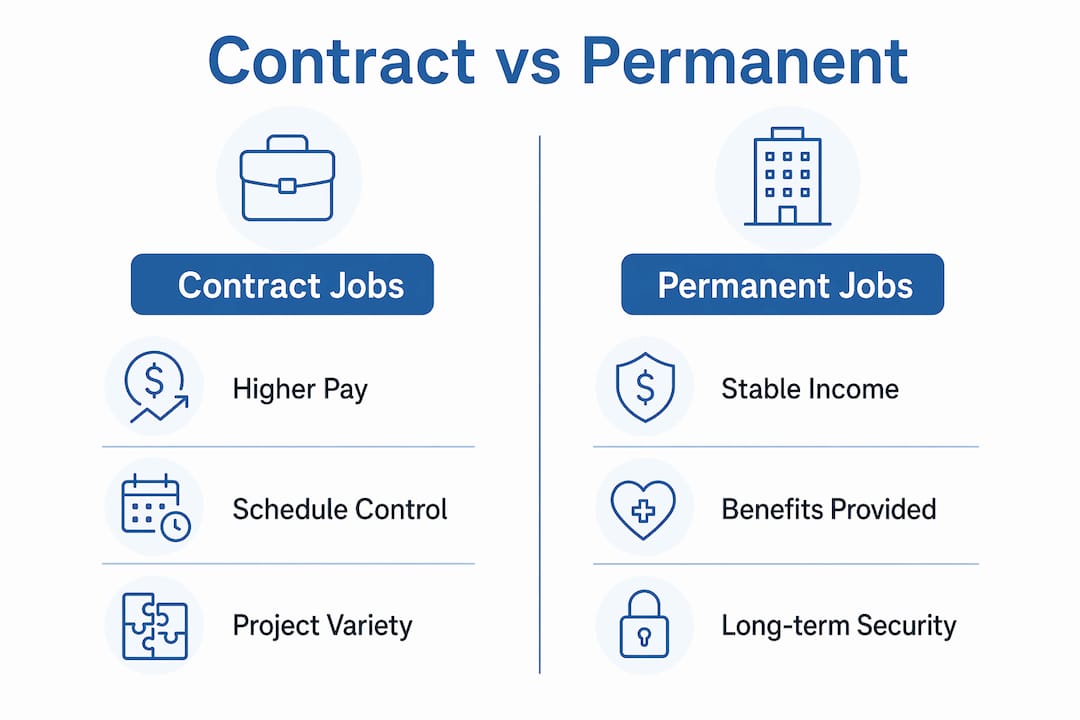
Contract jobs deliver three core advantages that permanent positions rarely match: schedule flexibility, project variety, and higher hourly pay. These are not abstract benefits. They show up in measurable ways across industries like technology, finance, legal services, and construction.
Contract workers select the projects and companies they want to work with, building broader experience than a single full-time role allows. A software engineer who takes three contract assignments in two years may work with a fintech startup, a healthcare platform, and a government agency. That range of exposure is difficult to replicate inside one organization.

The pay difference is real. Contractors typically earn up to 40% more hourly than comparable employees before taxes. That premium exists because clients pay for specialized skills on demand, without the overhead of benefits, payroll taxes, or long-term commitments.
Here is a direct comparison of contract versus permanent job features:
| Feature | Contract jobs | Permanent jobs |
|---|---|---|
| Schedule control | High. Set your own hours and availability. | Low. Fixed schedules set by employer. |
| Project variety | High. Choose clients and industries. | Low. Tied to one organization’s work. |
| Hourly pay rate | Higher. Up to 40% more before taxes. | Lower hourly rate, but stable. |
| Benefits (health, PTO) | Not included. Self-funded. | Included in compensation package. |
| Job security | Project-based. Ends with the contract. | Ongoing unless terminated. |
| Career exposure | Broad. Multiple industries and roles. | Narrow. One company’s culture and scope. |
Pro Tip: Before accepting a contract role, use the Cs-recruiters salary guide to benchmark the hourly rate against industry norms for your role and market.
Industries where contract roles are most common include information technology, engineering, accounting, legal services, and project management. In these fields, companies regularly bring in specialists for defined deliverables rather than building permanent headcount.
How Does Compensation Work for Contractors vs. Employees?
Higher hourly rates do not automatically mean higher total compensation. Contractors must account for costs that employers cover for permanent staff, including health insurance, retirement contributions, and paid time off.
Total compensation modeling is the practice of calculating your real take-home value by factoring in benefits, taxes, and unpaid gaps between contracts. A contractor earning $75 per hour may net less than a salaried employee at $95,000 per year once health premiums, self-employment taxes, and two weeks of unpaid downtime are factored in.
The tax side has a meaningful upside, though. Independent contractors can claim business expense deductions for equipment, home office space, software subscriptions, and travel. These deductions reduce taxable income in ways that W-2 employees cannot access. That advantage can partially offset the cost of self-funded benefits.
Key financial factors to evaluate before accepting a contract role:
- Health insurance cost: Price individual or family coverage through your state marketplace or a professional association.
- Self-employment tax: Contractors pay both the employer and employee portions of Social Security and Medicare taxes.
- Retirement savings: Without an employer match, you fund your own 401(k) or SEP-IRA.
- Unpaid time off: Vacations, sick days, and gaps between projects are all unpaid. Build this into your rate calculation.
- Business expenses: Track deductible costs carefully. They reduce your taxable income dollar for dollar.
Pro Tip: Multiply your target annual income by 1.3 to 1.4 to arrive at the minimum hourly contract rate you need to match a salaried position with full benefits.
What Legal and Classification Issues Do Contract Workers Face?
Worker classification is one of the most consequential legal questions in contract employment. The U.S. Department of Labor’s 2026 proposed rule identifies two core classification factors: the degree of control a company has over how work is performed, and the worker’s opportunity for profit or loss. These factors determine whether you are legally an independent contractor or an employee.
Classification matters because it affects your tax obligations, your access to labor protections, and your eligibility for unemployment insurance. Misclassifying workers as independent contractors when they function as employees creates legal risk for companies and strips workers of protections they are entitled to receive.
The table below summarizes the key factors regulators examine:
| Classification factor | Contractor indicator | Employee indicator |
|---|---|---|
| Work control | Sets own methods and schedule | Directed by company on how and when |
| Profit or loss opportunity | Bears financial risk of the project | Fixed pay regardless of outcome |
| Investment in tools | Provides own equipment and software | Uses company-provided resources |
| Permanency of relationship | Project-based, time-limited | Ongoing, indefinite relationship |
| Integral to business | Specialized, outside core operations | Core function of the business |
In the United Kingdom, agency workers gain equal pay and conditions after a 12-week qualifying period. Workers in agency arrangements must track their contract start dates carefully to know when those protections apply.
Pro Tip: If a client controls your daily schedule, assigns your tools, and integrates you into their core team, your arrangement may legally resemble employment. Consult an employment attorney if you are unsure of your classification.
Understanding your classification before signing a contract protects you from unexpected tax liabilities and ensures you receive the protections you are entitled to under current law.
How Can Contract Jobs Accelerate Long-Term Career Growth?
Contract roles are not a fallback. They are a deliberate career tool for professionals who want to build skills faster, expand their networks, and position themselves for better opportunities. Companies sometimes convert contractors to permanent employees after a successful assignment. That conversion path is one of the most underused advantages of contract employment.
The logic is straightforward. A contract role lets you prove your value in a real work environment before either side commits to a permanent arrangement. Employers reduce their hiring risk. You get a trial period to evaluate the culture, the team, and the long-term fit. Cs-recruiters covers this dynamic in detail in its guide on contract-to-hire benefits.
Recruiters play a central role in connecting contractors to clients and managing transitions between assignments. Building a strong relationship with a specialized recruiter reduces the gap between contracts and keeps your pipeline active.
Strategies to use contract jobs for career advancement:
- Target roles that stretch your skills. Accept contracts that require you to learn something new, not just repeat what you already know.
- Build relationships with every client. Former clients are your best source of referrals and repeat work.
- Document your results. Quantify outcomes from each project. Specific metrics make your resume and LinkedIn profile stand out.
- Work with specialized recruiters. A recruiter who knows your industry can match you with clients faster and negotiate better rates on your behalf.
- Pursue contracts in adjacent industries. Moving from healthcare IT to financial services IT, for example, broadens your market value significantly.
Portfolio careers built on contract work are gaining traction. The concept of fractional and portfolio careers reflects a broader shift where professionals build income and reputation across multiple clients rather than one employer. That model rewards specialists who can deliver results quickly and communicate their value clearly.
Key Takeaways
Contract employment offers higher hourly pay, schedule control, and faster skill development than permanent roles, but requires careful management of taxes, benefits, and legal classification.
| Point | Details |
|---|---|
| Higher pay with trade-offs | Contractors earn up to 40% more hourly but must self-fund benefits and retirement. |
| Total compensation modeling | Always calculate net value including taxes, insurance, and unpaid time before accepting a rate. |
| Legal classification matters | The DOL’s 2026 rule ties contractor status to work control and profit/loss opportunity, not job title. |
| Contract-to-hire pathway | Successful contract assignments frequently convert to permanent offers, making them a low-risk audition. |
| Recruiters accelerate results | Specialized recruiters reduce gaps between contracts and match professionals to better-fit opportunities. |
What I’ve Learned from Watching Professionals Navigate Contract Work
Most professionals who struggle with contract employment make the same mistake: they treat the hourly rate as the whole story. They accept a rate that looks strong on paper, then realize six months in that they are netting less than they did as a salaried employee once taxes, insurance, and downtime are factored in. The math is not complicated, but it requires discipline to run it before signing.
The second pattern I see is underestimating the legal side. Classification is not a technicality. If your client controls your hours, assigns your laptop, and includes you in their org chart, you may be functioning as an employee regardless of what your contract says. The DOL’s 2026 proposed rule makes this clearer, but many contractors still do not read their agreements carefully enough to spot the risk.
What separates professionals who thrive in contract work is intentionality. They choose projects that build toward something. They maintain relationships with two or three recruiters who know their market. They track their results and update their profiles after every assignment. Contract work rewards people who treat it as a business, not just a job. The career development strategies that apply to permanent employees apply here too, but with higher stakes and faster feedback loops.
— Bradford
Cs-Recruiters Connects Professionals to Contract Roles That Fit
Cs-recruiters places qualified professionals in contract roles across technology, finance, legal services, engineering, and project management. The firm’s contract staffing solutions match candidates to clients based on skills, industry experience, and availability, not just job titles. Cs-recruiters works across 29 U.S. markets and maintains active pipelines in high-demand specialties. For professionals who want project-focused placements, the project-based staffing service connects specialists to defined-scope engagements with clear timelines and deliverables. If you are ready to put your skills to work on a contract basis, Cs-recruiters has the industry connections to place you faster.
FAQ
What Is the Main Advantage of Contract Jobs over Permanent Jobs?
Contract jobs offer higher hourly pay, often up to 40% more than comparable permanent roles, along with greater control over your schedule and project selection. The trade-off is that contractors self-fund benefits and manage their own taxes.
Is Contract Work Right for Me if I Want Job Stability?
Contract work suits professionals who are comfortable with project-based timelines and can manage income variability between assignments. Successful contractors maintain active recruiter relationships and a strong professional network to minimize gaps.
How Are Independent Contractors Classified Under U.s. Law?
The U.S. Department of Labor’s 2026 proposed rule classifies workers based on two core factors: the degree of control the company has over the work and the worker’s opportunity for profit or loss. Job title and contract language alone do not determine classification.
Can a Contract Job Lead to a Permanent Position?
Yes. Companies frequently convert contractors to permanent employees after a successful assignment. A contract role functions as a working interview where both sides evaluate fit before committing to a long-term arrangement.
Do Contract Workers Pay More in Taxes than Employees?
Contractors pay self-employment tax, which covers both the employer and employee portions of Social Security and Medicare. However, they can offset this with business expense deductions for equipment, travel, and home office costs that W-2 employees cannot claim.
Recommended
- Contract Staffing Solutions | Careerscape
- Contract-to-hire: Benefits, comparisons, and expert insights
- Contract staffing: A practical guide for employers
- When to Use a Contract PM Instead of a Direct Hire — Careerscape