
Effective media recruiting prioritizes hiring candidates based on editorial judgment, adaptability, curiosity, and AI literacy, while focusing on mission-driven job descriptions rather than tool checklists. Structured interviews should assess communication, problem-solving, and collaboration skills, particularly for hybrid roles, and onboarding should begin before day one with clear, measurable goals for the first 30, 60, and 90 days. Building internal talent and upskilling programs is essential for reducing reliance on external hiring and enhancing retention.
- Prioritize hiring for editorial judgment, curiosity, adaptability, and AI literacy, especially for roles like editors, data journalists, and newsroom engineers.
- Use mission-based job descriptions focusing on outcomes and core responsibilities rather than listing tools or narrow skill checklists.
- Conduct structured interviews across panels with tasks that assess communication, problem-solving, and collaboration skills, particularly for hybrid roles.
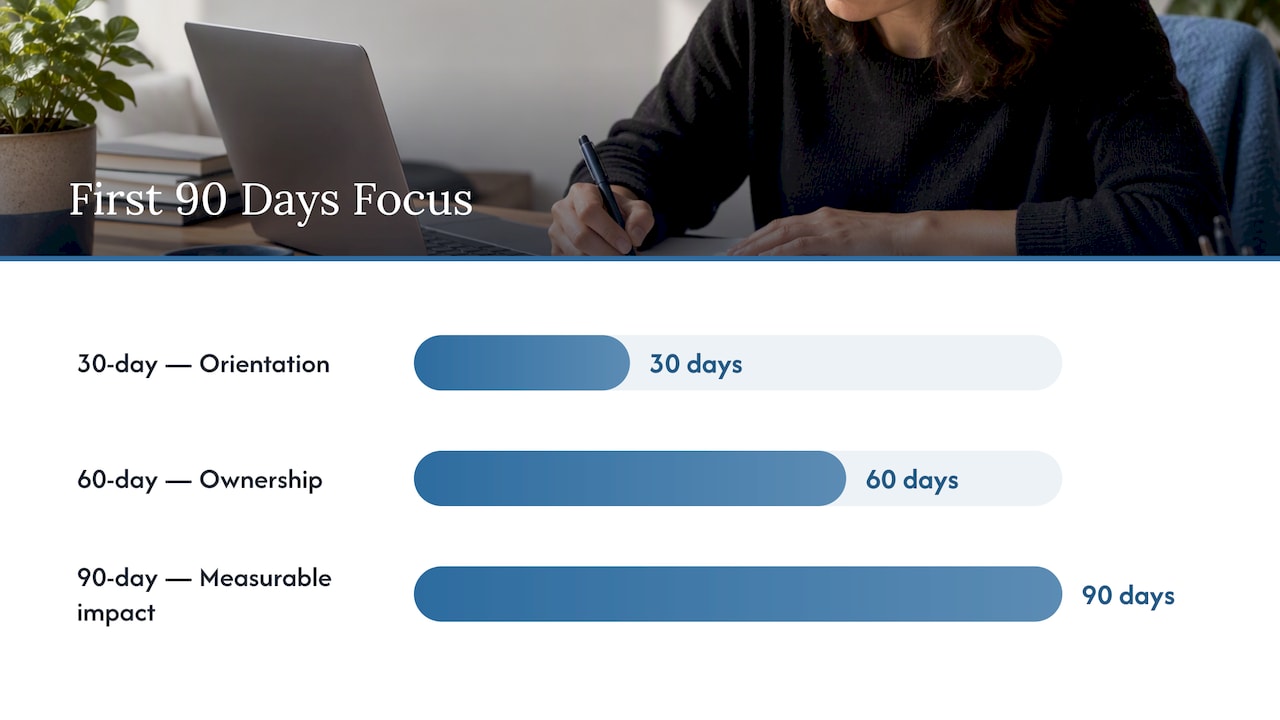
- Implement a 30-60-90 onboarding plan that begins before day one, with measurable goals that ensure new hires integrate quickly and contribute within three months.
- Build internal talent portfolios and foster internal upskilling programs to reduce reliance on external hiring for skills gaps and promote retention.
In this article
The most effective media recruiting strategy hires for editorial fundamentals and mindset first, adaptability, curiosity, and AI literacy, then layers in targeted technical skills through structured onboarding. This approach, backed by industry research and Careerscape’s placement experience, helps newsrooms and media companies build teams that stay productive as tools and workflows keep shifting. The sections below break the process into concrete steps: which roles to prioritize, how to write job postings that attract the right candidates, how to interview for judgment rather than just tool knowledge, and how to onboard specialists so they contribute fast.
Which media roles to prioritize and why
Not every open role deserves equal urgency. Media organizations should prioritize positions where talent gaps are widest and business impact is highest, then work outward from there.
Publishers report acute difficulty filling technical and hybrid roles. Survey data from the Reuters Institute found that many publishers struggle to attract and retain engineering and data-science talent, with the sharpest gaps showing up in those two areas. That scarcity should shape hiring order: fill the roles that are hardest to backfill later, not the ones that feel most familiar to recruit.
Priority roles typically include:
- Editors who can direct coverage while evaluating AI-assisted drafts and flagging accuracy issues.
- Data journalists who combine reporting instincts with the ability to clean and interpret datasets.
- AI or content strategists who translate emerging tools into editorial workflows.
- Producers who manage multi-platform output under tight deadlines.
- Audio and video specialists who understand both storytelling and the technical pipeline behind it.
- Newsroom engineers who build and maintain the systems everyone else depends on.
Deciding between a hybrid hire and a narrow specialist depends on team size and workload. A smaller newsroom often gets more value from one hybrid editorial-technical hire than from two specialists who each cover half the job. Larger organizations, or those running complex data projects, tend to need dedicated specialists working alongside editorial staff rather than one person stretched across both worlds.
How to write job descriptions and source media talent
A job posting that lists twelve software tools tells candidates you are hiring for a checklist, not a person. Media roles change too fast for that approach to work, so the stronger structure leads with mission and outcomes, not tool inventories.
Structure each posting around four elements:
- The mission: what this role exists to accomplish for readers, viewers, or the business, not just a list of duties.
- Core duties: the recurring responsibilities that define a typical week.
- Measurable outcomes: what success looks like at 90 days and at one year.
- Required versus nice-to-have skills: separate what a candidate must already have from what they can learn on the job.
Industry guidance backs this shift. Analysis published by InPublishing argues that hiring strategies should prioritize adaptability, curiosity, and over narrow tool mastery, since specific tools tend to become obsolete quickly. A candidate who learned three AI writing assistants in the past year signals learning agility that matters more than which assistant they happen to know today.
Sourcing follows the same logic. Journalism associations, civic tech communities, and data journalism meetups tend to surface candidates who already think in hybrid terms. Industry conferences and targeted outreach to specific bylines or portfolios often outperform generic job board postings, especially for data and AI-adjacent roles where the qualified pool is smaller.
Pro Tip: Ask candidates to describe a time they had to learn a new tool under deadline pressure. The answer reveals learning agility faster than any tools checklist.
Evaluating editorial and technical fit in interviews
A repeatable evaluation framework beats a gut-feeling interview every time, especially for hybrid roles where editorial and technical skills both matter. Structure assessments around three pillars: editorial craft, problem-solving mindset, and collaboration.
Editorial craft covers judgment, accuracy, and voice, the things a portfolio review and a timed writing or editing exercise reveal quickly. Problem-solving mindset covers how a candidate approaches ambiguity, including AI-related trade-offs. Collaboration covers how well someone works across editorial, product, and technical teams, which matters more in hybrid newsrooms than in traditional siloed ones.
Guidance from the Lenfest Institute recommends mixed interview panels, pulling from editorial, product, and technical teams, paired with a structured interview guide so every candidate gets evaluated on the same criteria. That combination reduces bias and gives hiring managers a clearer signal than a single editor’s impression.
Sample tasks that work well:
- Ask candidates to explain a technical concept like fine-tuning versus retrieval-augmented generation in plain language, testing communication as much as knowledge.
- Give a short editing exercise with an AI-generated draft and ask the candidate to flag accuracy risks.
- Run a scenario question about disagreeing with a teammate over a data interpretation.
Publishers report especially acute talent gaps in data-science (52%) and engineering (55%) roles, according to the Reuters Institute, which is exactly why a fair, structured rubric matters. When the pool is thin, a bad interview process costs you candidates you cannot easily replace.
Onboarding and first-90-day integration for specialized hires
A strong hire who lands in a vacuum stalls out fast. Onboarding for editorial-technical roles needs to start before day one and continue through a structured 30-60-90 window.
- Preboard with a project brief. Give the new hire a focused first project, system access, and an assigned internal partner before their start date.
- Set 30-day goals around orientation. The hire should understand workflows, meet key stakeholders, and ship one small, visible output.
- Set 60-day goals around ownership. The hire takes on a defined piece of a larger project with regular check-ins.
- Set 90-day goals around measurable impact. A published piece, a working dashboard, or an integrated workflow that demonstrates value.
- Integrate into existing sprint cycles, rather than letting the hire operate as a standalone experiment.
This structure follows guidance from the Lenfest Institute, which recommends preboarding project plans, assigned partners, and mapping new hires into existing sprint cycles to avoid friction. The same research found that hires who plugged into external communities, industry demos, and peer networks reached productivity faster and reported less isolation than those left to work alone.
Avoiding what practitioners sometimes call an “innovation island” matters most for AI and data roles, where a specialist hired to modernize a workflow can easily end up isolated from the team they are meant to support.
Pro Tip: Schedule the new hire’s first cross-team meeting in week one, not month one. Early visibility prevents the isolation that derails specialized hires.
Retention and developing internal talent portfolios
Hiring externally every time a skill gap opens is expensive and slow. A talent portfolio tracks what skills your current staff already has, what they are building toward, and where the gaps sit, giving you a map for internal moves before you post an external req.

Guidance on this approach recommends creating internal “skills academies” that redeploy existing staff into emerging roles rather than defaulting to a new hire every time, a practice covered by InPublishing. That reduces both the pressure on external recruiting and the risk of losing institutional knowledge.
Practical levers that support retention:
- Structured upskilling programs that give staff dedicated time to learn adjacent skills, not just optional evening courses.
- Mentoring pairs that connect technical specialists with editorial staff and vice versa.
- Short secondments that let someone try a hybrid role for a defined period before committing.
- Compensation and recognition tied to skill growth, so upskilling has a visible payoff.
A talent portfolio only works if someone owns updating it. Assign that responsibility explicitly, or it becomes a document nobody checks after the first quarter.
A compact recruiting checklist: timeline, approvals, and costs
Media hiring moves fastest when everyone knows the checkpoints in advance. A typical requisition-to-offer process runs through the same core steps regardless of role, though hybrid and specialist positions tend to take longer at the sourcing and interview stages.
- Requisition approval. Confirm budget, reporting line, and whether the role is direct hire or contract before posting.
- Job posting and sourcing. Combine a mission-led posting with targeted outreach through industry communities and events.
- Screening and interviews. Run a structured panel covering editorial craft, problem-solving, and collaboration.
- Reference and portfolio review. Verify past work samples, particularly for data and technical hybrids.
- Offer and approval gates. Route through compensation banding and any executive sign-off required for senior or newly created roles.
- 30/60/90 launch checklist. Confirm preboarding materials, assigned partners, and first-project scope are ready before the start date.
Budget for common cost items beyond salary: recruiting or agency fees, background checks, and any relocation or contract-to-hire conversion costs. Building these checkpoints into a shared timeline keeps hiring managers, finance, and HR aligned instead of discovering gaps mid-process.
Building an employer brand that attracts top media talent
Candidates researching a media employer look past the job posting to see how the organization actually treats editorial and technical work. An employer brand for media roles needs to show, not just claim, that the newsroom takes both craft and modernization seriously.
That starts with visibility. Publishing behind-the-scenes accounts of how a data project came together, or how an editorial team adopted a new workflow, tells candidates more than a mission statement ever could. Employee voices carry particular weight here: a data journalist or newsroom engineer talking honestly about their own work on a panel or in a company blog post does more to attract peers than polished recruiting copy.
Consistency matters as much as content. If a company’s public messaging emphasizes innovation but its job postings still read like a decade-old tool checklist, candidates notice the mismatch and often self-select out. Aligning careers pages, social presence, and actual day-to-day practice closes that gap.
Reputation among past hires travels fast in media circles, which tend to be small and interconnected. A newsroom known for onboarding specialists well and integrating them into real work, rather than parking them on side projects, builds a recruiting advantage that compounds over time. That reputation is earned through the onboarding and retention practices covered earlier in this guide, not manufactured through marketing alone.
Leveraging professional networks and media industry events for recruiting
Some of the strongest media hires never see a public job posting. They get referred through a professional network or spotted at an industry event where their work is already on display.
Journalism associations, data journalism meetups, and civic tech communities remain reliable sourcing grounds, particularly for hybrid roles where the qualified pool is small and concentrated. These spaces let hiring managers see actual work, panel talks, published projects, open-source contributions, before ever extending an interview invitation.
Industry conferences serve a dual purpose: they are sourcing grounds and employer branding opportunities at once. A hiring manager who speaks on a panel about how their newsroom integrated AI tools into editorial workflows is doing recruiting work even without mentioning an open role.
Targeted outreach works better than broad posting for niche technical roles. Reaching out directly to someone whose byline or portfolio shows the exact hybrid skill set you need, rather than waiting for them to find a job board listing, tends to surface stronger candidates faster. This mirrors a broader shift in media relations, where research from Cision’s State of the Media report found that relevance and personalization are what earn a response, whether the outreach concerns a pitch or a hiring conversation.
Measuring and analyzing recruiting metrics specific to media roles
You cannot improve a hiring process you are not measuring, and media recruiting has a few metrics that matter more than the generic HR dashboard suggests.
Time-to-fill deserves special attention for data and AI-adjacent roles, where the qualified pool is thin and a slow process loses candidates to competitors. Track it separately for specialist roles versus general editorial roles, since averaging them together hides the real bottleneck.
Cost-per-hire should include sourcing spend on niche channels like industry events or specialized job boards, not just standard job board fees, since those channels often carry a real cost but also a real return for hard-to-fill roles.
Retention rate at 90 days and one year tells you whether onboarding is working. A pattern of specialists leaving within the first year usually points to integration problems, the “innovation island” effect, rather than a hiring mistake.
Quality-of-hire signals, such as manager satisfaction scores at 90 days or whether a hire’s first project shipped on schedule, connect the recruiting process to actual outcomes rather than just speed.
Track these metrics by role category, not as one blended number. A newsroom filling five reporter roles and one data engineering role in a quarter learns very little from an average time-to-fill across both, since the two processes rarely move at the same pace.
Diversity and inclusion strategies tailored for media recruitment
Media coverage shapes public understanding, which makes newsroom composition a direct editorial concern, not just an HR metric. Diversity strategies for media recruitment work best when they are built into the sourcing and evaluation process rather than treated as a separate initiative.
Sourcing from a wider range of journalism programs, community media organizations, and regional outlets, rather than relying on the same handful of national programs, expands the candidate pool beyond who already has an inside connection. Partnering with journalism associations that focus on underrepresented groups extends that reach further.
Structured interview rubrics, the same ones recommended for evaluating editorial and technical fit, also reduce bias by ensuring every candidate answers comparable questions and gets scored against the same criteria rather than an interviewer’s informal impression. Mixed interview panels help here too, since a single perspective evaluating “culture fit” often reproduces the newsroom’s existing composition rather than expanding it.
Pay equity reviews matter as much as sourcing. A newsroom that recruits a diverse slate of finalists but offers inconsistent compensation across similar roles undermines its own goals and risks losing candidates during negotiation. Tracking retention and promotion data by demographic category, not just hiring numbers, shows whether inclusion efforts are working past the offer stage.
Navigating legal and compliance considerations in media hiring
Media hiring carries the same core legal obligations as any employment process: consistent, documented criteria; compliant background checks; and clear record-keeping on how decisions were made. These obligations apply whether a role is a staff reporter position or a contract-based technical hire, and they matter more, not less, as interview processes add structured rubrics and panel scoring.
Contract and freelance arrangements, common for project-based media work, carry their own classification rules that vary by role and jurisdiction. Getting the classification right at the outset avoids costly corrections later, particularly for organizations running frequent project-based or shift-based staffing.
Because employment law varies by state and by role type, media employers should confirm current requirements with legal counsel or a qualified HR advisor rather than relying on general industry practice alone.
A recruiter’s view on hiring for media roles
The most common mistake organizations make is writing a job description for the role they had two years ago, then wondering why candidates with the skills they actually need do not apply. The fix is not a longer tool list. It is hiring for adaptability and judgment first, then building the technical layer through onboarding and mentoring rather than expecting a finished product on day one. Careerscape’s industry-specialized recruiters see this pattern repeatedly across media clients and structure searches around it.
— Bradford
How Careerscape can help you fill media roles
Matching the right service to the hiring scenario saves time. A senior editor or newsroom leadership role often fits Direct Hire, where the goal is a permanent, well-vetted placement. A short-term data journalism project or a pilot AI workflow often fits Contract Staffing, letting you test the role’s shape before committing to a permanent line. Organizations scaling a new content vertical or hiring in volume across multiple markets can lean on RPO Services to manage the full pipeline.
The recruiting process centers on pre-screened candidates matched for fit and longevity, with results-based pricing and no upfront fees. Reach out to talk through your open role and see how a specialized recruiter can move your search faster.
FAQ
What is the best way to recruit editorial and technical hybrid roles?
Prioritize adaptability, curiosity, and AI literacy over narrow tool experience, since publishers report the widest talent gaps in data-science and engineering, according to the Reuters Institute. Pair that hiring standard with structured onboarding so the hire becomes productive quickly rather than stalling in isolation.
How long should onboarding take for a specialized media hire?
A 30-60-90 day plan works well: orientation and a small visible output by day 30, ownership of a defined project by day 60, and a measurable outcome like a published piece or working dashboard by day 90. This structure follows onboarding guidance from the Lenfest Institute.
Should media companies build AI skills internally or hire externally?
Both, depending on the gap. Building an internal talent portfolio and upskilling program reduces future external hiring pressure, an approach recommended by InPublishing, while external hires still make sense for entirely new capabilities the current team lacks.
What should a media job posting emphasize besides required skills?
Lead with the role’s mission and measurable 90-day and one-year outcomes, then separate required skills from nice-to-have ones instead of listing every tool. This structure attracts candidates with strong learning agility, which matters more than current tool mastery given how quickly media tools change.
How should media companies evaluate AI fluency in interviews?
Ask candidates to explain a technical concept, such as fine-tuning versus retrieval-augmented generation, in plain language rather than only testing which tools they have used. Mixed panels drawing from editorial, product, and technical teams, using a shared structured guide, give a fairer read on both fluency and communication.
Recommended
- Social Media Manager Recruiters — Strategy & Community
- Steps to Effective Job Posting for Recruiters in 2026
- 9 Proven Ways to Attract Top Talent in 2026