
Most executives assume that hiring at the senior level is simply a more intense version of their standard recruitment process. Post a job description, screen resumes, run a few interviews, and extend an offer. That assumption is expensive. Failed executive hires cost organizations an estimated 213% of the role’s annual salary when you factor in lost productivity, severance, and the time required to restart the search. Executive search is a fundamentally different discipline, built for a different kind of hire. This guide breaks down exactly what it is, how it works, and how to use it to secure the leadership talent your organization actually needs.
Table of Contents
- What is executive search?
- How does the executive search process work?
- Why companies choose executive search
- Selecting an executive search partner: What to look for
- The real value of executive search: Beyond filling roles
- Elevate your leadership recruiting with Careerscape
- Frequently asked questions
Key Takeaways
| Point | Details |
|---|---|
| Specialized recruitment | Executive search targets senior leadership and C-suite roles, not general hiring. |
| Strategic process | Executive search uses a multi-step, consultative approach for high-impact placements. |
| Value beyond hiring | Choosing the right search partner shapes company leadership and long-term outcomes. |
| Partner selection matters | Vetting and aligning with a specialized firm drives better executive hiring results. |
What Is Executive Search?
Executive search is a specialized recruitment service focused on identifying and placing senior leadership talent, typically at the C-suite, VP, and board level. Unlike standard recruitment, executive search is proactive, confidential, and highly targeted. Firms engaged in this work are not waiting for candidates to apply. They are actively mapping the market, engaging passive leaders, and qualifying talent against a precise set of criteria defined by your organization.
The distinction matters because senior leadership talent behaves differently than mid-level candidates. Most of the best people for a CEO, CFO, or SVP role are currently employed, performing well, and not actively looking. Traditional job postings simply will not reach them. Executive search bridges that gap by building direct, consultative relationships with leaders who are often invisible to conventional hiring channels.
Typical roles targeted by executive search firms include:
- Chief Executive Officer (CEO)
- Chief Financial Officer (CFO)
- Chief Operating Officer (COO)
- Chief Human Resources Officer (CHRO)
- Chief Technology Officer (CTO)
- Board Directors and Independent Board Members
- Senior Vice Presidents and General Managers
- Division Presidents and Managing Directors
Here is how executive search compares to traditional recruitment at a glance:
| Factor | Executive search | Traditional recruitment |
|---|---|---|
| Engagement model | Retained (fee paid upfront) | Contingency (fee paid on placement) |
| Candidate type | Primarily passive leaders | Primarily active job seekers |
| Search depth | Deep, targeted research | Broad database sourcing |
| Confidentiality | High; discreet outreach | Low; public job postings |
| Timeline | 8 to 12 weeks average | 2 to 6 weeks average |
| Assessment rigor | Structured, competency-based | Resume and interview screening |
| Best for | C-suite, board, senior VP | Mid-level, high-volume roles |
Pro Tip: If your open role directly influences company strategy, P&L accountability, or cultural direction, default to executive search rather than contingency recruitment. The upfront investment is substantially lower than the cost of a mis-hire at that level.
How Does the Executive Search Process Work?
Understanding the mechanics of executive search services removes uncertainty and helps your internal team collaborate more effectively with the search partner. The process is methodical, confidential, and iterative. It is not a single transaction but a structured engagement with defined phases.
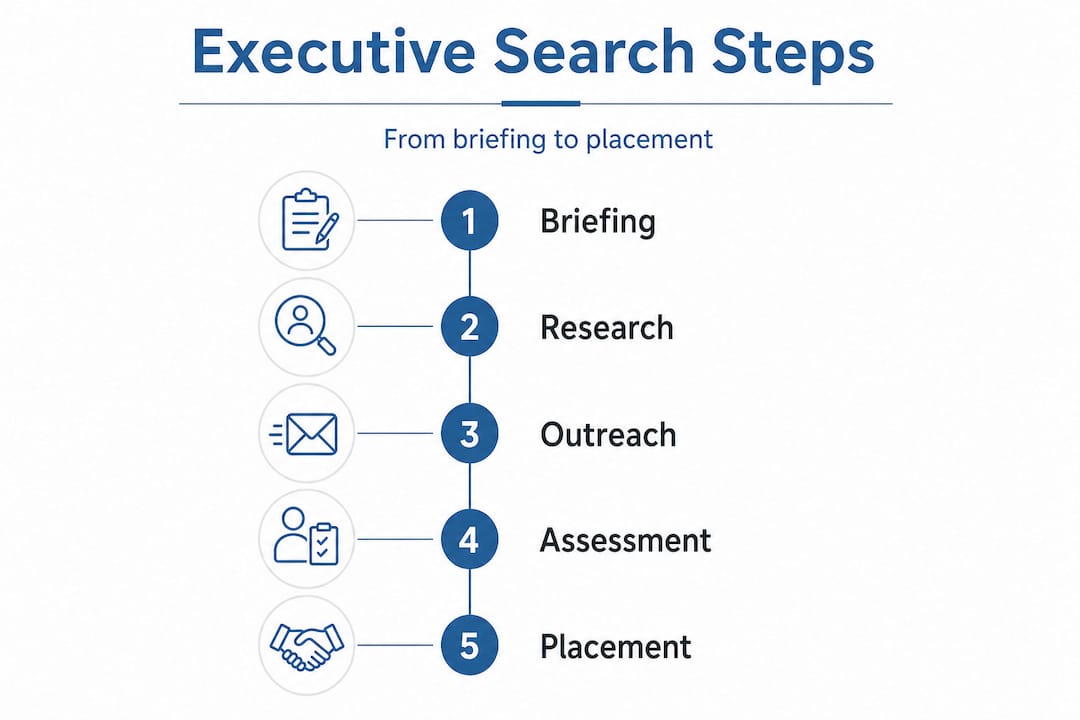
The typical executive search process follows these steps:
-
Client briefing and position specification. The search firm conducts an in-depth discovery session with key stakeholders. This surfaces not just the technical requirements of the role but also leadership style preferences, cultural fit criteria, and the strategic context driving the hire.
-
Market mapping and research. Researchers build a targeted map of qualified candidates across relevant organizations, industries, and geographies. This phase identifies who exists in the market, not just who is available.
-
Candidate identification and outreach. Confidential, personalized outreach is made to individuals identified through research. This is where the passive candidate pipeline is activated. Most of the best candidates at this level are reached only through direct, trusted introductions.
-
Screening and competency assessment. Executive search involves in-depth screening, passive candidate outreach, and strategic leadership assessment. Candidates are evaluated against the position specification using structured interviews, behavioral frameworks, and leadership competency models.
-
Shortlist presentation. A curated shortlist of typically three to five highly vetted candidates is presented to the hiring organization, along with detailed profiles, assessment summaries, and market context.
-
Client interviews and evaluation. The hiring team conducts structured interviews. The search partner helps design interview frameworks to ensure consistent, bias-reduced evaluation across all finalists.
-
Reference checks and background verification. Senior-level reference checks go beyond standard verification. They probe leadership impact, decision-making style, and how past peers and boards experienced the candidate.
-
Offer negotiation and onboarding support. The search partner facilitates compensation benchmarking, offer structuring, and often supports early onboarding to protect candidate retention.
| Phase | Key output | Typical duration |
|---|---|---|
| Briefing and research | Position specification, target list | Week 1 to 2 |
| Outreach and screening | Qualified candidate pipeline | Week 2 to 5 |
| Assessment and shortlist | Candidate profiles, ranking | Week 5 to 7 |
| Client interviews | Finalist selection | Week 7 to 9 |
| Offer and close | Signed offer, start date confirmed | Week 9 to 12 |
Pro Tip: The most successful executive searches happen when the client organization treats the search partner as a strategic advisor, not a vendor. Share real context about culture, performance expectations, and any sensitivities around the departure or transition. Transparency at the briefing stage compresses time-to-fill and improves shortlist quality significantly.
Why Companies Choose Executive Search
Forward-thinking organizations do not use executive search because it sounds prestigious. They use it because executive search is essential when filling mission-critical leadership roles that impact company direction. There is a measurable business case behind every well-run search.
The most compelling reasons companies engage executive search firms include:
- Access to passive candidates. The highest-performing executives are rarely on job boards. Executive search firms maintain deep networks and can approach talent that your internal team cannot reach through conventional sourcing.
- Confidential replacement. When an incumbent is still in the role or when the departure needs to remain undisclosed, executive search provides the discretion that protects your organization’s reputation and operations.
- Speed without sacrificing quality. A dedicated search firm running a focused engagement moves faster than an internal HR team managing multiple priorities simultaneously. The structured process reduces decision fatigue and shortens time-to-fill for senior roles.
- Reduced risk of mis-hire. The combination of deep candidate assessment, structured scorecards, and thorough reference verification significantly lowers the probability of a costly placement failure.
- Market intelligence. A good executive search partner provides real-time intelligence on compensation benchmarks, talent availability, and competitive positioning that informs both the search and your broader talent strategy.
“The return on investment from executive search is not just the candidate placed. It’s the candidates avoided. A disciplined search process filters out impressive-sounding leaders who would have been wrong for the role, the culture, or the moment.”
Executive search delivers specialized expertise across specific business situations where standard hiring simply cannot perform. Those situations include:
- Succession planning. When an organization is preparing for a CEO or CFO transition, search begins long before a vacancy exists. Building a proactive pipeline ensures continuity.
- Turnaround leadership. Companies navigating financial restructuring, performance recovery, or post-merger integration need leaders with a precise and rare skill set. Identifying them requires a targeted search, not a job posting.
- New market or vertical expansion. Entering a new geography or industry requires leaders with direct, credible experience in that space. Industry-focused recruiting ensures you are not taking a chance on general leadership talent in specialized terrain.
There are situations where executive search is not the right tool. Filling high-volume roles, mid-management positions, or roles with a large active candidate pool does not require the cost or timeline of a retained search. Knowing where to apply the tool is as important as knowing what it does.
Selecting an Executive Search Partner: What to Look For
The quality of your executive search outcome depends heavily on the firm you choose. Choosing a specialized partner ensures alignment with your industry and leadership needs. Not all executive search firms are built equally, and the vetting process matters.
Must-have qualities in an executive search partner:
- Industry expertise. A firm that has placed leaders in your sector understands your competitive landscape, talent pool, and the specific competencies your roles demand. Generic search capability is not enough for specialized industries.
- Demonstrated track record. Ask for placement history, retention rates at the 12-month and 24-month marks, and references from companies that hired for roles similar to yours.
- Confidentiality protocols. Understand exactly how the firm protects your brand, the identity of the role, and the candidates under consideration. Weak confidentiality can damage incumbent relationships and alert competitors.
- Network depth over network size. A large database of contacts is less valuable than deep, trusted relationships with senior leaders who actually respond. Ask how the firm sources its candidates and what its outreach response rates look like.
- Transparent methodology. You should be able to see and evaluate the firm’s search process, assessment criteria, and reporting cadence. Black-box recruiting at the executive level is a red flag.
- Alignment on timeline and communication. Establish expectations upfront regarding update frequency, milestone reporting, and how the firm handles search challenges or pivots.
Red flags to watch for:
- Inability to provide references from past executive clients
- Vague or inconsistent answers about sourcing methodology
- No clear process for assessing culture fit alongside technical qualifications
- Transactional or sales-heavy first conversation rather than a diagnostic one
- Over-reliance on their existing database without committing to active market research
Pro Tip: During your initial consultation, ask the firm: “Walk me through a search that did not go as planned. What happened and what did you do?” Their answer will reveal more about their integrity and capability than any success story they volunteer. Strong partners are candid about challenges.
Investing time in evaluating advisory consulting approaches during the selection phase also pays dividends. The best executive search firms act as thought partners, bringing industry-aligned recruiters and market insight to the engagement from day one.

The Real Value of Executive Search: Beyond Filling Roles
Here is a perspective most executive search guides skip: the placement is not the finish line. It is a milestone. Organizations that treat executive search as purely transactional, a role filled and a check issued, consistently underperform compared to those that treat it as a leadership infrastructure investment.
Think about what a single senior leadership hire actually changes. The right CFO does not just manage the books. She restructures capital allocation, attracts investor confidence, and reframes how the board thinks about risk. The right CHRO does not just manage HR operations. He reshapes culture, accelerates talent development, and becomes the internal face of organizational change. The impact of these hires radiates outward for years.
When executive search is treated transactionally, the briefing is shallow, the assessment is compressed, and the focus narrows to filling the seat as quickly as possible. The result is often a technically qualified leader who is misaligned with the organizational moment or culture. Those mis-hires are particularly painful in sectors like financial services leadership, where a mismatched executive can destabilize client relationships, regulatory standing, and team cohesion simultaneously.
The uncomfortable truth is that many organizations engage executive search after they have already failed. They post a role internally, run a half-hearted process, make the wrong hire, and then call a search firm six months later when the damage is visible. That reactive posture is avoidable. The companies winning the talent competition at the senior level treat executive search as a proactive, ongoing capability, not a break-glass emergency response.
The real deliverable of a well-run executive search is not a name on an org chart. It is organizational confidence. Confidence that the person leading a critical function was identified through a rigorous, market-wide process. Confidence that you know who else is in that talent market and what you paid to attract your hire. Confidence that the search partner who guided the process understands your business well enough to add value on the next search too. That is the standard worth holding executive search partners to.
Elevate Your Leadership Recruiting with Careerscape
Careerscape was built on a straightforward premise: executive and specialized hiring should be fast, honest, and led by people who genuinely understand your industry. If your organization is ready to move on a critical leadership role or build a more strategic approach to senior hiring, Careerscape’s team is ready to help. From executive search solutions for C-suite and VP-level roles to contract staffing options for project-based leadership needs, Careerscape brings depth, discretion, and industry-specific knowledge to every engagement. Explore specialized recruitment services and connect with a Careerscape advisor to discuss your next critical hire.

Frequently Asked Questions
What Types of Roles Are Executive Search Firms Best Suited to Fill?
Executive search firms target senior leadership roles such as CEO, CFO, board members, and other C-suite or VP-level positions where passive candidate access and deep assessment are required.
How Long Does an Executive Search Process Usually Take?
The executive search process typically spans 8 to 12 weeks, though role complexity, geographic scope, and market conditions can extend or compress that timeline.
How Is Executive Search Different from Contingency Recruiting?
Executive search involves in-depth screening, passive candidate outreach, and strategic leadership assessment, while contingency recruiting is faster and more transactional, drawing primarily from active job seekers.
What Questions Should Companies Ask When Vetting Executive Search Firms?
Ask about their industry-specific placement history, assessment methodology, confidentiality protocols, and request references. Choosing a specialized partner with direct experience in your sector is the single most reliable indicator of a strong outcome.
Recommended
- What is the talent market? A guide for smarter hiring
- Executive Search & C-Suite Recruiting | Careerscape
- Types of recruitment agencies: A smarter hiring guide
- Staffing best practices to boost recruitment and culture