
The cost of hiring has never been higher, and the timeline has never been longer. Cost-per-hire for executives has surged 113% since 2017, and the average time-to-fill now hovers around 44 to 45 days. Yet many organizations still treat HR as a back-office function, processing paperwork and scheduling interviews rather than shaping business outcomes. That mindset is costly. This guide explores how HR has evolved from process management to strategic talent architecture, covering evidence-backed frameworks, modern best practices, and actionable steps you can apply immediately.
Table of Contents
- How HR leads the structured hiring process
- Structured vs. unstructured interviews: Predictive outcomes and best practices
- Why skills-based, data-driven hiring is redefining HR’s mission
- Balancing technology and human judgment: AI’s impact on hiring
- The uncomfortable truth most experts won’t tell you about HR’s hiring influence
- Connect with specialized HR hiring solutions
- Frequently asked questions
Key Takeaways
| Point | Details |
|---|---|
| Structured hiring matters | A step-by-step HR-led process reduces mis-hires and aligns talent to business needs. |
| Interview method is key | Structured interviews consistently outperform unstructured ones in predicting candidate success. |
| Skills over credentials | Modern HR focuses on skills and data-driven decision making, not just resumes and degrees. |
| AI accelerates hiring | AI-driven tools cut time-to-hire, but human oversight is critical for fit and compliance. |
| HR drives business value | Strategic HR links recruiting to revenue, retention, and faster time-to-market. |
How HR Leads the Structured Hiring Process
With hiring costs and timelines rising across nearly every industry, understanding how HR leads the full recruitment lifecycle is no longer optional. It is a competitive necessity.
HR’s role in hiring workflow starts long before a job posting goes live. It begins with workforce planning, the process of forecasting talent needs and aligning recruitment activity with broader business goals. When HR skips or rushes this step, the entire pipeline suffers. Mis-hires become more common, onboarding costs spike, and managers end up frustrated with candidates who looked good on paper but were never the right fit.

Workforce planning strategies that tie headcount decisions to revenue projections, team structure, and skill gaps give HR the strategic footing it needs. From there, the structured hiring process follows a clear sequence that HR leads at every stage, including workforce planning, job requisition, sourcing, screening, interviews, selection, offer, and onboarding.
Here is how that sequence breaks down in practice:
- Workforce planning — Identify current gaps and future talent needs based on business strategy.
- Job requisition — Define the role clearly, with accurate responsibilities, required competencies, and compensation range.
- Sourcing — Activate job boards, referral networks, talent pipelines, and passive candidate outreach.
- Screening — Apply consistent criteria to resumes and initial assessments to identify qualified candidates.
- Interviewing — Use structured formats with standardized questions to evaluate candidates fairly.
- Selection — Score and compare candidates using defined criteria, not gut feeling.
- Offer and negotiation — Extend competitive, compliant offers aligned with market data.
- Onboarding — Integrate new hires into culture, workflows, and expectations from day one.
Each stage depends on the one before it. A poorly written job requisition, for example, attracts the wrong applicants, making screening harder and more expensive. Early misalignment costs organizations time, money, and credibility with candidates.
Comparing key hiring stages and common failure points:
| Hiring stage | HR’s primary responsibility | Common failure point |
|---|---|---|
| Workforce planning | Align headcount to business goals | Reactive rather than proactive planning |
| Job requisition | Define role scope and competencies | Vague or unrealistic job descriptions |
| Sourcing | Build diverse, qualified pipelines | Over-reliance on a single channel |
| Screening | Apply consistent evaluation criteria | Inconsistent standards across candidates |
| Interviewing | Structure evaluations for validity | Unstructured, bias-prone conversations |
| Onboarding | Accelerate integration and retention | Treating onboarding as a one-day event |
Pro Tip: Use the Bureau of Labor Statistics JOLTS (Job Openings and Labor Turnover Survey) data as a benchmark for your industry’s time-to-fill. If your open roles are taking significantly longer to fill than the sector average, that signals a sourcing or screening bottleneck that HR can directly address with process adjustments.
Structured vs. Unstructured Interviews: Predictive Outcomes and Best Practices
Once the process is set, HR must decide how to evaluate candidates effectively. And the evidence here is unambiguous.
Structured interviews improve predictive validity with validity coefficients of 0.50 compared to 0.38 for unstructured formats, according to SHRM research. That gap might sound modest, but in practice it represents a meaningful difference in your ability to predict who will actually succeed in a role. Unstructured interviews, where each interviewer asks different questions based on their own instincts, introduce significant variability and unconscious bias. Structured interviews remove that inconsistency by standardizing the questions, evaluation criteria, and scoring rubrics across all candidates.
Key interview metrics HR should track:
| Metric | What it measures | Why it matters |
|---|---|---|
| Predictive validity coefficient | How well interviews forecast job performance | Justifies interview format choices |
| Time-to-hire | Days from application to accepted offer | Signals process efficiency |
| Number of applicants per interview | Pipeline conversion rate | Identifies sourcing or screening bottlenecks |
| Interview-to-offer ratio | How many interviewed candidates receive offers | Reveals interview quality and alignment |
| Offer acceptance rate | Percentage of offers accepted | Reflects candidate experience and compensation competitiveness |
The US median time to hire is 35 days, and organizations using AI-assisted screening tools are achieving that 26% faster than those relying on manual processes alone. Speed matters, but not at the expense of quality. The goal is the right hire in the right timeframe, not just the fastest hire.
Best practices for structured interview design and evaluation include:
- Develop role-specific competency models before writing interview questions, so every question maps to a skill or behavior the role actually requires.
- Use behavioral and situational questions that ask candidates to describe past experiences or respond to realistic scenarios rather than hypothetical abstractions.
- Standardize scoring rubrics with clear definitions for what a 1, 3, or 5 response looks like for each question, reducing interpretation differences between interviewers.
- Train all interviewers on the scoring rubric before the interview begins, not after.
- Conduct independent scoring before group debrief to prevent anchoring bias, where early opinions skew the group’s final decision.
- Document everything, both for legal defensibility and for continuous improvement of your interview process over time.
AI can support several of these steps, including screening resumes at scale and flagging candidates who meet minimum qualifications. But AI does not replace the human judgment needed to assess communication style, adaptability, or how a candidate’s values align with your team’s working culture. Learn more about staffing best practices that blend technology with relationship-driven evaluation.
Why Skills-Based, Data-Driven Hiring Is Redefining Hr’s Mission
Interview outcomes and skill assessment are now central to how HR defines its mission in the modern organization.
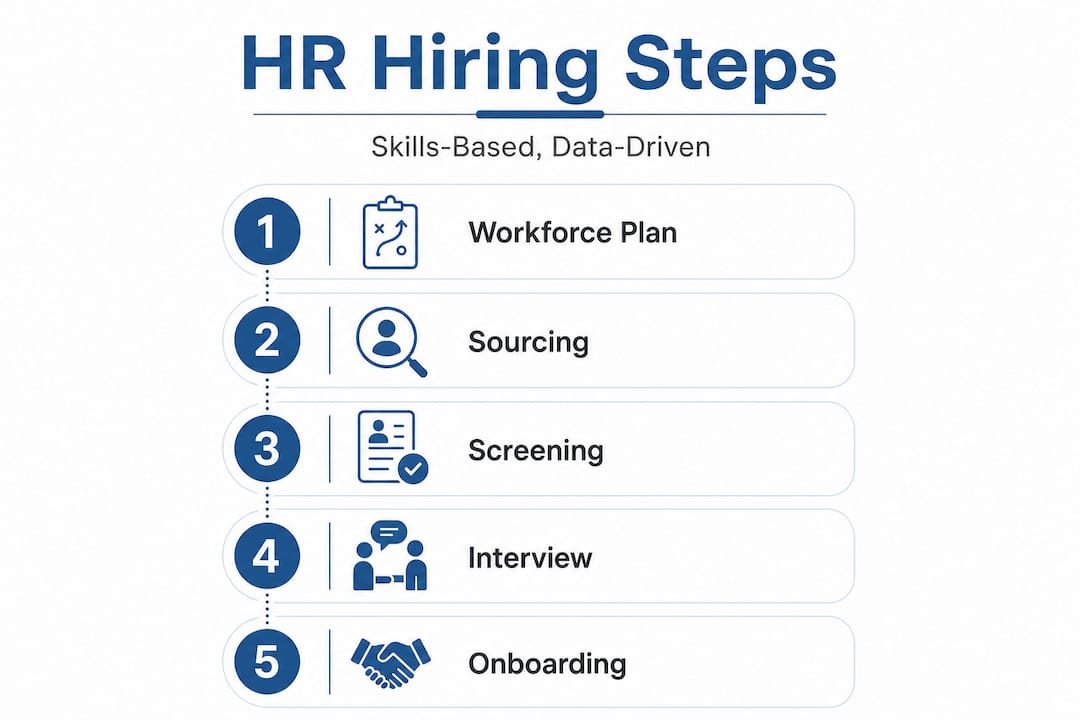
The traditional hiring model relied heavily on credentials: degrees, job titles, and years of experience. That model is breaking down. HR professionals are evolving into “Talent Architects” who focus on skills-based, data-driven strategies rather than conventional credential screening. SHRM’s research makes this shift explicit, describing it as one of the most significant transformations in how organizations think about talent acquisition.
The pressure to change is real. 69% of organizations struggle to fill roles, and recruiting has become the top HR priority for leadership teams across sectors. When nearly seven in ten organizations are struggling to fill open positions, resume screening alone clearly is not enough.
Skills-based recruiting models evaluate candidates on what they can actually do rather than where they went to school or what their job titles were. This opens up dramatically wider talent pools, improves workforce diversity, and reduces reliance on narrow credentialing that often screens out high-potential candidates.
Here is how data analytics is transforming hiring decisions in skills-based organizations:
- Predictive analytics identify which candidate attributes correlate most strongly with high performance in your specific roles, letting you weight those attributes more heavily in screening.
- Talent mapping uses workforce data to identify internal employees with transferable skills who could be developed or repositioned rather than replaced through external hiring.
- Funnel analysis tracks conversion rates at each stage of the hiring process to pinpoint exactly where candidates drop off or where HR is losing quality applicants.
- Retention analytics connects hiring source, interview score, and role match to long-term retention outcomes, creating feedback loops that improve future sourcing decisions.
- Compensation benchmarking uses real-time market data to position offers competitively, reducing offer rejections and improving time-to-fill.
“The most effective HR teams are not those with the most technology. They are the ones who use data to make faster, more defensible decisions about people.”
Pro Tip: Any selection procedure your organization uses, whether it is a skills assessment, structured interview, or work sample test, should be validated in accordance with EEOC guidelines. Validated selection tools reduce legal risk and improve your ability to defend hiring decisions if they are ever challenged. Review EEOC technical standards and consult legal counsel to confirm your tools meet Uniform Guidelines on Employee Selection Procedures.
Read the modern recruiting guide for a practical breakdown of how to build a skills-based hiring framework from the ground up.
Balancing Technology and Human Judgment: Ai’s Impact on Hiring
With data at the center of modern hiring, technology now influences nearly every decision in the recruitment process.
AI’s impact on speed is measurable. Median time to hire in the US is 35 days, and AI-powered tools reduce that by 26%, while the global median sits at 38 days. For high-volume hiring, that kind of acceleration can translate directly into cost savings and competitive advantage, particularly when roles stay open long enough to hurt productivity and revenue.
But here is a number that often surprises HR leaders: out of an average of 73 applicants per role, only 3 candidates actually make it to the interview stage. That means your screening process, whether AI-assisted or manual, is filtering out more than 95% of applicants before a human ever speaks with them. The stakes of getting that screening right are enormous.
Benefits of AI in recruitment:
- Reduces time spent on manual resume review, freeing HR for higher-value activities.
- Improves consistency in screening by applying the same criteria to every applicant.
- Surfaces passive candidates from talent databases who might not apply through traditional channels.
- Accelerates scheduling, assessment delivery, and candidate communication.
- Provides dashboards and analytics that make hiring metrics visible in real time.
Risks of AI in recruitment:
- Algorithms trained on historical data can replicate or amplify existing biases.
- Over-reliance on keyword matching screens out qualified candidates with non-traditional backgrounds.
- Candidates may feel depersonalized by automated processes, damaging employer brand.
- Compliance with emerging AI hiring regulations varies by jurisdiction and requires active monitoring.
- AI cannot assess cultural alignment, leadership potential, or communication nuance.
Access to passive candidates through curated talent communities can complement AI tools by bringing pre-screened, relationship-qualified professionals into your pipeline. For technology roles specifically, where competition for candidates is intense, specialized IT recruiters add the human layer that AI simply cannot replicate.
The right balance is using AI to scale and accelerate the administrative workload of hiring, while keeping humans accountable for every decision that involves culture, values, and team fit. Explore modern hiring tools that combine automation with recruiter expertise.
The Uncomfortable Truth Most Experts Won’t Tell You About Hr’s Hiring Influence
Having explored both frameworks and technology, it is worth reflecting on what actually limits HR’s strategic impact in most organizations. And the answer is not technology. It is perception.
65% of business leaders agree that HR functions as a strategic business driver, linking hiring decisions to revenue outcomes through reduced turnover, faster time-to-market for new products, and stronger organizational capability. Yet the majority of organizations still measure HR’s performance through purely operational metrics: how many positions were filled, how quickly, and at what cost-per-hire. Those metrics matter, but they do not tell the full story.
Here is the uncomfortable truth: HR teams that focus only on filling positions will always be seen as a support function. HR teams that connect their hiring decisions to business outcomes, such as revenue per employee, product launch velocity, or customer retention rates tied to team stability, earn a seat at the strategy table. The difference is not capability. It is framing.
Many HR professionals are not measuring what their executive leadership actually cares about. If your CEO is focused on reducing time-to-market, show how faster hiring in engineering reduces project delays. If the CFO is focused on controlling labor costs, demonstrate how lower turnover from better hiring saves 50 to 200% of a departed employee’s annual salary in replacement costs. That is the language of business strategy, and it is fully within HR’s power to speak it.
Linking your HR hiring impact to revenue outcomes shifts the conversation from “how did we do on recruiting?” to “how did our talent strategy drive business results?” The onboarding and HRIS processes that follow hiring decisions are equally critical to this story because a great hire who fails in onboarding represents a measurable loss.
Pro Tip: Build a quarterly dashboard that links three or four hiring metrics directly to business outcomes. For example, time-to-fill tied to project start dates, retention rate of hires from specific sources tied to team productivity, and new hire ramp time tied to revenue contribution. Present this to leadership alongside standard HR reporting and watch the conversation about HR’s value shift quickly.
The organizations winning the talent competition are not the ones with the biggest recruiting budgets. They are the ones where HR has built the credibility, the data, and the executive relationships to make talent strategy inseparable from business strategy.
Connect with Specialized HR Hiring Solutions
If the frameworks in this guide have clarified where your hiring process needs work, the next step is finding the right partner to help you act on them. Careerscape offers industry-specialized recruiting that connects organizations with qualified professionals across HR, technology, operations, and more. Whether you are building a talent pipeline, filling a critical HR leadership role, or redesigning your workforce planning approach, Careerscape brings both speed and expertise to the process. Hiring should be fast, honest, and backed by people who understand your industry. That is exactly what we are built to deliver.
Frequently Asked Questions
What Are the Main Steps in HR-Led Hiring?
HR typically leads workforce planning, sourcing, screening, interviewing, selection, and onboarding for new hires, managing the full recruitment lifecycle from role definition to day-one integration.
How Does AI Influence Hiring Speed and Quality?
AI tools reduce time-to-hire by approximately 26%, but human judgment remains essential for assessing cultural fit, communication quality, and legal compliance in final selection decisions.
Why Are Structured Interviews Preferred over Unstructured Ones?
Structured interviews yield higher predictive validity (0.50 vs. 0.38) for candidate performance, producing more consistent, defensible hiring decisions that reduce costly mis-hires.
What Challenges Do HR Professionals Face in Filling Roles?
69% of organizations report difficulty filling vacant roles, making recruiting one of HR’s highest-priority functions and pushing teams toward skills-based and data-driven strategies to stay competitive.
Recommended
- HR Coordinator Recruiters — HRIS, Onboarding & Benefits | Careerscape
- HR Recruiters by City — Local People Operations Staffing | Careerscape
- What is recruiting? The employer’s guide to modern hiring
- Staffing best practices to boost recruitment and culture