
In this article
Choosing the right hiring model is one of the most consequential decisions an HR team can make, yet many organizations default to familiar options without fully understanding the alternatives. Contract-to-hire occupies a unique and often misunderstood space between temporary staffing and direct placement, and conflating it with either model leads to misaligned expectations, wasted recruiting budgets, and costly turnover. This article clarifies exactly what contract-to-hire means, how it compares to other employment structures, when it makes the most strategic sense, and how to execute it well from day one.
Key Takeaways
| Point | Details |
|---|---|
| Flexible hiring solution | Contract-to-hire bridges temporary and permanent staffing for risk-managed trials. |
| Comparison clarity | Understanding contract-to-hire versus temp and direct hire helps employers make informed decisions. |
| Mitigate hiring risks | Using contract-to-hire lets you assess performance and fit before committing to a full-time role. |
| Best practices matter | Transparent communication and clear criteria drive successful contract-to-hire outcomes. |
Understanding Contract-to-Hire: Definition and Basics
Contract-to-hire is not simply a temp arrangement with a vague possibility of permanence. It is a structured, intentional employment model with defined phases and clear decision points. Contract-to-hire (C2H) is an employment arrangement where a worker is hired initially as a contractor for a trial period, typically 3 to 6 months (and up to 12 months), with the option to convert to a permanent full-time employee if performance and fit are satisfactory.
The structure matters. During the contract phase, the worker is usually paid on an hourly or fixed basis, often through a staffing agency that handles payroll, taxes, and benefits administration. The hiring company directs the work day to day, but the staffing firm remains the employer of record. At the end of the contract period, both parties evaluate the relationship and decide whether to formalize it as permanent employment.
Key features of a contract-to-hire arrangement include:
- A defined contract duration (typically 3 to 6 months)
- A clear conversion option written into the agreement
- Payroll managed by the staffing agency during the contract phase
- The employer directing daily work tasks and performance evaluation
- A mutual decision point at contract end for full-time conversion
What makes C2H attractive to employers is the ability to evaluate real on-the-job performance before making a long-term commitment. You get to see how a person actually works within your team, not just how they perform in an interview. For workers, the arrangement provides an opportunity to assess the company culture, management style, and growth potential before accepting a permanent role. For a deeper look at how this fits into broader workforce planning, the contract staffing guide covers the full scope of options available to employers.
Pro Tip: Before the contract phase begins, document what success looks like. Define specific performance benchmarks, soft-skill expectations, and cultural fit criteria. This gives both parties a transparent roadmap and removes subjectivity from the conversion decision.
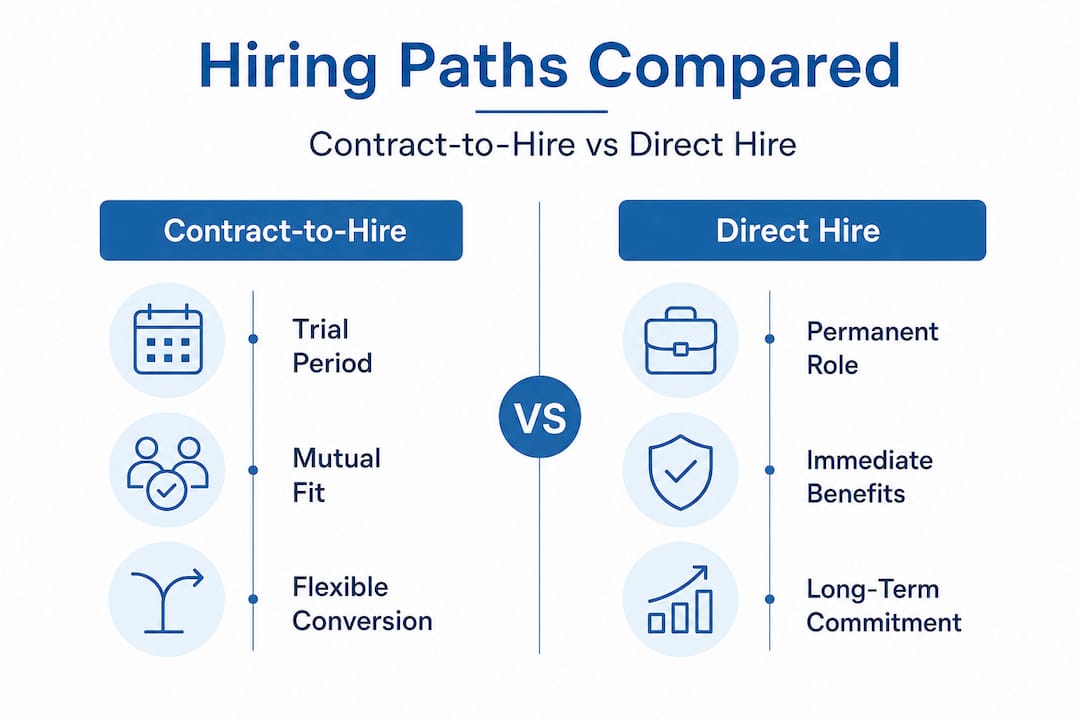
Contract-to-Hire vs. Temp Staffing vs. Direct Hire
Now that you know the basics, let’s examine how contract-to-hire stacks up against other common hiring methods. Many HR professionals use “temp,” “contract,” and “contract-to-hire” interchangeably, but these models serve fundamentally different purposes. Understanding the distinctions helps you deploy the right tool for the right situation.
As employment options research confirms, C2H differs from temp staffing (which has no permanence intent and ends at project completion), direct hire (where the worker is a permanent employee from day one), and independent contractor arrangements (1099, self-employed, working with multiple clients simultaneously).

Here is a side-by-side comparison of the three main models:
| Feature | Contract-to-hire | Temp staffing | Direct hire |
|---|---|---|---|
| Permanence intent | Yes, at contract end | No | Yes, from day one |
| Typical duration | 3 to 12 months | Days to months | Indefinite |
| Employer of record | Staffing agency | Staffing agency | Hiring company |
| Benefits during placement | Through agency | Through agency | Through employer |
| Conversion option | Built in | Not included | Not applicable |
| Ideal use case | Skill and fit validation | Short-term coverage | Leadership, specialized roles |
“The single most important distinction between contract-to-hire and temp staffing is intent. Temp staffing fills a gap. Contract-to-hire builds toward a permanent relationship from day one.”
Common scenarios where each model fits best:
- Temp staffing works well for seasonal surges, parental leave coverage, or project-specific needs with a fixed end date. Explore temporary staffing services if short-term coverage is your primary need.
- Direct hire is the right call when you need a role filled permanently and quickly, especially for executive, technical, or highly specialized positions where a trial period is unnecessary. Direct hire staffing through an experienced firm reduces your time-to-fill dramatically.
- Contract-to-hire hits the sweet spot when you need someone productive now but want the flexibility to validate fit before committing to full-time employment and its associated costs. For organizations ready to explore this model, contract staffing solutions offer a structured path to smarter permanent hiring.
One common misconception is that independent contractors and contract-to-hire workers are the same. They are not. Independent contractors operate on a 1099 basis, typically serve multiple clients, and maintain control over how their work is performed. Contract-to-hire workers function much more like employees during the contract phase, with the staffing agency managing legal employment while the hiring company manages the work itself.
Why Choose Contract-to-Hire? Pros and Ideal Situations
Having compared employment models, let’s highlight when and why contract-to-hire is a smart strategy for employers. The most honest answer is that C2H solves specific problems that other models cannot address as efficiently. If your organization has experienced a costly bad hire, a role with unclear long-term scope, or a team culture that is difficult to assess through traditional interviews, contract-to-hire is worth serious consideration.
C2H provides flexibility for workforce management and allows employers to assess performance and fit before converting to full-time. That is a straightforward benefit, but the downstream implications are significant. A bad permanent hire can cost 1.5 to 2 times the employee’s annual salary when you factor in recruiting costs, onboarding investment, productivity loss, and separation expenses. Contract-to-hire dramatically lowers that risk.
Key advantages for employers, in order of strategic impact:
- Performance validation before commitment. You see real output, not interview performance. Soft skills, work habits, and team dynamics become visible within weeks, not months after a permanent offer is made.
- Reduced cost-per-hire risk. If a placement does not work out, the engagement ends at contract close without the legal and financial complexity of terminating a full-time employee.
- Faster time-to-fill for critical roles. Candidates who might hesitate on a direct hire offer will often accept a contract-to-hire position, widening your available talent pool.
- Flexibility in uncertain markets. When project scope is unclear or budget approval is pending, C2H lets you bring in talent now without locking in a permanent headcount commitment.
- Streamlined onboarding ROI. Because the conversion decision is intentional and performance-based, employees who convert to permanent status tend to ramp faster and retain longer than those hired through cold direct placements.
- Reduced administrative burden during the contract phase. The staffing agency manages payroll taxes, benefits administration, and compliance during the trial period, freeing your HR team to focus on evaluation rather than paperwork.
Situations where C2H is the best fit:
- Roles where technical skills are hard to verify through traditional interviews alone (software development, engineering, financial analysis)
- New positions without established performance benchmarks
- Teams undergoing structural change where cultural fit is especially critical
- Organizations expanding into new markets where role scope is still being defined
- Budget-constrained environments where permanent headcount requires extended approval timelines
Partnering with experts who understand your industry deepens the value of this model significantly. Strong contract staffing expertise means your candidates are pre-screened not just for skills but for the specific behavioral profile that fits your team’s culture.
What Do Typical Contract-to-Hire Terms Look Like?
Most contract-to-hire arrangements run three to six months on the staffing firm’s payroll before the conversion decision. Conversion fees are set in the original agreement, and the standard pattern is a declining scale: a meaningful fee if you convert in the first weeks, stepping down as billed hours accumulate, often reaching zero after a defined threshold. Two things to pin down before the placement starts: exactly when the fee hits zero, and whether the bill rate already prices the conversion in. The closely related temp-to-hire model works the same way with shorter evaluation windows.
Common Pitfalls and Best Practices for Contract-to-Hire Recruitment
To maximize contract-to-hire success, it is important to recognize and avoid common recruitment pitfalls. Even well-intentioned C2H programs fail when the process is unclear, expectations are not set upfront, or evaluation is left to the last minute.
C2H assignments typically last 3 to 6 months with an option for permanent hire, making transparency and process critical. That window moves fast. Organizations that wait until week ten of a twelve-week contract to evaluate fit often find themselves scrambling to make a decision with incomplete data.
Common mistakes to avoid:
- Treating contractors like permanent employees from day one without documentation. Co-employment risk is real. Work with your legal and HR teams to maintain clear boundaries during the contract phase.
- Failing to communicate the conversion criteria upfront. Both the worker and the internal hiring team should know exactly what the evaluation looks like before the contract begins.
- Using the trial period as a passive observation phase. Active feedback, check-ins, and structured mid-point reviews dramatically improve conversion rates and reduce surprises at contract end.
- Not involving the direct manager early enough. HR-driven placements that do not loop in the day-to-day supervisor often miss team dynamics issues that would be obvious to someone working alongside the contractor daily.
- Ignoring the candidate’s experience during the contract phase. Top performers have options. If the onboarding experience is disorganized or the team is disengaged, they will not convert even if you want them to.
Best practices for contract-to-hire recruitment:
- Partner with a staffing firm that has deep experience in your industry, not just your job category. Industry context matters for recruitment outsourcing as much as it does for direct placement.
- Align staffing and recruiting services with your internal talent acquisition team so that expectations are consistent from the first job brief to the final conversion offer.
- Use structured evaluation scorecards during the contract phase, not just gut impressions. Define four to six measurable performance dimensions at the start and revisit them at the midpoint and end of the contract.
- Build a communication cadence with the staffing agency so that any performance concerns surface early, giving you time to coach or reassess before the contract deadline.
- Study industry recruiting best practices specific to your sector, as conversion benchmarks, compensation expectations, and timeline norms vary significantly across fields.
Pro Tip: Set your evaluation criteria in writing before the contract phase begins and share them with the candidate directly. Transparency about what success looks like is not just fair, it actually improves performance during the trial period because the worker knows exactly what they are being measured on.
A Fresh Perspective: What Most Guides Miss About Contract-to-Hire
Most content on contract-to-hire focuses on mechanics: how long contracts last, who manages payroll, how conversion works. That information is useful but incomplete. The real differentiator in C2H outcomes is not process. It is intentionality.
The organizations that get the most value from contract-to-hire treat the contract phase as a structured onboarding investment, not a passive evaluation window. They assign mentors, provide feedback at the thirty-day mark, include contractors in team meetings, and make the person feel genuinely welcome even before a permanent offer is made. This approach sounds obvious, but it is practiced far less often than you would expect.
Here is the contrarian view: most employers significantly underestimate how much cultural fit evaluation is happening in both directions during the contract phase. You are watching the contractor. The contractor is watching you. In a tight labor market, top performers are constantly assessing whether your organization lives up to what was promised in the recruiting process. Companies that run disorganized, feedback-free contract phases lose strong candidates at conversion, not because of compensation but because of experience.
The contract PM insights from project-based placements illustrate this clearly: workers who feel like contributors during the contract phase convert at significantly higher rates than those who feel like “temps on trial.” The distinction is cultural, not contractual.
There is also a broader workforce trend worth naming. In periods of economic uncertainty, contract-to-hire functions as a strategic lever for maintaining momentum without overcommitting. Organizations that build C2H into their standard hiring toolkit, rather than treating it as a fallback option, are better positioned to scale responsively without the whiplash of rapid hiring followed by painful layoffs.
The most sophisticated HR teams use C2H not just to fill roles but to build tested, culture-aligned talent pipelines. When a contract engagement ends without conversion, a well-run program still produces a credentialed reference pool and a warm candidate relationship. That has long-term recruiting value that most organizations simply leave on the table.
Next Steps: Connect with Contract-to-Hire Staffing Experts
If contract-to-hire sounds like the right tool for your next hire or your broader workforce strategy, Careerscape can help you put it into practice. Our team specializes in contract staffing solutions built around your industry, your timeline, and your specific performance expectations. Whether you need one placement or are building a scalable project-based staffing model, we bring the recruitment expertise and industry knowledge to make the contract phase count. Connect with our team through industry recruiting support tailored to your sector, and let’s identify the staffing approach that fits your organization’s goals right now.
Frequently Asked Questions
How Long Does a Contract-to-Hire Assignment Usually Last?
Most contract-to-hire roles last 3 to 6 months, but some extend up to 12 months depending on project scope or the complexity of the performance evaluation needed.
What Happens After the Contract Period Ends?
If performance and fit are satisfactory, the employer extends a permanent full-time offer; if not, the contract simply ends without the legal complexity of a termination.
Can a Contract-to-Hire Worker Decline a Permanent Offer?
Yes. Conversion to permanent is based on mutual satisfaction, meaning the worker can decline a full-time offer even if the employer wants to move forward.
How Is Contract-to-Hire Different from Temp Staffing?
Temp staffing is designed for short-term coverage with no permanence intent, while contract-to-hire includes a built-in option for full-time employment from the start of the engagement.
Recommended
- Contract staffing: A practical guide for employers
- Contract Staffing Solutions | Careerscape
- When to Use a Contract PM Instead of a Direct Hire — Careerscape
- Temporary Staffing Services | Careerscape