
Every top candidate you want is already talking to three other companies. The longer your hiring process runs, the higher the odds that your first-choice candidate signs an offer letter from someone else. Organizations filling full-time roles in an average of 42 days outperform the market average of 47 days, and that five-day gap regularly determines who lands the best talent. This guide walks through how to diagnose delays, prepare your process, execute at speed, and fix the problems that most commonly slow teams down.
Table of Contents
- Diagnose bottlenecks in your hiring process
- How to prepare for fast hiring before you post the job
- Essential steps to hire fast: from posting to offer
- Troubleshooting: how to fix or avoid common hiring slowdowns
- A fresh perspective: why faster hiring often means better long-term results
- Streamline hiring with Careerscape’s expert solutions
- Frequently asked questions
Key Takeaways
| Point | Details |
|---|---|
| Benchmark your speed | Measure and compare your hiring timeline against industry leaders to target rapid improvements. |
| Prepare before posting | Have approvals, job details, and interview teams ready ahead of time to minimize wasted days. |
| Keep steps moving | Use fast-track workflows and make hiring decisions promptly to engage top candidates. |
| Tackle common delays | Act early to avoid slowdowns in interviewing, approvals, or offer turnaround. |
| Faster means better | Speedy hiring is linked to stronger results when your process stays disciplined. |
Diagnose Bottlenecks in Your Hiring Process
Most hiring managers assume delays happen during sourcing. The real culprits are usually internal. Slow approvals, unclear ownership of interview stages, and feedback that takes days to surface all add up to a process that costs you candidates before they even receive an offer.
Understanding where time is lost requires tracking two core metrics:
- Time-to-fill: The number of days between when a job requisition is approved and when an offer is accepted. This measures the entire recruiting lifecycle.
- Time-to-hire: The number of days between when a candidate first applies and when they accept an offer. This reflects the candidate experience and process efficiency.
These two numbers tell different stories. A long time-to-fill often signals upstream problems like delayed approvals or slow sourcing. A long time-to-hire usually points to interview scheduling delays or indecision at the offer stage.
Here is a quick reference for common bottleneck categories and their typical causes:
| Bottleneck area | Common causes | Avg. days lost |
|---|---|---|
| Job requisition approval | Multi-level sign-off chains | 5 to 10 days |
| Sourcing and screening | Broad job descriptions, unclear criteria | 7 to 14 days |
| Interview scheduling | Interviewer availability conflicts | 5 to 8 days |
| Feedback collection | No deadline for interviewers | 3 to 7 days |
| Offer approval | Compensation band uncertainty | 3 to 6 days |

Looking at roles that typically have longer time-to-fill can also help you set realistic benchmarks and flag when a specific role is running behind pace. Technical, senior leadership, and highly specialized positions consistently take longer, and knowing that upfront allows you to start earlier.
Top-performing recruiters are roughly five days faster than average organizations, not because they work harder but because they have eliminated unnecessary friction at every stage.
Pro Tip: Build a simple hiring dashboard in your ATS or a shared spreadsheet that tracks average days at each stage by role type. After three to four hiring cycles, patterns emerge that make your bottlenecks impossible to ignore.
Working with streamlined hiring services can also fast-track your sourcing phase significantly, especially when your internal team is stretched thin.
How to Prepare for Fast Hiring Before You Post the Job
Once bottlenecks are identified, setting up your process for speed starts before the position even goes live.
The single biggest time-waster in recruitment is starting without consensus. When stakeholders disagree on requirements mid-process, or when budget approval comes back after interviews have already started, everything stalls. Preparation eliminates that problem entirely.
Here is a pre-launch checklist every hiring team should complete before posting any role:
- Finalize the job description. Define the top three to five non-negotiable requirements. Keep the nice-to-have list short to avoid filtering out qualified candidates unnecessarily.
- Confirm the compensation range. Get budget sign-off before sourcing starts. Discovering the range is misaligned after two rounds of interviews wastes everyone’s time.
- Identify and brief the interview team. Know exactly who will conduct each interview, what they will assess, and how they will score candidates using a structured interview scorecard.
- Set a target start date and work backward. Map your ideal timeline from offer acceptance to first day, then trace backward to identify when sourcing must begin.
- Get requisition approval in advance. Pre-approved headcount cuts five to ten days off the front of your time-to-fill instantly.
- Define your decision criteria. Agree on the top factors that will drive the final hiring decision before any resumes are reviewed.
- Assign a single point of ownership. One person should own the process from posting to offer. Shared ownership creates diffusion of responsibility.
The difference between companies that prepare and those that do not is stark. See how these two approaches compare:
| Factor | With pre-approval and prep | Without pre-approval and prep |
|---|---|---|
| Time to post the job | 1 to 2 days | 5 to 10 days |
| Time to screen first candidates | 3 to 5 days | 7 to 14 days |
| Interview scheduling time | 2 to 4 days | 5 to 8 days |
| Offer approval time | 1 to 2 days | 4 to 7 days |
| Estimated total time-to-fill | 28 to 35 days | 47 to 55 days |
SHRM’s 2026 data reinforces this clearly: organizations that measure and benchmark recruiting velocity using time-to-fill and time-to-hire outperform those flying blind on process metrics.
For organizations managing multiple openings or high-volume hiring, outsourced recruiting solutions provide the infrastructure to handle pre-launch preparation at scale without burdening internal HR teams.
Pro Tip: Start pre-screening candidate profiles through your talent pipeline or a recruiting partner as soon as the hiring need is identified, even before the job is officially posted. By the time the role goes live, you may already have two or three qualified candidates ready to interview.
Essential Steps to Hire Fast: From Posting to Offer
With your process prepared, here is how to keep up the speed from the moment you post your job through to the offer stage.
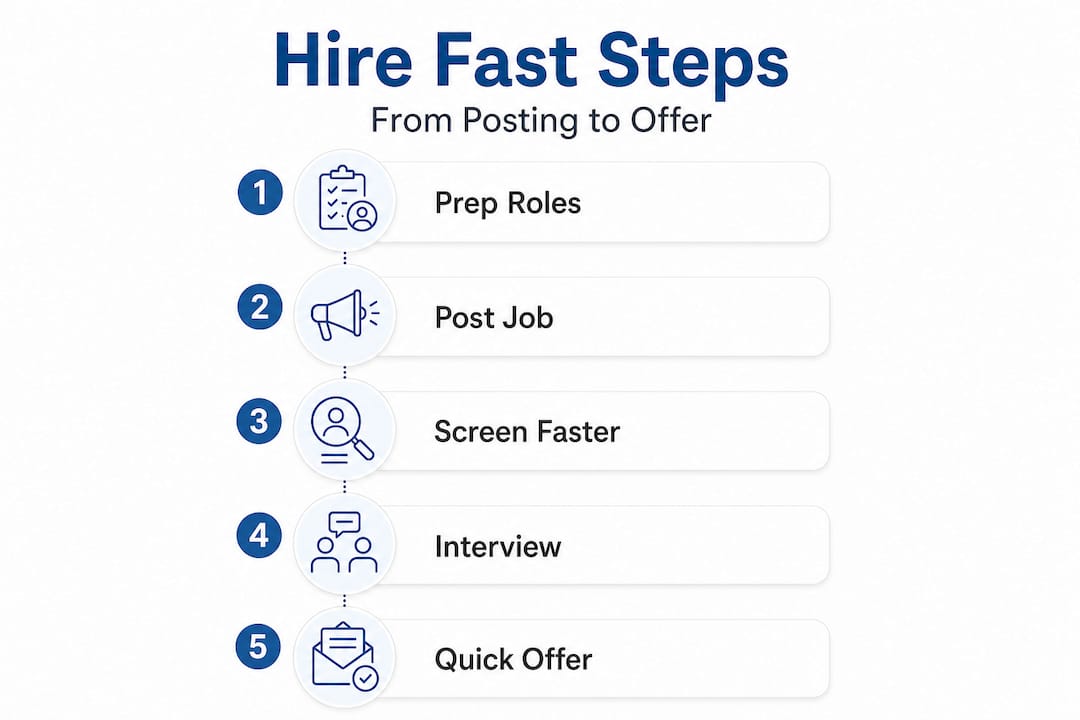
Speed at the execution phase depends on compressing timelines without compressing quality. Every stage should have a clear owner, a defined time limit, and a communication protocol so nothing idles in someone’s inbox.
Follow this rapid-hire workflow:
- Post the job across targeted channels simultaneously. Do not wait for one platform to underperform before adding others. Post on your ATS, LinkedIn, niche job boards, and through your recruiting partner at the same time.
- Set a 48 to 72-hour application review window. Do not leave applications aging in the queue. Assign someone to review and respond within 72 hours of each application.
- Conduct a 15-minute phone screen within 24 to 48 hours of flagging a qualified candidate. This filters out poor fits quickly and signals to top candidates that you move with purpose.
- Schedule interviews in batches. Rather than interviewing candidates one per week, group your top candidates into a two to three day window. This enables direct comparison and faster decisions.
- Use panel interviews where possible. One structured panel interview with two or three stakeholders covers more ground than three separate one-on-one interviews scheduled days apart.
- Debrief the interview team on the same day. Waiting a week for feedback kills momentum. Block 30 minutes immediately after the final interview for a real-time calibration.
- Issue the verbal offer within 24 hours of the final decision. Then follow with the written offer within 24 hours of verbal acceptance.
“Top-performing talent architects fill full-time roles in an average of 42 days. Every stage of your process either earns or surrenders that advantage.”
Using your company’s online hiring portal to centralize job postings, candidate tracking, and communication makes this workflow measurably faster. When everyone on the hiring team works from the same platform, information stops getting buried in email threads.
The most important thing to remember at this stage is that urgency communicates respect. Candidates who receive rapid responses feel valued. Those left waiting for a week after an interview often accept other offers, not because they preferred the other company but because that company moved first.
Troubleshooting: How to Fix or Avoid Common Hiring Slowdowns
Even with a streamlined process, delays can happen. Here is how to spot and resolve them quickly.
The most common reasons hiring stalls after it starts are predictable and fixable. Understanding them in advance gives your team the tools to course-correct in real time rather than losing a candidate before you realize there is a problem.
Slow interview scheduling
- Fix: Use a shared scheduling tool like Calendly or your ATS’s built-in scheduler so candidates can self-book from your team’s available windows. Eliminate the back-and-forth email chain entirely.
- Prevention: Pre-block interview slots for each active role at the start of the week so availability is ready before you need it.
Unclear decision-making authority
- Fix: Before the first interview, confirm in writing who has final say on the hire. One decision-maker, not a committee.
- Prevention: Include decision authority in the intake meeting agenda for every new role.
Delayed feedback from interviewers
- Fix: Set a four-hour feedback deadline after each interview. Use a structured interview scorecard with a 1 to 5 rating system so feedback is quick to provide and easy to compare.
- Prevention: Brief interviewers before the first candidate on what to assess and when feedback is expected.
Offer approval bottlenecks
- Fix: Pre-approve a compensation range with a defined variance (for example, up to 5% flexibility for exceptional candidates) so offer letters do not require fresh sign-off for every hire.
- Prevention: Include offer parameters in your pre-launch preparation checklist.
Candidate communication gaps
- Fix: Set an auto-acknowledgment for every application and a status update every five business days regardless of where the candidate sits in the process.
- Prevention: Assign candidate communication ownership to one person on the recruiting team.
Top-performing recruiters maintain speed not through luck or extra resources but through process discipline. The teams that are consistently faster have systems in place for every one of these scenarios before they occur.
For industries where candidate pools are especially competitive, building industry-specialized recruiting strategies into your workflow reduces time-to-fill by targeting the right professionals from the start rather than relying on broad sourcing.
A Fresh Perspective: Why Faster Hiring Often Means Better Long-Term Results
Here is something the traditional HR playbook rarely acknowledges: slow hiring does not produce better hires. It produces more anxious ones.
When a process drags out over six to eight weeks, something predictable happens. The candidates who are most employable, the ones with options, move on. What remains is a candidate pool of people who were willing to wait, and willingness to wait is not a proxy for quality. It often means fewer alternatives. Organizations that slow-walk decisions in the name of being “thorough” frequently end up making offers to second-choice candidates at above-market rates because their first choice already started somewhere else.
Speed, when applied to a well-structured process, actually clarifies hiring decisions. Urgency forces alignment. When you have a tight window to evaluate and decide, stakeholders come prepared, feedback is sharper, and the comparison between candidates is cleaner. The ambiguity that stretches slow processes for weeks often disappears when the team is operating with a defined timeline.
There is also a downstream effect worth noting. Candidates who move through a fast, organized process tend to onboard more confidently. They start with a positive impression of how the organization operates. Contrast that with someone who spent seven weeks in a drawn-out process, receiving minimal communication, unsure of where they stood. That person’s psychological starting point on day one is very different.
Building workforce agility partnerships with recruiting firms that understand your industry gives you the capacity to move fast even when internal bandwidth is stretched. The teams that consistently out-hire their competitors are not necessarily better at interviewing. They have built the infrastructure to act quickly when the right candidate shows up.
The uncomfortable truth is that cautious, slow hiring feels rigorous but rarely is. Speed with structure is the real standard.
Streamline Hiring with Careerscape’s Expert Solutions
Careerscape is built for exactly the kind of fast, precise hiring this guide describes. Whether you need contract staffing options to fill an urgent gap or direct hire services to land a permanent team member quickly, Careerscape’s recruiters bring industry knowledge, pre-screened talent pipelines, and a process designed to move without wasting your time. Every engagement is backed by transparent communication and a genuine understanding of what your industry actually demands from candidates. If you are ready to compress your time-to-fill and stop losing top candidates to slower-moving competitors, start by requesting talent now and put a Careerscape recruiter to work for you today.
Frequently Asked Questions
What Is the Average Time-to-Fill for a Full-Time Role in 2026?
According to SHRM’s Spring 2026 data, the average time-to-fill is 47 days, but top-performing organizations achieve 42 days by applying consistent process discipline across every hiring stage.
What Is the Difference Between Time-to-Fill and Time-to-Hire?
Time-to-fill measures the days from job requisition approval to offer acceptance, while time-to-hire measures from the candidate’s first application to their acceptance, making it a direct indicator of process efficiency from the candidate’s perspective.
Does Hiring Fast Mean Lowering Candidate Quality?
No. When every stage of the process is well-structured, faster hiring actually improves candidate quality by retaining top applicants who would otherwise accept competing offers during a slow process.
How Can Companies Benchmark Their Recruiting Speed?
Companies should track their own time-to-fill and time-to-hire across multiple hiring cycles, then compare against SHRM benchmarks to identify whether they are operating above, at, or below the performance threshold for their industry.
What Is the Biggest Driver of Hiring Delays Most Companies Can Control?
Slow internal communication and approval chains are the most common controllable cause of hiring delays, and addressing them through pre-approved headcount, clear ownership, and structured feedback deadlines delivers the fastest measurable improvement to time-to-fill.
Recommended
- Employer Portal | Careerscape
- Hire Talent — Staffing & Recruiting Services | Careerscape
- Careerscape | National Staffing & Recruiting Agency