
Job searches fail most often due to disorganized approaches, generic applications, and no system for tracking results. Candidates significantly improve their callback rates by tailoring each resume to match job-description keywords (which helps pass automated screening systems), maintaining a structured tracker for all applications and follow-ups, and prioritizing referrals, which consistently outperform cold applications in interview pass-through and offer acceptance rates. Sustained, consistent daily effort combined with monitoring where applications drop off in the funnel and adjusting accordingly is more effective than high-volume, untargeted applying.
Sending out dozens of applications and hearing nothing back is one of the most demoralizing experiences a job seeker can face. The process feels random, but it rarely is. Most unsuccessful searches share the same root problems: a lack of structure, generic materials, and no system for measuring what works. The good news is that research and real-world recruiting data consistently point to a set of practical, repeatable strategies that improve callback rates and shorten the time to offer. This guide walks through each one in detail, from building your search infrastructure to leveraging referrals and monitoring your results like a pro.
Table of Contents
- Preparation: Set up your job search system
- Execution: Target and tailor every application
- Supercharge with networking and referrals
- Monitor progress and iterate your approach
- What most job search advice misses: Consistency, cadence, and the feedback loop
- Take your job search further with expert support
- Frequently asked questions
Key Takeaways
| Point | Details |
|---|---|
| Structured tracking matters | Logging applications and follow-ups increases your job search efficiency and success rate. |
| Tailor every application | Resumes customized to each posting with job keywords are much more likely to get interviews. |
| Leverage referrals | Network connections and referrals open doors and result in higher job offer rates than standard applications. |
| Monitor and adapt | Track each stage of your search and refine your approach based on where results drop off. |
| Consistency beats intensity | Sustained, steady effort over time outperforms occasional bursts, especially during periods of unemployment. |
Preparation: Set up Your Job Search System
A productive job search does not happen by chance. It is built on a foundation of organized, repeatable habits that keep you moving forward even when the market feels slow. Before you send a single application, invest time in setting up the systems that will keep your search on track.
Indeed’s structured search guidance recommends using a tracking spreadsheet or document to log applications, contacts, dates, and interview appointments as a core step in any effective job search process. This single habit can transform a chaotic scatter of applications into a manageable pipeline.
Your job search tracker should include:
- Company name and role title for every application submitted
- Date applied so you know when to follow up
- Application status (submitted, phone screen, interview scheduled, offer, rejected)
- Contact name and email for every recruiter or hiring manager you reach
- Notes on each role including salary range, location, and why it interests you
- Follow-up dates to keep communication timely and professional
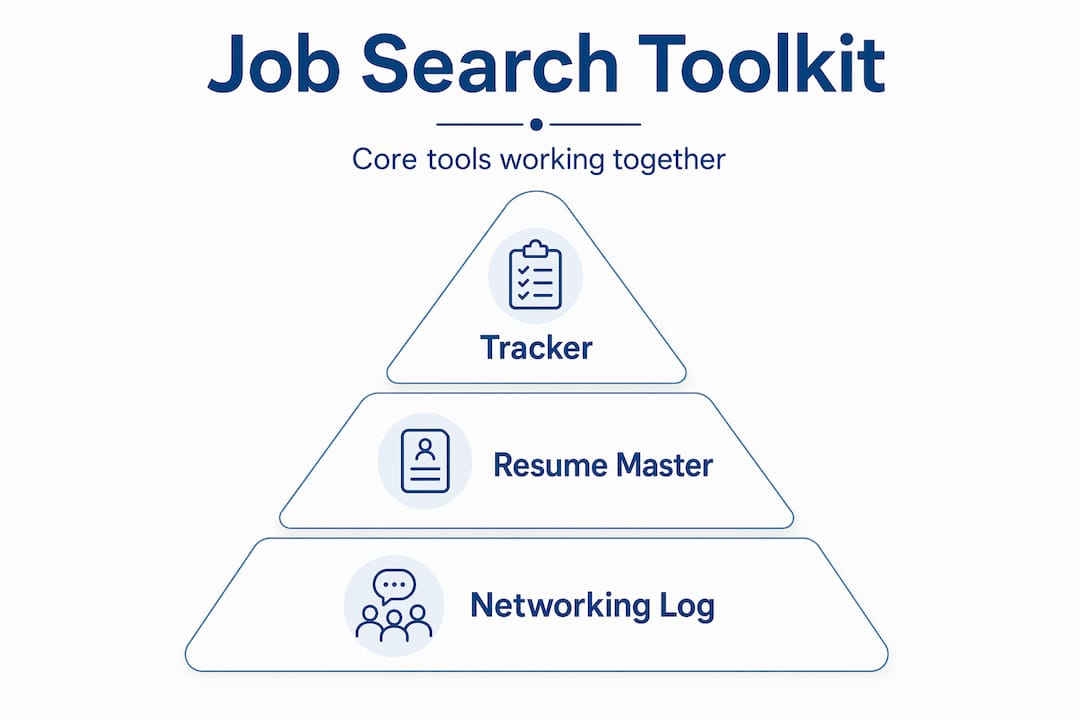
Beyond the tracker, you need three core tools working together: a spreadsheet or dedicated job search app for logging activity, a calendar for scheduling interviews and follow-up reminders, and a candidate portal to streamline your engagement with recruiters and job leads. These tools are not complicated, but using them consistently makes a measurable difference.
| Tool | Purpose | Frequency of use |
|---|---|---|
| Tracking spreadsheet | Log all applications and contacts | Every time you apply |
| Calendar | Schedule interviews and follow-up tasks | Daily |
| Candidate portal | Access curated job leads and recruiter support | Weekly or as needed |
| Notes document | Record interview feedback and key talking points | After each interaction |
Pro Tip: Set a specific time each day, even 30 minutes, dedicated solely to job search activity. Consistency builds momentum and prevents the search from stalling during slow weeks.
The key insight here is that your job search is a project, not an event. Treating it like one, with defined milestones, records, and follow-through, is what separates candidates who get traction from those who spin their wheels.
Execution: Target and Tailor Every Application
With your search system in place, focus on how to maximize each application’s impact. The single most common mistake job seekers make is submitting the same resume and cover letter to every opening. Generic applications consistently underperform compared to targeted ones, and the data backs this up.

Tailored resumes with job-description keywords pass through applicant-tracking systems (ATS) at significantly higher rates than generic resumes. ATS software, used by most mid-size and large employers, scans resumes for specific terms that match the job posting before a human ever reviews the document. If your resume does not mirror the language of the job description, it may be filtered out automatically.
Job search data from Q1 through Q3 2025 shows that conversion rates from application to interview are meaningfully higher for candidates who tailor their materials. In a market where time-to-offer has also extended for many roles, standing out at the application stage is more important than ever.
How to tailor each application in five steps:
- Read the job description carefully and highlight keywords related to skills, tools, and responsibilities.
- Mirror that language directly in your resume summary, bullet points, and skills section.
- Quantify your achievements wherever possible. “Increased sales pipeline by 40% over two quarters” is far stronger than “Helped grow sales.”
- Customize your cover letter opening to reference the specific company and role, not just the job category.
- Adjust your professional headline on your resume to reflect the exact title or function the employer is hiring for.
| Application type | ATS pass-through rate | Interview conversion |
|---|---|---|
| Generic, untailored | Lower | Significantly below average |
| Tailored with keywords | Higher | Meaningfully above average |
| Tailored with quantified results | Highest | Well above average |
This process takes more time per application. But submitting 20 targeted applications will typically generate more interviews than sending 80 generic ones. Quality over volume is not just good advice; it is what the conversion data supports.
Explore more proven job hunting tactics to sharpen your approach further, and check out current roles in demand to focus your targeting on where hiring activity is strongest.
Pro Tip: Create a “master resume” with every role, achievement, and skill you have ever held. Then pull from it selectively for each application rather than editing from scratch every time. This keeps your materials fresh and efficient.
Supercharge with Networking and Referrals
Now that you understand targeting and tailoring, discover how personal connections can power your job search even more. Networking and referrals are not soft strategies. They are measurably the most effective channel for landing a job, and the data is clear.
Recruiting operations benchmarks spanning January 2021 through March 2026 show that referrals consistently outperform all other candidate sources across two critical metrics: pass-through rates at each interview stage and offer acceptance rates. Referred candidates move faster through the hiring funnel and are more likely to accept offers when they come.
“Referrals consistently outperform other sources across pass-through and offer acceptance metrics.” — Ashby Recruiting Operations Benchmarks
The mechanism behind this is straightforward. When someone inside a company recommends you, you enter the process with a layer of built-in credibility that a cold application cannot replicate. Hiring managers pay closer attention to referred candidates, and those candidates tend to be better informed about the role and culture before they even walk in the door.
However, it is important to understand that networking does not benefit every job seeker equally. Research on informal job search effectiveness finds that outcomes depend significantly on a candidate’s existing social capital and professional status. Job seekers with well-established networks, strong industry reputations, or senior experience tend to benefit more immediately from informal channels. This does not mean networking is off the table for early-career professionals; it means the strategy needs to be deliberate.
Practical networking tactics that generate results:
- Reconnect with former colleagues and managers. These are warm relationships that can reactivate quickly. A short, genuine message reminding someone of your shared work can open doors faster than a cold LinkedIn request.
- Attend industry events and professional association meetups. Showing up in person signals commitment and makes you memorable in a way that digital messages rarely do.
- Engage on LinkedIn with intention. Comment thoughtfully on posts from people in your target companies. Share your own insights. Build visibility before you need a favor.
- Ask for informational interviews. A 20-minute conversation with someone in a role or company you are targeting is often more valuable than three formal applications.
- Make it easy to refer you. When asking for a referral, give the person a short paragraph about your background and the specific role you want. Make it simple for them to advocate on your behalf.
Pro Tip: When reaching out to your network, lead with value before making a request. Share an article, offer to help with something, or simply express genuine interest in what they are working on. People refer candidates they trust and like, not just candidates they know.
For deeper networking strategy tips that go beyond the basics, build time into your weekly search schedule specifically for relationship-building activities.
Monitor Progress and Iterate Your Approach
With networking and referrals in action, it is vital to track results and course-correct when needed. Most job seekers measure effort, counting how many applications they submitted, but what actually matters is conversion at each stage of the funnel.
Think of your search as a three-stage funnel: application to phone screen, phone screen to interview, interview to offer. Recruiting operations data shows that different stages and sourcing channels behave differently, which means a bottleneck at stage one requires a different fix than a bottleneck at stage three. You cannot improve what you do not measure.
Building your personal job search funnel:
- Track every stage in your spreadsheet: applications sent, responses received, phone screens completed, interviews scheduled, and offers made.
- Calculate your conversion rate at each stage. If you are sending 30 applications and getting two responses, that is a top-of-funnel problem. If you are getting interviews but no offers, that is a late-stage issue requiring a different solution.
- Set a weekly review date to assess your funnel. Friday afternoons work well for most job seekers.
- Identify which sources are working. Are most of your interviews coming from LinkedIn, referrals, or direct outreach? Double down on what converts.
- Adjust tactics based on evidence, not emotion. If tailored applications are generating better results, shift more of your time there even if another approach feels more comfortable.
| Funnel stage | Signal to watch | Action if stuck |
|---|---|---|
| Applications sent | Low response rate below 5% | Revisit targeting and tailoring |
| Phone screens | Few progressing to interviews | Refine your verbal pitch and story |
| Interviews | No offers after multiple rounds | Request feedback, practice intensively |
| Offers | Offer stage stalling | Review compensation expectations and timeline |
One of the most important findings in recent research on job finding comes from a large-scale study of over 600,000 applications tracking 15,000 job seekers. It shows that both the number of applications submitted and the number of interviews secured tend to decline the longer someone is unemployed. This “duration dependence” is a hidden trap. Momentum drops, effort decreases, and the search stalls precisely when it needs to stay active.
Being aware of this pattern is the first step to countering it. If your activity levels have been drifting downward, that is a signal to recalibrate, not to reduce effort further. Maintaining a minimum weekly target of applications, outreach messages, and networking contacts keeps the funnel full even during stretches when results feel slow. Boosting your recruitment outcomes often starts with recognizing where your personal funnel is breaking down and fixing it with data-driven adjustments.
What Most Job Search Advice Misses: Consistency, Cadence, and the Feedback Loop
Most guides cover the steps: build a resume, tailor applications, network, follow up. The advice is not wrong, but it is incomplete. What is consistently underemphasized is the importance of treating your job search as an ongoing, adaptable process rather than a linear checklist.
The research on duration dependence is instructive here. Effort naturally declines over time, not because job seekers give up consciously, but because the emotional weight of a prolonged search erodes cadence. Every rejection, or worse, every silence, nudges weekly application counts lower. This is the most dangerous pattern in a job search, and it is rarely discussed directly.
True momentum in a job search comes from building a feedback loop. Every application is data. Every rejection is signal. Every interview is a chance to learn what works and what does not. But most job seekers do not treat it that way. They experience each outcome emotionally rather than analytically, which prevents them from making the rapid, evidence-based adjustments that actually move the needle.
The job seekers who get hired consistently are not always the most qualified. They are the ones who maintain their cadence, measure every stage, and iterate quickly when something is not working. They ask for feedback after rejections. They test different resume formats and track which gets more responses. They treat the search like a conversion-rate optimization problem, not a waiting game.
There is also a structural truth that most advice ignores: the job market rewards activity and visibility, not just quality. A highly polished resume submitted to five roles will usually underperform a well-tailored resume submitted to twenty, combined with active networking across all of them. The effective strategies guide at Careerscape reflects this philosophy, emphasizing both quality and volume as complementary levers.
The bottom line: the candidates who succeed are the ones who do not let a slow week become a slow month. They set benchmarks, review them honestly, and adjust without ego. That discipline is harder than any single tactic, and it is worth more.
Take Your Job Search Further with Expert Support
A well-structured strategy gives you a strong foundation, but working with experienced recruiting professionals can accelerate your path to the right role significantly. Careerscape connects qualified professionals with employers who are actively hiring across a wide range of industries and job functions. Our approach is built on speed, transparency, and genuine industry knowledge, so you are never left guessing where you stand.
Whether you are in finance, technology, engineering, healthcare, or another sector, our team offers industry-specialized recruiting that matches your background to roles where you will genuinely fit. We also provide specialized staffing options for candidates looking for contract, direct-hire, or project-based opportunities. If you are ready to work with a team that understands your market, visit Careerscape to get started and connect with a recruiter who can help you move faster.
Frequently Asked Questions
What Is the Most Effective Way to Organize a Job Search?
Use a structured tracking system, such as a spreadsheet or dedicated portal, to record applications, contacts, and interview dates for consistent follow-up. Indeed’s job-search guidance specifically recommends this step-by-step approach to keep your search organized and actionable.
Does Customizing Resumes for Each Job Really Improve Results?
Yes, tailored resumes with relevant keywords show higher interview conversion rates compared to generic applications. Job search trend data through Q3 2025 confirms that application-to-interview conversion improves measurably when materials match job description language.
Are Referrals Truly More Effective than Job Boards?
Referrals consistently outperform job boards for moving candidates through interview and offer stages, according to recruiting benchmarks. Ashby’s sourcing data covering five years of recruiting operations shows referrals leading on both pass-through rates and offer acceptance.
How Should I Adjust My Approach if I Am Not Getting Interviews?
Check each funnel stage for bottlenecks, regularly revise your targeting and application quality, and increase networking efforts. Recruiting operations benchmarks recommend treating application-to-offer as a funnel and identifying exactly where the conversion breaks down.
Does Job Search Effectiveness Change the Longer I Am Unemployed?
Yes, research using 600,000 application records shows both application volume and interview rates tend to decline with unemployment duration, making it critical to maintain effort and refresh strategies proactively.
Recommended
- Effective Strategies for Finding Your Next Job | Careerscape
- The Financial Reality of Job Seekers in 2026 | Careerscape
- Employer Portal | Careerscape