
Filling a vacant role costs more than most managers realize. Beyond the job board fees, there are hours lost to resume reviews, phone screens, and interviews that go nowhere, all while the position stays empty and productivity suffers. That is exactly why use staffing agencies has become one of the most searched questions among hiring managers today. Staffing agencies absorb the operational weight of recruitment, from candidate sourcing to pre-screening to compliance, so your team can stay focused on the work that actually drives results. This guide breaks down the concrete benefits, the financial logic, and the strategic value of partnering with a staffing firm.
Table of Contents
- How staffing agencies streamline hiring processes
- Cost benefits of using staffing agencies
- Flexibility and scalability advantages
- Access to specialized talent and compliance expertise
- How staffing agencies support workforce stability and growth
- Why staffing agencies are smarter partners than reactive solutions
- How Careerscape can help you leverage staffing agencies effectively
- Frequently asked questions
Key Takeaways
| Point | Details |
|---|---|
| Faster hiring process | Staffing agencies handle recruitment tasks quickly to reduce time-to-hire significantly. |
| Cost-effective staffing | Using agencies lowers total hiring costs by minimizing turnover and recruitment expenses. |
| Flexible workforce scaling | Employers can easily adjust staff levels with temporary and contract workers. |
| Access specialized talent | Agencies connect you with candidates having niche skills and certifications. |
| Legal compliance support | Agencies manage payroll and employment law to reduce your legal risks. |
How Staffing Agencies Streamline Hiring Processes
The time-to-fill metric, meaning how long it takes to go from job opening to accepted offer, is one of the clearest indicators of recruitment health. For many organizations, that number stretches to 30, 45, even 60 days when hiring is handled entirely in-house. Every day a role sits open is a day of lost output, increased burden on your existing team, and potential revenue impact.
Staffing agencies compress that timeline significantly. They maintain pre-built talent pipelines with candidates who are already screened, referenced, and in many cases, ready to start. When you submit a job order, you are not starting from zero. You are drawing from a curated pool that took months or years to build.
“Hiring can eat up weeks or even months when done in-house. Staffing agencies handle the initial screening and interviews, freeing your team to focus on core tasks.”
One often-overlooked advantage: access to passive candidates. These are professionals who are not actively applying to job boards but are open to the right opportunity. Staffing agencies cultivate relationships with this segment continuously, which means you gain access to talent your competitors are not even seeing.
Temporary staffing services are particularly effective when speed is the priority. For project launches, seasonal demand spikes, or sudden team gaps, agencies can place qualified workers in days rather than weeks. Contract staffing solutions work similarly, allowing you to bring in specialized skills for a defined scope of work without a lengthy hiring process.
Pro Tip: Before engaging an agency, document your ideal candidate profile in writing. Include not just technical requirements but also team dynamics, communication style expectations, and growth trajectory. The more context you give, the tighter the candidate match will be on the first submission.
- Submit a detailed job description and candidate profile to your agency.
- Agency sources and screens candidates from existing pipelines and active outreach.
- Pre-qualified candidates are presented, often within 24 to 72 hours.
- You conduct a focused interview with a short list, not an overwhelming stack of resumes.
- Offer is extended, onboarding begins with agency support.
Cost Benefits of Using Staffing Agencies
The most common objection to using staffing firms is the fee. Agencies typically charge a markup on hourly wages for temporary placements or a percentage of annual salary for direct hires. That number can feel significant on a spreadsheet. But it rarely reflects the full cost picture.
Consider what in-house hiring actually costs. Job board advertising, recruiter time, hiring manager hours across multiple interview rounds, background check fees, and the cost of a bad hire if the process moves too fast or skips steps. Turnover savings from agencies are real: by vetting candidates more thoroughly before placement, agencies reduce the likelihood of early attrition, which is where the true financial damage happens.
A bad hire at the mid-level can cost anywhere from 30% to 150% of that employee’s annual salary when you factor in lost productivity, rehiring costs, and team disruption. Agencies reduce that risk materially.
- Advertising costs eliminated: Agencies absorb job board and sourcing costs.
- Screening time recovered: Internal HR teams spend fewer hours on unqualified applicants.
- Faster fill times: Less time with an empty seat means less productivity loss.
- Reduced benefits exposure: Temporary workers placed through agencies are typically on the agency’s payroll, not yours.
- Lower training investment: Pre-vetted candidates arrive with the skills the role requires.
| Cost category | In-house hiring | Using a staffing agency |
|---|---|---|
| Job advertising | Paid by employer | Covered by agency |
| Recruiter/HR time | High | Reduced significantly |
| Time-to-fill | 30 to 60+ days | 3 to 10 days typical |
| Bad hire risk | Higher without structured vetting | Lower with agency screening |
| Temp worker benefits | Employer’s responsibility | Agency’s responsibility |
| Turnover-related rehiring | Frequent if vetting is weak | Reduced through better matching |
Pro Tip: Use a temp-to-perm arrangement when hiring for critical long-term roles. The worker earns in the temporary period, and you evaluate real performance on actual work before committing to a full-time offer. It is one of the most practical ways to reduce hiring regret.
Temporary staffing and contract staffing both give you budget flexibility. Instead of adding headcount permanently during a growth phase, you can scale labor costs in direct proportion to actual business volume.
Flexibility and Scalability Advantages
Workforce planning is rarely a straight line. A manufacturing company might need 20 additional workers in Q4 and 5 in Q1. A tech firm might need a team of developers for a six-month product launch and nobody after that. Committing to permanent hires in either scenario creates cost and complexity that outlasts the actual need.
Staffing agencies are purpose-built for this reality. As business demands fluctuate, agencies supply temporary workers for projects, peaks, or absences, giving you the agility to scale up or down without locking in permanent headcount.
| Staffing model | Best for | Key advantage | Key consideration |
|---|---|---|---|
| Temporary | Seasonal peaks, short-term gaps | Fast deployment, no long-term cost | Less continuity after assignment ends |
| Contract | Project-based or specialized work | Defined scope, specialized skills | Requires clear project milestones |
| Permanent (direct hire) | Core team roles | Long-term stability and loyalty | Longer time-to-fill, higher upfront cost |
Project-based staffing fits companies running defined initiatives with a clear start and end date. Temporary staffing is better suited for recurring volume fluctuations. Understanding the difference lets you choose the right model for each situation rather than defaulting to permanent hiring out of habit.
- Avoid overstaffing and the fixed payroll costs that come with it.
- Respond to market changes faster than competitors who are locked into rigid headcount plans.
- Protect full-time employees from burnout during peak periods by augmenting with temporary support.
- Test new roles or departments before making them permanent parts of your org chart.
Pro Tip: Build an ongoing relationship with one or two staffing agencies before you urgently need them. When a need arises suddenly, an agency that already knows your culture, standards, and preferences will deliver faster and more accurate results than one you are contacting cold.
Access to Specialized Talent and Compliance Expertise
Some roles are genuinely difficult to fill. Skilled tradespeople, IT security specialists, clinical laboratory professionals, compliance officers with niche regulatory knowledge. These candidates do not apply in volume to generic job postings. They are often placed through relationships, referrals, and industry-specific networks.

For niche roles like IT specialists or legal experts, agencies maintain networks of hard-to-find talent, connecting you with professionals who hold rare certifications or specialized experience your internal team may not be equipped to evaluate.
This matters especially for technical roles where the hiring manager may not have the depth to distinguish between a qualified and an underqualified candidate on paper. Agencies that specialize in a sector bring knowledge of what “good” looks like, which improves the quality of every candidate they forward to you.
Compliance is the other dimension that hiring managers frequently underestimate. Employment law is not static. Overtime rules, worker classification standards, benefits requirements, and leave entitlements change regularly. Misclassifying a worker as an independent contractor when they should be an employee carries serious penalties.
Staffing firms stay current on employment regulations, ensuring all placements meet legal standards and protecting your company from fines or lawsuits tied to misclassification or wage violations. When the agency is the employer of record for a temporary worker, legal exposure sits with the agency, not you.
- Access to passive candidates with rare certifications or niche industry backgrounds.
- Industry-specialized recruiting teams that understand technical role requirements deeply.
- Payroll processing, tax withholding, and benefits administration handled by the agency.
- Risk transfer on worker classification, reducing your compliance exposure.
- Contract staffing solutions with built-in legal oversight for complex engagements.
How Staffing Agencies Support Workforce Stability and Growth
Retention rate, meaning the percentage of employees who stay for a defined period, is a metric most HR teams track but struggle to improve. High turnover is expensive, disruptive, and often symptomatic of poor initial hiring decisions. When candidates are matched more carefully to role requirements and team culture from the start, they tend to stay longer.
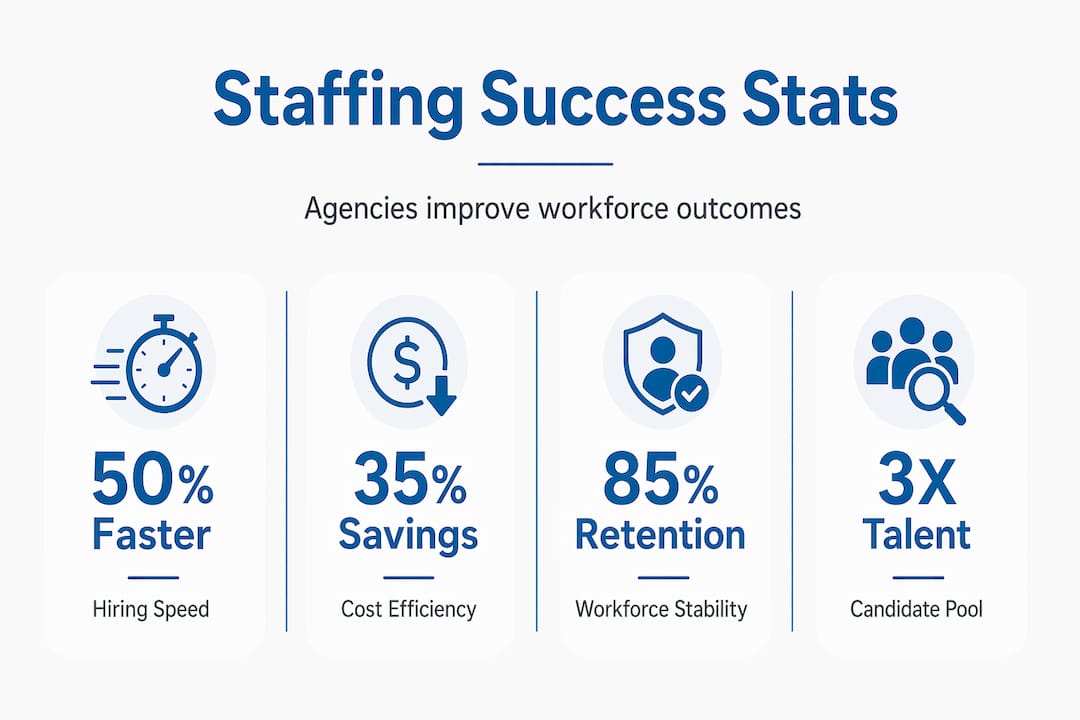
By matching candidates more accurately, agencies help reduce voluntary departures, which lowers spending on repeated hiring cycles and preserves institutional knowledge within your team.
The temp-to-perm model (also called “try before you buy”) deserves special attention. Many agencies offer temp-to-perm arrangements, letting you evaluate workers on the job before offering full-time roles. This approach removes the guesswork from permanent hiring decisions. You are not making a commitment based on two interview rounds and a reference call. You are making it based on weeks or months of observed, real-world performance.
- Reduce turnover by improving initial fit between candidates and roles.
- Use temp-to-perm hiring for roles where culture fit is especially hard to assess in interviews.
- Maintain coverage continuity during unexpected departures by calling on agency talent immediately.
- Support growth phases by scaling qualified staff quickly without stretching your internal recruiting capacity.
Steps to build a productive long-term agency partnership:
- Start with a clear scope: define which role types you will use the agency for and which you will handle internally.
- Share your culture, values, and team environment so the agency can screen for fit, not just skills.
- Provide honest feedback on every placement, both positive and critical, so the agency calibrates over time.
- Set regular check-ins with your agency contact, not just when a role opens, to share workforce planning context.
- Measure outcomes using retention rate, time-to-fill, and cost-per-hire across agency versus internal hires to quantify the partnership’s value.
Temporary staffing services and industry-specific recruiting together create a flexible foundation for workforce stability that internal teams alone rarely achieve.
Why Staffing Agencies Are Smarter Partners than Reactive Solutions
Most companies call a staffing agency when a crisis lands on their desk. A key employee resigns with two weeks notice. A project ramps up faster than anticipated. A leave of absence creates a coverage gap. The agency fills the hole. Problem solved, at least temporarily.
That reactive approach captures maybe 20% of what a staffing partnership can actually deliver.
The companies getting the most from their agency relationships treat them as an extension of the HR function, not a break-glass emergency contact. They share quarterly hiring forecasts. They loop agencies into early-stage conversations about expansion plans. They use agencies to gather market intelligence on compensation benchmarks, candidate availability in specific skill sets, and how competitors are positioning their employer brand.
The most successful businesses build proactive, evolving partnerships with staffing agencies that create durable workforce advantages throughout the year. That means lower cost-per-hire, faster response when roles open, and better quality candidates because the agency has spent months understanding your business.
There is also a labor market intelligence angle that rarely gets discussed. A well-connected staffing agency talks to dozens of candidates every week. They know which skills are becoming scarce. They know when a competitor is restructuring. They know where compensation expectations are shifting before that data shows up in published surveys. That intelligence, shared proactively with a trusted HR partner, is genuinely valuable for workforce planning.
Treating a contract staffing partnership as a strategic relationship rather than a transactional vendor arrangement changes the outcomes measurably. The agency invests more. The quality improves. The friction goes down over time, not up.
How Careerscape Can Help You Leverage Staffing Agencies Effectively
If the advantages of staffing firms outlined above align with what your organization needs, Careerscape is built to deliver them. Careerscape offers contract staffing solutions and project-based staffing tailored to your specific workforce demands, not off-the-shelf placements. Our recruiters specialize by industry, which means they understand the technical requirements, compensation norms, and candidate expectations unique to your sector. You can explore our industry-specialized recruiting to see where Careerscape has the deepest expertise. From compliance handling to pre-vetted candidate delivery, we take the operational burden of hiring off your plate so your team can focus on running the business. Hiring should be fast, honest, and handled by people who know your industry. That is what Careerscape is built for.
Frequently Asked Questions
What Types of Roles Can Staffing Agencies Help Fill?
Staffing agencies assist with temporary, contract, permanent, and specialized positions across many industries, from entry-level to executive, including hard-to-fill niche roles that require rare certifications or technical expertise.
How Do Staffing Agencies Reduce Hiring Time?
They manage candidate screening, interviewing, and background checks, presenting pre-qualified candidates quickly. Because agencies maintain active talent pipelines, time-to-fill compresses from weeks to days in many cases.
Can I Try a Temporary Worker Before Hiring Them Permanently?
Yes. Temp-to-perm arrangements let you evaluate a worker’s real-world performance before extending a full-time offer, which significantly reduces the risk of a costly permanent hiring mistake.
Do Staffing Agencies Handle Legal Compliance for Temporary Hires?
Reputable agencies act as the employer of record, managing payroll, taxes, and benefits, and ensuring placements meet current employment law standards to shield your business from classification and wage compliance risks.
How Do Staffing Agencies Help with Workforce Flexibility?
They provide temporary and contract workers on demand, enabling you to scale staffing up or down based on seasonal demand or project needs without the financial commitment of permanent headcount.
Recommended
- Types of recruitment agencies: A smarter hiring guide
- Contract staffing: A practical guide for employers
- Staffing best practices to boost recruitment and culture