
A 6-step checklist for multi-site hiring emphasizes the importance of a central talent governance team combined with local hiring managers to ensure consistency and compliance while speeding up the hiring process. Key strategies include setting clear service-level agreements (SLAs) for each stage, standardizing selection procedures, and utilizing a shared dashboard to monitor key performance indicators (KPIs) like time-to-fill and candidate experience. By documenting processes and maintaining clear roles, employers can effectively coordinate hiring across locations while minimizing legal risks and enhancing efficiency.
- Setting clear SLAs and having designated owners at each stage ensures timely hiring processes across all locations.
- Standardizing core role profiles, interview scorecards, and selection procedures helps maintain legal defensibility and consistency.
- Employers should keep records of validation studies, monitor for adverse impact, and involve counsel before expanding assessments.
- A central KPIs dashboard tracks time-to-fill, source effectiveness, and candidate experience signals to identify bottlenecks early.
- Combining a small central team with localized hiring ownership and external RPO or vendor support enables scalable, compliant multi-site hiring.
In this article
We coordinate hiring across multiple locations by combining a small central talent governance team with empowered local hiring owners, enforcing short service-level agreements, and tracking location-level KPIs on a shared dashboard. This structure keeps selection decisions consistent and legally defensible while still letting local managers weigh in on job-level nuance. The result is faster fills without sacrificing the documentation that compliance requires.
A 6-step checklist for coordinating hiring across sites
Multi-location hiring coordination breaks down when each site invents its own process. A short, repeatable checklist keeps every location moving at the same pace without erasing local judgment.
- Set governance and RACI. Assign a central talent acquisition team to own strategy, tooling, and compliance, while local managers and site coordinators own interviews and day-to-day logistics.
- Document role profiles and allowable variations. Write one core profile per role, then note which requirements can flex by location (shift patterns, licensure, language needs).
- Implement SLAs for every stage. Set firm windows for screening, interview completion, and offer decisions so no site stalls the pipeline.
- Design selection steps with validation in mind. Build assessments and interview scorecards that hold up under employment tests and selection procedures requirements, or have an alternative ready.
- Standardize core sourcing channels. Use shared job boards and employer branding, then let local recruiters add outreach suited to their market.
- Define a measurement cadence. Review KPIs weekly at the site level and monthly across the full portfolio of locations.
A few operational habits make this checklist stick:
- Put one owner’s name next to every SLA, not a department.
- Review exceptions before they become patterns, not after.
- Keep the same interview scorecard across sites for the same role.
Roles, responsibilities, and governance: who does what
Clear ownership prevents the two most common multi-site failures: duplicated effort and dropped handoffs. SHRM’s guidance on building a cohesive hiring strategy points to the same balance: consistency from the center, flexibility at the local level, and local managers involved early enough that the process reflects how the role actually works on site.
- Central talent team: owns strategy, employer brand, the applicant tracking system, and the KPI dashboard.
- Local hiring managers: define job-level nuance, run interviews, and make the final fit decision.
- Site coordinator or recruiter: handles scheduling, local logistics, and the candidate’s day-to-day experience.
- Escalation path: unresolved SLA breaches move to a joint central and local review within 48 hours.
- Alignment cadence: a short weekly sync between central and site leads keeps small issues from becoming backlogs.
Some employers fill the site coordinator role with an embedded partner instead of a new hire. A Vendor-on-Premise Recruiting arrangement places a dedicated recruiter inside a location to carry that exact function without adding headcount to the internal team.
Compliance guardrails: selection procedures and recordkeeping
Every site using the same test, interview rubric, or screening tool is making the same legal commitment: the tool has to be job-related and consistently applied. The Uniform Guidelines on Employee Selection Procedures spell out what documentation a validated selection procedure needs, including the location and dates of any study, how results are used, and the evidence behind cutoff scores or rankings.
Recruitment activities and selection procedures are not the same thing, and multi-site employers tend to blur them. A job fair or sourcing channel expands the pool; a scored interview or test narrows it, and only the latter carries validation obligations.
Fast fact: federal guidance requires job-related, validated selection procedures under Title VII, meaning a test that screens out a protected group at a higher rate without a documented, job-related justification creates exposure regardless of which location administers it.
Practical steps for each location:
- Keep records of dates, locations, and parameters for any validation study tied to a test or assessment.
- If a step shows adverse impact at one site, pause it there and investigate before expanding it elsewhere.
- Loop in employment counsel or an EEO specialist before rolling out a new assessment system-wide.
Our own approach reflects the same standard across every search we run, outlined on our equal employment opportunity page.
Process design and SLAs that prevent drift
Process drift, where one location quietly builds its own workaround, is usually what breaks multi-site hiring even when every site uses the same applicant tracking system. The fix is a documented flow with enforced time limits at each handoff.
- Source and screen: recruiter reviews applications and completes an initial phone screen promptly after application.
- Interview: hiring manager completes the full interview loop within a short, defined window from screen to decision.
- Offer: hiring manager delivers an offer decision promptly after the final interview.
- Onboarding handoff: offer acceptance triggers a local onboarding checklist the same day.
Pro Tip: Attach every SLA to a named owner and a dashboard alert, not a policy document; policies get read once, dashboards get checked daily.
SLAs only work when someone is accountable for enforcing them, and understanding how LLM recruiter bots score candidates can help avoid bias in those processes. A weekly automated reminder to the owner of each stage, paired with a dashboard that flags breaches in real time, replaces the manual follow-up that usually falls through the cracks at a third or fourth location.
Rather than rolling every SLA out company-wide on day one, pilot the thresholds in two or three locations first. Watch where the 48-hour or 5-day window is unrealistic for a specific role or market, adjust, then extend the model to the rest of the network.

Dashboards and KPIs that reveal location performance
A central dashboard is what turns scattered local hiring into something a central team can actually manage. The numbers that matter most are the ones that expose a bottleneck before it becomes a pattern.
- Time-to-fill by location and by role, to catch sites that consistently lag.
- Interview-to-offer conversion, which flags a mismatch between sourcing and the interview bar.
- Source-to-hire by channel, so spend follows what actually produces hires.
- Candidate experience signals, gathered consistently across every site.
Fast fact: SHRM’s guidance on building a cohesive hiring strategy notes that the strongest multi-location hiring teams keep the candidate experience fast and meaningful at every site, not just the flagship office.
A useful dashboard breaks these KPIs out by role, by recruiter, by source, and by site, with a standing exception list for anything past its SLA and a short weekly summary for leadership. Keep the underlying records auditable: who touched an application, when a step closed, and what data was used, since the same documentation that supports a KPI review also supports a compliance inquiry if one arises.
Onboarding and local logistics to close the loop
A fast hire that stalls on day one undoes the work of the whole pipeline. Onboarding needs the same discipline as sourcing and interviewing.
- Trigger IT access, payroll setup, and equipment orders the moment an offer is accepted, not on the start date.
- Confirm workplace access and any site-specific requirements (badges, safety training, local licensure) a week before start.
- Assign one local onboarding owner per hire, with a timeline that starts at offer acceptance.
- Keep core onboarding elements (benefits enrollment, compliance training, system access) identical across sites, and leave room for local tweaks like team introductions or site tours.
Track first-90-day outcomes, including early attrition and manager feedback, by location. A site with strong time-to-fill numbers but high 90-day turnover usually points to a hiring bar or onboarding gap worth investigating before it spreads to other locations.
Why uniform process beats improvised speed
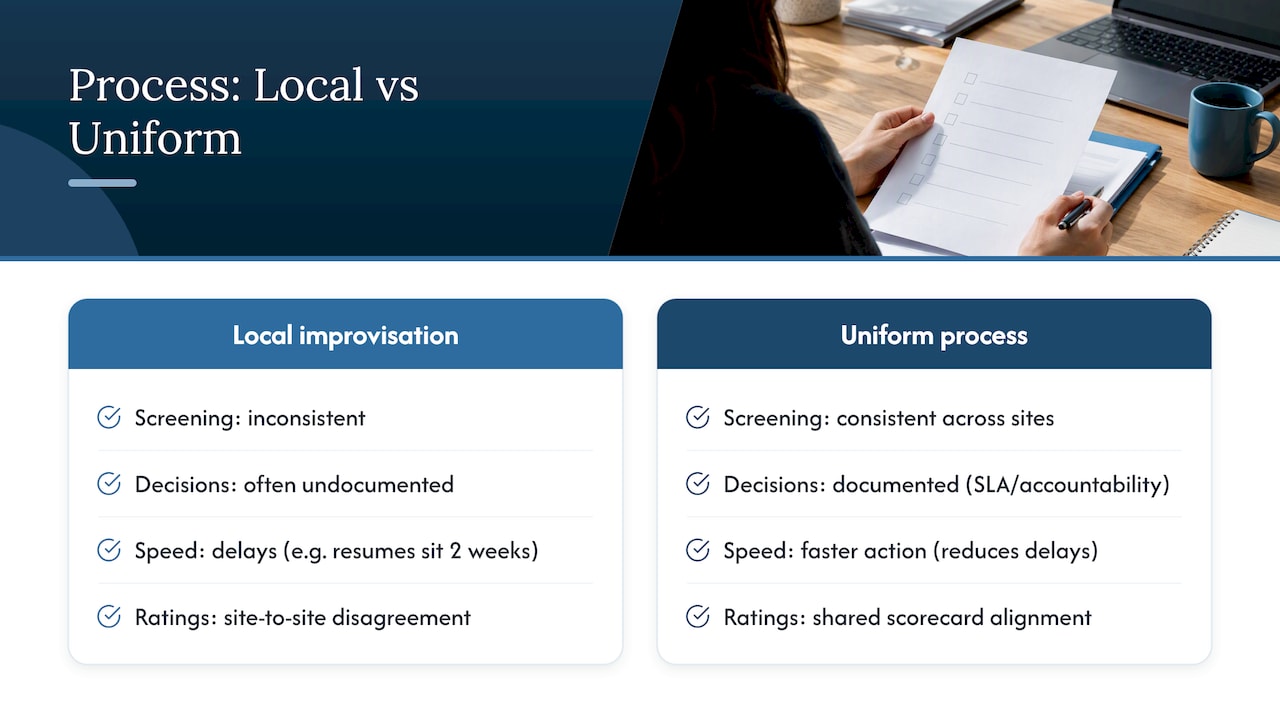
The instinct at most growing companies is to let each location hire however works best locally, on the theory that local knowledge produces better fits faster. In practice, that approach produces the opposite: inconsistent screening, undocumented decisions, and a compliance gap that only surfaces when a claim or audit forces someone to explain why one site’s process looked nothing like another’s.
The more defensible position is that structure creates speed, not the other way around. A documented SLA removes the ambiguity that causes a hiring manager to sit on a resume for two weeks. A shared scorecard removes the guesswork that causes two sites to rate the same candidate completely differently. Local flexibility still matters, but it belongs in the parts of the process that do not carry legal weight: outreach messaging, interview scheduling, team culture questions, not in the selection criteria itself.
— Bradford
How Careerscape supports coordinated hiring across locations
We built our model around a governance structure with a central point of contact for strategy and specialized, industry-focused recruiters who understand local role requirements. Through RPO services, Vendor-on-Premise Recruiting, and an employer portal with real-time dashboard access, we give employers a way to outsource the parts of multi-location coordination that are hardest to staff internally. If your team needs to fill roles across several sites without building a full central recruiting function from scratch, explore our RPO services to see how we can take on that coordination directly.
FAQ
What is the best way to manage hiring across multiple locations?
The most reliable model pairs a small central talent team handling strategy and compliance with local managers who own interviews and final decisions. Short SLAs and a shared KPI dashboard keep every location accountable without forcing identical processes everywhere.
How do you prevent inconsistent hiring practices between offices?
Standardize the parts that carry legal and quality risk, like role profiles, interview scorecards, and selection criteria, while allowing local flexibility in sourcing outreach and scheduling. Reviewing SHRM’s guidance on cohesive hiring strategy helps frame which elements to lock down centrally.
What SLAs should multi-site hiring teams use?
A common starting point is a 48-hour initial screen, a 5-day window to complete the interview loop, and a 24-hour offer decision after the final interview. These thresholds work best piloted in a few locations first, then adjusted before a full rollout.
Do selection tests need to be validated for every location?
Any selection procedure used to screen or rank candidates should be job-related, and the Uniform Guidelines on Employee Selection Procedures require documentation of where and when any validation study was conducted. If a test shows adverse impact at one site, pause and investigate before using it elsewhere.
Should we build an internal team or outsource multi-location hiring?
That decision usually comes down to volume and how often you are opening new locations. Teams hiring at a steady pace across many sites often choose an RPO or Vendor-on-Premise partner to supply the local coordination without expanding internal headcount.