
Most HR teams treat recruitment as a transaction: post the role, screen candidates, fill the seat. The role of talent advisory challenges that assumption directly. Rather than simply matching resumes to job descriptions, talent advisors align hiring decisions with long-term business objectives, workforce planning, and market intelligence. The difference between the two approaches shows up in retention rates, quality of hire, and how quickly your organization can adapt to growth. This article breaks down how talent advisory works, why it matters, and how to put it into practice.
Table of Contents
- Key takeaways
- The role of talent advisory in modern HR
- How talent advisory transforms recruitment outcomes
- Practical strategies for implementing talent advisory
- Measuring the impact of talent advisory
- My take on where talent advisory is headed
- How Cs-recruiters can support your talent strategy
- FAQ
Key Takeaways
| Point | Details |
|---|---|
| Talent advisory goes beyond recruiting | Advisors align people strategy with business goals, not just fill open roles. |
| Proactive pipeline building wins | Sourced candidates convert to hires at 4x the rate of inbound applicants. |
| Data drives smarter decisions | KPIs like quality of hire, time-to-fill, and retention rate reveal where hiring strategy needs adjustment. |
| Early retention risk is real | 20% of new hire attrition occurs within the first 45 days, making advisory guidance in onboarding critical. |
| Strategic partnerships pay off | Talent advisors function as business partners, not service providers, which produces measurably better workforce outcomes. |
The Role of Talent Advisory in Modern HR
Talent advisory is not a rebranded version of recruiting. The functions are fundamentally different, and confusing the two leads to underinvestment in a discipline that directly shapes how well an organization grows, competes, and retains its people.
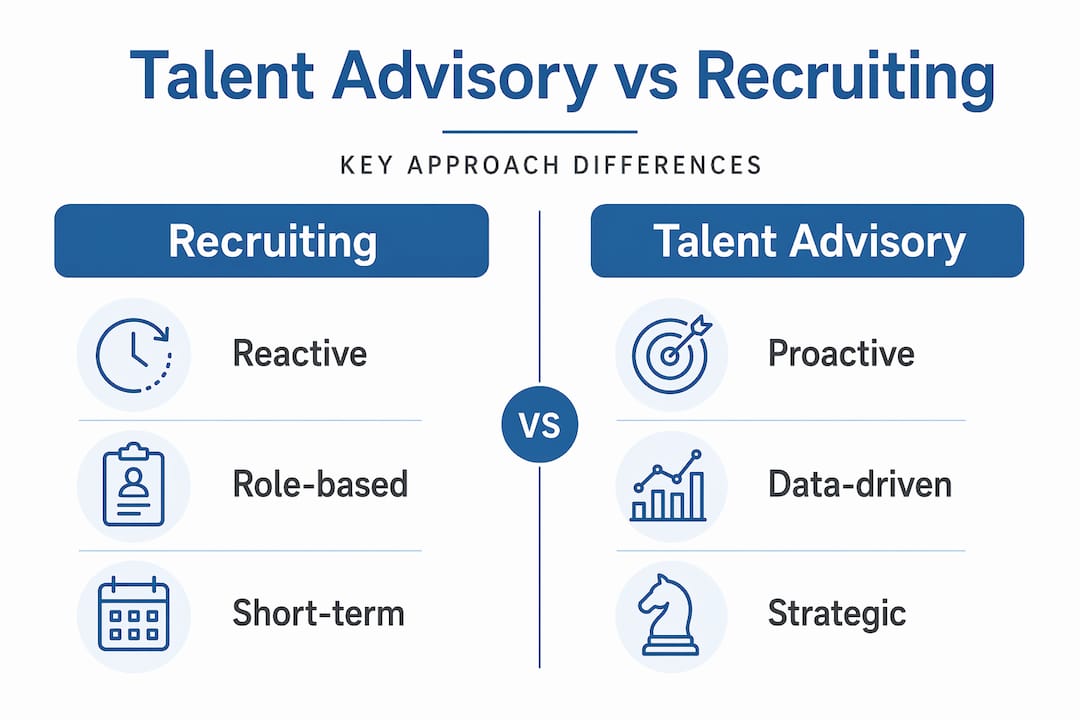
A traditional recruiter focuses on filling a specific open role. A talent advisor focuses on whether the organization is building the right workforce for the next two to five years. The distinction matters more than most hiring managers realize. Talent advisors utilize labor market data and talent intelligence to advise on hiring decisions, not just execute them.
The core functions of talent advisors include:
- Workforce planning: Mapping anticipated headcount needs against business growth scenarios, not just backfilling attrition.
- Talent market mapping: Identifying where qualified candidates exist, what they earn, and how accessible they are given current market conditions.
- Leadership capability evaluation: Assessing whether existing teams have the skills to execute on strategic priorities or whether new capabilities need to be recruited in.
- Hiring manager partnership: Advising leaders on how role design, compensation benchmarks, and interview processes affect candidate quality and offer acceptance rates.
- Talent pipeline architecture: Building relationships with future candidates before roles are open, so hiring is faster and better when the need arises.
The shift in mindset is significant. Talent advisors shift focus from “can this person do the role?” to “how might this person grow with us?” That single reframe elevates HR from an administrative function to a genuine strategic partner.
Pro Tip: When onboarding a talent advisor into your organization, start with a workforce planning session rather than an open requisition. This establishes the advisory relationship from day one and sets expectations about the scope of the work.
Understanding the talent market dynamics relevant to your industry is a prerequisite to advisory work. Without that context, even well-intentioned hiring advice is just opinion.
How Talent Advisory Transforms Recruitment Outcomes
Reactive recruiting has a ceiling. You open a role, post it, and hope the right person applies in time. Talent advisory removes that ceiling by building proactive systems that run continuously, not just when a seat is empty.
Here is how the shift from reactive to advisory-driven recruitment plays out in practice:
- Always-be-recruiting mindset. Talent advisors maintain warm pipelines of candidates who are not actively looking but are open to the right opportunity. This reduces time-to-fill significantly when roles open.
- Alignment with long-term workforce needs. Hiring decisions are tied to organizational goals, not just immediate operational gaps. If the company plans to enter a new market in 18 months, talent advisors start building relationships with relevant candidates today.
- Skill gap analysis. Advisors evaluate whether current workforce capabilities match where the business needs to go, then inform hiring plans accordingly rather than waiting for a skills crisis to surface.
- Retention strategy integration. Advisory doesn’t stop at the offer. A siloed HR approach that separates recruitment and talent management limits strategic impact. Talent advisory bridges that gap by treating onboarding, development, and engagement as part of the hiring outcome.
The contrast between reactive and advisory-driven hiring is sharp enough to affect the bottom line:
| Dimension | Reactive Recruiting | Advisory-Driven Hiring |
|---|---|---|
| Trigger | Vacant role | Workforce forecast |
| Candidate pool | Inbound applicants | Pre-built talent pipelines |
| Decision basis | Resume match | Skills, growth potential, cultural fit |
| Time-to-fill | Longer due to cold starts | Shorter due to warm pipelines |
| Retention focus | Ends at offer acceptance | Extends through onboarding and beyond |
| HR’s role | Transactional | Strategic partner |
Organizations that prioritize skills-based sourcing report significantly better hiring outcomes than those relying on title-matching alone. The advisory model makes that shift systematic rather than incidental.

Practical Strategies for Implementing Talent Advisory
Adopting talent advisory requires more than hiring someone with “advisor” in their title. It requires structural changes in how HR operates, how it partners with leadership, and what data it uses to make decisions.
The following practices form the foundation of a functional talent advisory model:
- Build a strategic partnership with hiring managers. Talent advisors need a seat at the table when business strategy is discussed, not just when headcount is approved. Schedule quarterly workforce reviews with functional leaders to assess upcoming skill needs and market conditions.
- Invest in labor market intelligence. Effective advisory depends on data. Tools that provide compensation benchmarking, candidate supply and demand metrics, and competitor hiring activity give advisors the credibility and accuracy to guide real decisions.
- Develop recruiter advisory skills. Most recruiters are trained to execute, not advise. Structured learning in workforce planning, business acumen, and consultative communication is what separates a transactional recruiter from a genuine talent advisor.
- Integrate talent acquisition strategy components. Effective talent acquisition involves workforce demand forecasting, pipeline architecture, assessment design, and onboarding integration. Advisory ensures each component connects to the others rather than operating in isolation.
- Address pre-boarding as a retention lever. Since 20% of new hire attrition occurs within the first 45 days, talent advisors should be involved in designing pre-boarding experiences, not just filling the role.
Pro Tip: Use a structured interview scorecard tied to competencies aligned with your 12-month business objectives. This simple tool forces alignment between what the business needs and what interviewers are actually evaluating.
HR staffing specialists who understand your organization’s structure can accelerate the transition from transactional to advisory-driven HR. The right hire in an advisory role pays for itself within a single hiring cycle when it prevents a costly mis-hire.
Real-world examples reinforce the value of getting this right. A technology company that integrates talent advisory into its annual planning process can map six months of hiring needs before a single role is posted, giving recruiters time to build pipelines, benchmark compensation, and align on ideal candidate profiles. Compare that to the company that reacts to a resignation with a job posting. The first organization hires faster, pays less per hire, and lands better candidates.
Measuring the Impact of Talent Advisory
Talent advisory without measurement is just activity. The effectiveness of talent advisory services becomes visible only when organizations track the right metrics consistently and use them to refine their approach.
| KPI | What It Measures | Why It Matters in Advisory |
|---|---|---|
| Quality of hire | Performance and retention of new hires | Tracks whether advisory-driven hiring improves outcomes |
| Time-to-fill | Days from role opening to accepted offer | Measures pipeline readiness built through advisory |
| Cost-per-hire | Total recruitment spend per filled role | Reflects efficiency gains from proactive sourcing |
| Retention rate (90-day) | Percentage of hires retained after 90 days | Captures early attrition risk advisory should address |
| Offer acceptance rate | Accepted offers as a percentage of offers made | Signals alignment between role design and market expectations |
TA Managers use data fluency across time-to-fill, cost-per-hire, and quality of hire to drive strategic decisions. When those numbers are tracked over time, patterns emerge. High time-to-fill often signals a weak pipeline. Low offer acceptance rates signal a compensation or role design problem. Quality of hire issues trace back to assessment or misaligned job criteria.
HR leaders benefit from integrating advisory insights to align people strategies with business priorities through data analytics. The measurement loop is what transforms advisory from a qualitative discipline into one that can demonstrate clear ROI to executive stakeholders.
My Take on Where Talent Advisory Is Headed
I’ve worked closely enough with organizations on both sides of this issue to say plainly: the companies still treating HR as a support function are leaving real money on the table. I’ve seen firms hire brilliantly through economic uncertainty because they built advisory relationships with their talent partners years before they needed them. I’ve also seen organizations scramble through growth phases, overpaying for talent and still getting the wrong people, because their recruiting model was entirely reactive.
What I’ve learned is that the importance of talent advisory isn’t really about hiring. It’s about organizational agility. When advisory is done right, leadership has visibility into the talent market before it becomes a crisis. They know what skills cost, where to find them, and what retention risks exist in their current workforce. That kind of intelligence doesn’t come from a job board. It comes from people who are genuinely embedded in the market.
The future of this work is moving toward tighter integration between talent advisory, workforce analytics, and business planning cycles. Organizations that treat their talent advisors as strategic contributors, not just recruitment vendors, will outpace those that don’t. That gap is only going to widen.
— Bradford
How Cs-Recruiters Can Support Your Talent Strategy
Cs-recruiters, operating as Careerscape, is built for exactly this kind of work. Hiring should be fast, honest, and backed by people who know your industry. Whether you need contract staffing solutions for flexible headcount, project-based teams for specialized initiatives, or industry-specialized recruiting aligned to your specific sector, Careerscape brings advisory-level thinking to every engagement. The goal is not just to fill a role. It is to help you hire the right person, at the right time, for the right reasons. Reach out to Careerscape to explore how tailored talent advisory support can strengthen your workforce strategy.
FAQ
What Does Talent Advisory Actually Do?
Talent advisory goes beyond filling roles. Advisors work with organizational leadership to align hiring strategy, workforce planning, and talent pipeline development with long-term business objectives.
How Is Talent Advisory Different from Traditional Recruiting?
Traditional recruiting is reactive and role-specific. Talent advisory is proactive, data-driven, and focused on building workforce capability over time rather than just responding to open positions.
What Kpis Measure the Effectiveness of Talent Advisory?
Key metrics include quality of hire, time-to-fill, cost-per-hire, 90-day retention rate, and offer acceptance rate. Tracking these consistently reveals where advisory interventions are producing results.
Why Does Proactive Sourcing Outperform Inbound Applications?
Sourced candidates convert to hires at four times the rate of inbound applicants, which is why talent advisors invest in pipeline building rather than relying on job postings alone.
When Should an Organization Invest in Talent Advisory Services?
Organizations benefit most from talent advisory during periods of growth, strategic pivots, or when recurring hiring problems, such as high attrition or long time-to-fill, signal that reactive recruitment is no longer sufficient.
Recommended
- What is the talent market? A guide for smarter hiring
- Workforce Advisory & Talent Consulting | Careerscape